Do More with Less
Do More with Less is an applied improvisation exercise inspired by the improvisational principle that constraints generate creativity. Participants identify a real or hypothetical problem they face with limited resources, then use constraint-based thinking to generate solutions that work without the resources they think they need. The exercise challenges the assumption that more resources automatically produce better solutions.
Structure
Setup
Participants identify a genuine resource constraint they face: limited budget, limited staff, limited time, limited tools. The facilitator frames the constraint not as an obstacle but as the condition of the creative challenge.
Constraint Acceptance
Participants are instructed to accept the constraint as permanent rather than as a temporary condition to overcome. The exercise begins from that acceptance: given that this resource will not appear, what can be done?
Assumption Reversal
A second phase introduces a structured technique: participants identify three assumptions they hold about what the task requires, then reverse each assumption. For each reversal, they generate at least one idea that becomes possible if the reversed assumption is true.
Alternative Generation
Groups brainstorm low-cost, low-resource alternatives to their assumed approaches, evaluated not by how closely they resemble the standard approach but by how well they serve the actual underlying goal.
Conclusion
Groups present their most promising alternatives and discuss which ideas might be genuinely implementable.
How to Teach It
Objectives
Do More with Less targets creative constraint thinking, assumption identification, and the productive reframing of resource scarcity from obstacle to creative condition. It addresses the organizational tendency to defer action until conditions are ideal.
How to Explain It
"You don't have what you think you need. That's not going to change. Given that, what can you actually do? Let's find out what's possible from where you actually are."
Common Pitfalls
Participants often spend the exercise describing what they would do with more resources rather than generating alternatives within the constraint. The facilitator must firmly redirect: the resources are not coming. What works without them?
In Applied Settings
Learning Objectives
Do More with Less addresses the organizational tendency to wait for ideal conditions before acting, and develops the capacity to generate meaningful progress within genuine constraints. The exercise builds creative resourcefulness, the identification and reversal of limiting assumptions, and the willingness to begin from where the team actually is rather than from where it wishes it were.
Workplace Transfer
The skills developed transfer directly to project management in resource-constrained environments, startup and early-stage organizational contexts, nonprofit and public sector settings where resource scarcity is structural, and any organizational situation where waiting for sufficient resources means not acting at all. The assumption-reversal technique is a portable analytical tool that participants can apply independently.
Facilitation Context
The exercise is used in innovation workshops, organizational problem-solving sessions, entrepreneurship programs, nonprofit leadership development, and any applied setting where resource constraints are a real and ongoing feature of the participants' work.
Debrief Framing
Facilitators ask: "Which alternative surprised you most? Which assumption, when reversed, opened up the most new possibilities? What would it look like to actually try this alternative? What is one small step you could take this week that requires no additional resources?"
Skills Developed
Worth Reading
See all books →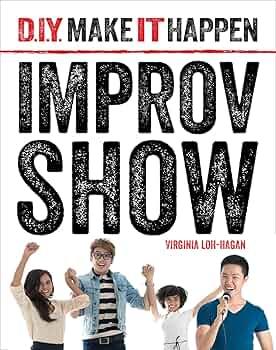
Improv Show
Virginia Loh-Hagan

Pirate Robot Ninja
An Improv Fable
Billy Merritt; Will Hines
Improvising Cinema
Gilles Mouëllic

Theatrical Improvisation
Short Form, Long Form, and Sketch-Based Improv
Jeanne Leep

Whose Improv Is It Anyway?
Beyond Second City
Amy E. Seham

The Improv Illusionist
Using Object Work, Environment, and Physicality in Performance
David Raitt
Related Exercises
Positive Scene Challenge
Positive Scene Challenge is an exercise in which performers must play an entire scene without conflict, negativity, or problems to solve. The constraint forces players to find sources of engagement beyond argument and teaches that scenes can be compelling through shared joy, discovery, and mutual support.
Three Line Environment
Three Line Environment is a scene exercise in which performers must establish a complete physical environment using only three descriptive lines of dialogue or three physical actions. The constraint teaches economy of expression and the power of specific, well-chosen details to create a vivid shared space.
Three Rules
Three Rules is a scene exercise in which the facilitator establishes three specific constraints that performers must maintain throughout their scene. The constraints can be physical (always touching the wall, never letting your hands go below your waist), verbal (never using the letter S, only asking questions), or behavioral (treat your partner as royalty, move as if underwater). The exercise demonstrates that limitations generate rather than restrict creative choices, and trains performers to divide attention between scene work and rule compliance.
Create Obstacles
Create Obstacles is a scene exercise in which performers deliberately introduce complications and barriers to their characters' goals. The exercise teaches that obstacles are the engine of dramatic interest: characters who get what they want without resistance produce flat, unengaging scenes. By practicing the creation of obstacles, performers develop the instinct to generate tension and problem-solving pressure from within the scene rather than waiting for obstacles to arrive from outside.
Without Words
Without Words is a scene exercise in which performers play scenes using sounds, gibberish, or silence instead of coherent language. The constraint forces communication through emotional tone, physicality, spatial relationship, and vocal texture rather than words. The exercise demonstrates that language is only one channel of theatrical communication and develops performers' physical and vocal expressiveness.
Something Old Something New
Something Old Something New is a scene exercise that uses the wedding tradition as a structural prompt. Performers must incorporate elements that are old, new, borrowed, and blue into their improvised scene. The constraints provide a creative framework that guides choices without restricting them, teaching players to find freedom within structure.
How to Reference This Page
The Improv Archive. (2026). Do More with Less. Retrieved March 17, 2026, from https://improvarchive.org/exercises/do-more-with-less
The Improv Archive. "Do More with Less." The Improv Archive, 2026. https://improvarchive.org/exercises/do-more-with-less.
The Improv Archive. "Do More with Less." The Improv Archive, 2026, https://improvarchive.org/exercises/do-more-with-less. Accessed March 17, 2026.
The Improv Archive is a systemically maintained repository. The archive itself acts as the corporate author.