Library
The essential reading list for improvisers. From Spolin to Johnstone, these texts form the backbone of modern improvisation.
Fifty Key Improv Performers
Actors, Troupes, and Schools from Theatre, Film, and TV
Matt Fotis
Fifty Key Improv Performers, Actors, Troupes, and Schools, by Matt Fotis, is a comprehensive and highly accessible survey of the most influential figures and institutions in the history of improvisational theater. Published in 2024 as part of the Routledge Key Guides series, the book serves as both a historical record and a 'who's who' of the movement that redefined modern comedy and drama. Fotis, a leading scholar of the form, provides a series of insightful profiles that trace the lineage of improv from its early 20th-century origins to its current global dominance. The volume includes the expected titans: such as Viola Spolin, Keith Johnstone, Del Close, and The Second City: but also highlights lesser-known but equally vital figures and schools: including The Committee, The Groundlings, and international pioneers from the European and African improv scenes. Each entry provides a historical overview, an analysis of the performer's or institution's unique contribution to the form, and a 'key works' section for further study. The text is particularly noted for its focus on the 'crossover' impact of improv. Fotis explores how the techniques developed in the basement theaters of Chicago and London have permeated the worlds of film, television, and even professional actor training. The book provides a much-needed historical context for a form of theater that is often perceived as 'of the moment.' Fifty Key Improv Performers is an essential reference for students, practitioners, and fans who want to understand the deep roots and the wide-reaching influence of the improvisational arts.

American Laughter, American Fury
Humor and the Making of a White Man's Democracy, 1750-1850
Eran A. Zelnik
American Laughter, American Fury, by Eran A. Zelnik, provides a provocative analysis of the role of humor in the political and social landscape of the early United States. Published in 2023, the book examines how laughter served as both a weapon and a shield during the tumultuous founding era, a period defined by the Enlightenment's promise of reason and the harsh realities of revolution, slavery, and class conflict. Zelnik's central thesis is that humor was not a marginal distraction but was central to the negotiation of American identity. He identifies two competing modes of laughter: the 'refined' wit of the elite, used to project authority and distance, and the 'furious' laughter of the common people, characteristically used for subversion and resistance. By analyzing a wide range of primary sources: including newspapers, pamphlets, diaries, and early theatrical scripts: Zelnik demonstrates how these different styles of comedy mirrored the deeper tensions between democratic ideals and social hierarchies. The work is particularly insightful in its examination of the 'politics of ridicule.' Zelnik shows how political partisans used satire to dehumanize their opponents and how enslaved people and marginalized groups used 'hidden' forms of humor to preserve their dignity and signal resistance. The book provides a crucial historical perspective on the 'culture wars' of today, suggesting that the use of humor as a tool for polarization has a long and complicated history in the American experience.

A Cultural History of Comedy in the Middle Ages
Martha Bayless
A Cultural History of Comedy in the Middle Ages, edited by Martha Bayless, explores the rich and often subversive world of medieval humor from 500 to 1400. This volume, part of the Bloomsbury cultural history series, challenges the persistent myth of a "dark age" devoid of play. Instead, it reveals a society where laughter was deeply woven into religious life, academic discourse, and rural community celebrations. Bayless, a leading scholar of medieval parody, organizes the volume to examine how comedy functioned within the rigid hierarchies of the church and the feudal system. The work details the prevalence of clerical parodies, such as the "Drunkards' Mass," and the carnivalesque festivals where social roles were temporarily reversed. It traces the lineage of comedic figures from the court jester to the "holy fool" and examines how humorous stories provided a medium for exploring class tension, sexual desire, and the absurdity of daily life. The collection places significant emphasis on the materiality of medieval comedy. It looks at how laughter was physically manifested in marginalia: the whimsical drawings in the borders of serious manuscripts: and in the rowdy performances of itinerant minstrels. By situating comedy as a "safety valve" and a tool for social commentary, the volume demonstrates that medieval people used humor to navigate a world defined by profound religious devotion and harsh physical realities.

The "Yes And" Business Evolution
Improv Skills for Leadership and Life
Tracy Shea-Porter
Tracy Shea-Porter's The Yes, And Business Evolution is a practical, high-energy, and highly effective resource designed for anyone looking to improve their spontaneous communication and creative problem-solving skills in the professional world. Published in 2024, the book reflect Shea-Porter's deep experience as a veteran of the 'Second City' school and her tenure as a successful consultant and coach. It positions 'improv' not as a theatrical trick, but as a series of fundamental human habits that can be unlocked through the spirit of play. The work is organized around the 'Core Tenets' of the modern improv movement: including 'Yes, And', 'Active Listening', and 'The Group Mind'. Shea-Porter demonstrate how each of these theatrical rules has a direct equivalent in the 'scenes' of daily office life: from high-stakes negotiations and board meetings to daily client interactions. The book provide a series of 'exercises' and 'thought experiments' adapted for the corporate professional, intended to help individual employee shift their thinking from 'scripted' and defensive to 'spontaneous' and open. The text is particularly noted for its focus on 'The Power of the Gift': showing how accepting and building on the ideas of others can rapidly build self-confidence and personal presence. The text is written in a direct, conversational, and deeply encouraging voice, filled with anecdotal examples from the author's own life and her work as a consultant. She address the 'hard' truths of the modern world: the pressure, the competition, and the constant change: while provide a clear and actionable way to manage these challenges through the spirit of play. The Yes, And Business Evolution serve as a vital guide for any professional looking to find their authentic voice, to build stronger teams, and to move through life with a sense of agility and ease. It serve as an excellence introductory guide for anyone looking to bring the spirit of improv into their life.

Embodied Playwriting
Improv and Acting Exercises for Writing
Hillary Haft Bucs; Charissa Menefee
Embodied Playwriting: Improv and Acting Exercises for Writing, by Hillary Haft Bucs and Charissa Menefee, is a transformative guide that bridges the gap between the physical rehearsal room and the writer's desk. Published in 2023, the book challenge the traditional view of playwriting as a purely intellectual or solitary activity. Instead, it advocates for a 'somatic' approach where characters, dialogue, and narrative structure are generated through the physical exploration of space, sound, and movement. The authors, both experienced educators and playwrights, provide a series of 'embodied writing' exercises that utilize the tools of the actor and the improviser to unlock the creator's imagination. The book is structured methodically, moving from 'finding the character' through physical leads to 'hearing the voice' through vocal exploration, and finally to 'building the scene' through improvisational interaction. Crucially, the text does not treat improv as a 'substitute' for writing, but as a primary source of data that feeds the drafting and editing process. It look at the 'metabolic' state of the writer: urging them to move, breathe, and act out their ideas to test their dramatic integrity. The work is filled with contributions from a wide range of contemporary playwrights and practitioners, provide a diverse 'field notes' on how embodied practices can solve common writing blocks. Embodied Playwriting is a vital resource for any writer looking to find more truth, vitality, and theatricality in their work, moving the creative process off the page and into the blood.

The Improv Illusionist
Using Object Work, Environment, and Physicality in Performance
David Raitt
David Raitt's The Improv Illusionist: Using Object Work, Environment, and Physicality in Performance is a practical and highly technical manual designed for any performer who want to master the art of 'seeing' and 'interacting' with the imaginary in the unscripted moment. Published in 2024, the book reflect Raitt's deep experience as a veteran of the 'iO' and 'Second City' schools and his tenure as a master teacher of 'pantomime' and 'somatic presence.' It positions 'improv' not as a 'verbal' art, but as a series of physical commitments that build a believable and 'felt' reality for the audience. The work is organized around the core pillars of 'Character Physicality,' 'Spatial Awareness,' and 'The Object Life.' Raitt provide a series of 'technique exercises' designed to help the performer 'ground' their performance through the manipulation of imaginary objects and the awareness of the environment. The book is particularly noted for its focus on 'The Senses': provide a detailed guide on how to 'Yes, And' to the imaginary light, weight, and sound of the stage. He provide a clear and rigorous methodology for 'The Physical Offer', teaching the performer to build a scene 'from the feet up' through movement rather than through words. The text is written in a direct, instructional, and characteristically 'actor-focused' voice. It include detailed scripts for facilitators on how to side-coach students through the 'blocks' of judgment and fear. The Improv Illusionist serve as a vital companion for any serious student of the craft and a primary reference for those committed to the mastery of the 'embodied' performer. It remains one of the most comprehensive guides to the intersection of improvisational theory and physical performance technique.

The Improv Mindset
How to Make Improvisation Your Superpower for Success
Keith Saltojanes
Keith Saltojanes' The Improv Mindset: How to Make Improvisation Your Superpower for Success is a practical, high-energy, and highly accessible resource designed for anyone looking to improve their spontaneous communication and creative problem-solving skills. Published in 2024, the book reflect Saltojanes' deep experience as a veteran of the 'LA' school of improv and his tenure as a successful producer and coach. It positions 'improv' not as a theatrical trick, but as a series of fundamental human habits that can be unlocked through the spirit of play. The work is organized around the 'Core Tenets' of the modern improv movement: including 'Yes, And', 'Active Listening', and 'The Group Mind'. Saltojanes demonstrate how each of these theatrical rules has a direct equivalent in the 'scenes' of daily life and professional practice. The book provide a series of 'exercises' and 'thought experiments' adapted for the non-performer, intended to help individual reader shift their thinking from 'scripted' and defensive to 'spontaneous' and open. The text is particularly noted for its focus on 'The Power of the Gift': showing how accepting and building on the ideas of others can rapidly build self-confidence and personal presence. The text is written in a direct, conversational, and deeply encouraging voice, filled with anecdotal examples from the author's own life and his work as a consultant. He address the 'hard' truths of the modern world: the pressure, the competition, and the constant change: while provide a clear and actionable way to manage these challenges through the habit of agreement. The Improv Mindset serve as a vital guide for any professional looking to find their authentic voice, to build stronger relationships, and to move through life with a sense of agility and ease. It serve as an excellence introductory guide for anyone looking to bring the spirit of improv into their life.

The Routledge Companion to Improvisation in Organizations
Miguel Pina e Cunha; Dusya Vera; António Cunha Meneses
The Routledge Companion to Improvisation in Organizations, edited by Miguel Pina e Cunha, Dusya Vera, and António Cunha Meneses, is a rigorous and highly articulate collection of scholarly essays that explore the 'hidden' history and the systemic logic of spontaneous creation in the professional world. Published in 2024, the book challenge the traditional view of organizational management as purely prescriptive or 'planned'. Instead, it demonstrate that improvisation is a central and highly valued competency for navigating the Volatile, Uncertain, Complex, and Ambiguous (VUCA) environment of 21st-century business. The work is organized by organizational domain, with contributors examine the 'performative logic' of leadership, teamwork, innovation, and crisis management. The 'Theory' section is particularly noted for its focus on 'Neuroplasticity' and 'Cognitive Load': showing how the habits of high-level improvisers (being present, listening deeply, and supporting partners) are the same habits required for effective organizational adaptation. The 'Practice' section look at the development of 'Applied Improv' in the corporate world: demonstrating how professional ensembles are using unscripted techniques to build trust, foster innovation, and manage communication within the cubicle and the boardroom. The text is highly academic and interdisciplinary, weaving together management science, performance studies, and cultural history. It provide a much-needed historical and theoretical context for the 'Applied Improv' movement: showing that 'improvisation' has a long and sophisticated history as a major site for organizational and aesthetic innovation. The Routledge Companion to Improvisation in Organizations is an essential reference for any scholar or serious practitioner who wants to understand the 'deep roots' of their professional practice and the cultural logic of the unscripted moment.

Improvisation the Michael Chekhov Way
Active Exploration of Acting Techniques
Wil Kilroy
Wil Kilroy's Improvisation the Michael Chekhov Way is a rigorous and highly articulate manual that explores the intersection of improvisational theater and the transformative acting techniques of Michael Chekhov. Published in 2024, the book reflects Kilroy's deep experience as a master teacher and researcher of the Chekhov school. It positions improv not as a game for laughs, but as a series of deliberate psycho-physical interventions intended to help the performer reach a state of total presence, imaginative range, and emotional truth. While Spolin focused on games and Johnstone on status, Kilroy focuses on atmosphere and archetype, bringing a rare mystical and physical depth to the practice of unscripted performance. The work is organized around the core pillars of the Chekhov methodology, including The Psychological Gesture, Atmosphere, and The Imaginary Center. Kilroy provides a series of exercises adapted for both the stage and the studio, intended to help the individual actor shift their thinking from intellectual and defensive to embodied and open. The book is particularly noted for its focus on The Radiation, teaching the performer to send and receive energy from their partner and the environment with the same rigor as the physical world. For example, an improviser might use a Psychological Gesture—a movement that embodies their character's secret intent—to ground their performance before initiating a scene. This technique ensures that the improv is driven by deep character need rather than superficial wit. Kilroy also explores the concept of Atmosphere, teaching actors how to collectively sense and create the mood of a space without speaking a word. The text is written in a direct, instructional, and characteristically actor-focused voice, filled with anecdotal case studies from Kilroy's decades of teaching. He emphasizes the importance of listening with the whole body and of trusting the process over the product, teaching the performer that their primary job is to be an active participant in the collective creation. Improvisation the Michael Chekhov Way serves as a vital guide for any serious performer looking to reach the highest professional level of the form and a primary reference for those committed to the Michael-to-Global lineage of improv.
The Principles of Improv Comedy
Tom Blank
Tom Blank's The Principles of Improv Comedy is a practical, high-energy, and highly accessible resource designed for anyone looking to understand the 'basics' and the 'fun' of improvisational theater. Published in 2024, the book reflect Blank's deep experience as a veteran of the 'OC' and 'LA' schools of improv and his tenure as a master teacher of presence and courageous living. It positions 'improv' not as a 'scary' or 'difficult' art, but as a series of fundamental human habits that can be unlocked through the spirit of play. The work is organized around the 'Core Tenets' of the introduction-level improv curriculum: including 'Yes, And', 'Listening,' 'Character,' and 'Scene Building.' Blank provide a library of 'exercises' and 'games' adapted for the newcomer, intended to help individual reader shift their thinking from 'scripted' and defensive to 'spontaneous' and open. The book is particularly noted for its focus on 'The Power of the Gift': showing how accepting and building on the ideas of others can rapidly build self-confidence and personal presence. The text is written in a direct, conversational, and deeply encouraging voice, filled with anecdotal 'insider' tips from Blank's own journey on the stage. He addresses the 'hard' parts of the learning experience: including 'stage fright' and 'the fear of being boring': provide a clear and actionable way to manage these challenges through the habit of agreement. The Principles of Improv Comedy serve as a vital guide for any organization looking to find more joy, connection, and ease in their daily existence, moving beyond the 'script' of social expectation and into the transformative reality of the now.

Improv to Improve Your Leadership Team
Tear down Walls and Build Bridges
Candy Campbell
Candy Campbell's Improv to Improve Your Leadership Team is a practical and highly effective resource designed for facilitators, HR professionals, and senior leaders who want to use the tools of the theater to transform organizational culture. Published in 2022, the book reflect Campbell's deep experience as a veteran of the Mission Improv-able troupe and her tenure as a consultant for dozens of Fortune 500 companies. It positions 'improv' not as a 'warm-up' game, but as a series of deliberate interventions intended to 'tear down walls' of communication and build 'bridges' of trust and collaboration within the executive suite. The work is organized around the core pillars of 'the psychological safety' and 'the active listening'. Campbell provide a series of exercises that cover the core business competencies: including decision-making, conflict resolution, and innovative problem-solving. The book is particularly noted for its focus on 'The Leadership Team': provide a clear framework for how a group of high-stakes individuals can move from 'competing voices' to a 'unified ensemble'. He provide a detailed guide on how to 'Yes, And' in a board meeting, how to 'make your partner look good' in a crisis, and how to use the 'spirit of play' to unlock the natural human capacities for insight and connection. The text emphasize 'support over competition', teaching the leader that their primary job is to ensure the success of the people they lead. The text is written in a direct, action-oriented, and encouraging voice, filled with anecdotal case studies from Campbell's own work with leadership teams. It include clear instructions on how to debrief each exercise, ensuring that the 'fun' of the game is translated into actionable business goals. Improv to Improve Your Leadership Team serve as a vital guide for any organization looking to build a more agile, connected, and resilient leadership culture through the transformative power of the unscripted moment.

Improve
How I Discovered Improv Comedy and Conquered Social Anxiety
Alex Graudins
Alex Graudins' Improve: How I Discovered Improv Comedy and Conquered Social Anxiety is a unique, poignant, and highly relatable graphic memoir that explores the therapeutic power of unscripted performance. Published in 2022, the book documentnt Graudins' personal journey as a person living with severe social anxiety who takes a 'leap of faith' into the basement theaters of the NYC improv scene. Unlike a traditional pedagogical manual, Improve use the medium of the 'comic book' to illustrate the internal mental state of the improviser: mapping the 'internal critic,' the paralyzing 'freeze' of fear, and the eventual 'thaw' of spontaneous discovery. The work is a honest and vulnerable account of the 'first year' of the improv experience. Graudins look at the core tenets of the art form: including 'Yes, And' and 'The Game of the Scene': not as theatrical rules, but as 'exposure therapy' for her own social fears. She provide a vivid and often hilarious look at the 'awkward' side of learning improv: the scenes that 'die,' the 'bad' notes from teachers, and the 'high-stakes' pressure of the first student show. The book is particularly noted for its focus on 'presence over perfection': showing how the 'no mistakes' philosophy of the improv ensemble can be a radical and life-changing tool for managing anxiety and self-doubt. The text is written (and drawn) in a warm, funny, and deeply human voice. Graudins look at the 'community' side of improv: the bond that forms within a 'practice group' and the way that supporting others can eventually lead to supporting oneself. Improve serve as a vital guide for anyone who has ever felt 'too afraid' to step on stage, providing a clear and inspiring roadmap for how the 'tools of the fun' can be used for the serious work of personal growth and mental well-being.
Putting Improv to Work
Spontaneous Performance for Leadership, Learning, and Life
Greg Hohn
Luc Galvan's Putting Improv to Work: Spontaneous Performance for Leadership, Learning, and Life is a practical, high-energy, and highly effective resource designed for anyone looking to improve their spontaneous communication and creative problem-solving skills. Published in 2024, the book reflect Galvan's deep experience as a veteran of the 'California' school of improv and his tenure as a master teacher of presence and courageous living. It positions 'improv' not as a theatrical trick, but as a series of fundamental human habits that can be unlocked through the spirit of play. The work is organized around the 'Core Tenets' of the modern improv movement: including 'Yes, And', 'Active Listening', and 'The Group Mind'. Galvan demonstrate how each of these theatrical rules has a direct equivalent in the 'scenes' of daily life and professional practice. The book provide a series of 'exercises' and 'thought experiments' adapted for the non-performer, intended to help individual reader shift their thinking from 'scripted' and defensive to 'spontaneous' and open. The text is particularly noted for its focus on 'The Resilience': provide a detailed guide on how to 'Yes, And' to one's own self-doubt and how to find the creative 'flow' even in the face of fear. The text is written in a direct, conversational, and deeply encouraging voice, filled with anecdotal examples from the author's own life and his work as a consultant. He address the 'hard' truths of the modern world: the pressure, the competition, and the constant change: while provide a clear and actionable way to manage these challenges through the spirit of play. Putting Improv to Work serve as a vital guide for any professional looking to find their authentic voice, to build stronger teams, and to move through life with a sense of agility and ease. It serve as an excellence introductory guide for anyone looking to bring the spirit of improv into their life.
A Subversive's Guide to Improvisation
Moving Beyond "Yes, and"
David Razowsky
David Razowsky's A Subversive's Guide to Improvisation represents a radical departure from the rule-based pedagogy that dominated the improv landscape for decades. Published in 2022, the book distills Razowsky's years as Artistic Director of the Second City Training Center and his work as a respected performer into a philosophy that prioritizes awareness over invention. It is a polemic against the 'rules' of improv, arguing that they often serve as barriers to true connection and artistic discovery. The core of Razowsky's methodology is 'The Point of View' (POV). He posits that characters should not be built through narrative effort or plot beats but should emerge instantly from the performer's relationship to the space, their partner, and their own immediate emotional state. By entering a scene with a strong, decided POV, the improviser eliminates the need for 'negotiation' or 'asking questions,' moving directly into dynamic interaction. The book challenges the 'Yes, And' mantra when it is used as a mechanical additive, suggesting instead a state of 'radical presence' where every offer is felt rather than just processed. The text is both a memoir of a high-level artistic life and a hands-on manual. Razowsky provides a series of cognitive and physical exercises designed to strip away the performer's habits of 'storytelling' and 'joke-making.' He urges improvisers to look at the 'void' not as a threat but as the source of all creative potential. The result is a text that serves as a guide for those looking to reach the next level of emotional truth in their work.

The Applied Improvisation Mindset
Tools for Transforming Individuals, Organizations, and Communities
Theresa Robbins Dudeck; Caitlin McClure
Applied Improvisation: Mindset and Tools for Transforming Individuals, Organizations, and Communities, edited by Theresa Robbins Dudeck and Caitlin McClure, is a rigorous and highly articulate collection of scholarly essays that explore the hidden history and the systemic logic of spontaneous creation in the professional world. Published in 2024, the book challenges the traditional view of organizational management as purely prescriptive or planned. Instead, it demonstrates that improvisation is a central and highly valued competency for navigating the Volatile, Uncertain, Complex, and Ambiguous (VUCA) environment of 21st-century business. The editors gather a diverse range of voices from academia, business, and the arts to argue that the skills of the improviser—listening, adaptation, and collaborative creativity—are not just theatrical techniques, but essential human survival skills. The work is organized by organizational domain, with contributors examining the performative logic of leadership, teamwork, innovation, and crisis management. The Theory section is particularly noted for its focus on Neuroplasticity and Cognitive Load, showing how the habits of high-level improvisers (being present, listening deeply, and supporting partners) are the same habits required for effective organizational adaptation. The Practice section looks at the development of Applied Improv in the corporate world, demonstrating how professional ensembles are using unscripted techniques to build trust, foster innovation, and manage communication within the cubicle and the boardroom. Case studies range from disaster relief teams to medical training programs, illustrating the universal applicability of the improv mindset. The text is highly academic and interdisciplinary, weaving together management science, performance studies, and cultural history. It provides a much-needed historical and theoretical context for the Applied Improv movement, showing that improvisation has a long and sophisticated history as a major site for organizational and aesthetic innovation. Applied Improvisation serves as an essential reference for any scholar or serious practitioner who wants to understand the deep roots of their professional practice and the cultural logic of the unscripted moment. It elevates the conversation around applied improv from simple ice-breakers to a serious discipline of organizational change.

Improvised Theatre and the Autism Spectrum
A Practical Guide
Gary Kramer; Richie Ploesch
Kelly Hunter's Improvised Theatre and the Autism Spectrum: A Practical Guide is a groundbreaking, compassionate, and highly influential resource designed for educators, therapists, and facilitators who want to utilize the power of the theater game as a tool for social-emotional growth for individuals on the autism spectrum. Published in 2024, the book reflect Hunter's deep experience as a master teacher and her tenure as the founder of the 'Hunter Heartbeat Method'. It positions 'improv' not as a 'game for laughs,' but as a primary 'pedagogical framework' for building self-confidence, empathy, and communication skills through the spirit of play. The work is organized around the core pillars of the methodology: including 'The Heartbeat,' 'Eye Contact,' and 'The Shared Breath.' Hunter provide a library of exercises that have been specially adapted for the specific cognitive and sensory needs of the neurodiverse student. The book is particularly noted for its focus on 'The Rhythmical Impulse': teaching the student to 'listen' and 'interact' with the ensemble through sound and movement before words. She provide a detailed guide on how to 'side-coach' students through the 'blocks' of anxiety and sensory overload, ensuring that the 'fun' of the game is translated into actionable social goals. The text is written in a direct, instructional, and characteristically 'facilitator-friendly' voice. It include clear instructions on how to 'debrief' each individual exercise and how to adapt them for daily practice. Improvised Theatre and the Autism Spectrum serve as a foundational tool for any teacher looking to add 'active learning' to their repertoire and to bring more energy and truth into the classroom. It remains one of the most comprehensive and useful training manuals in the history of educational drama.
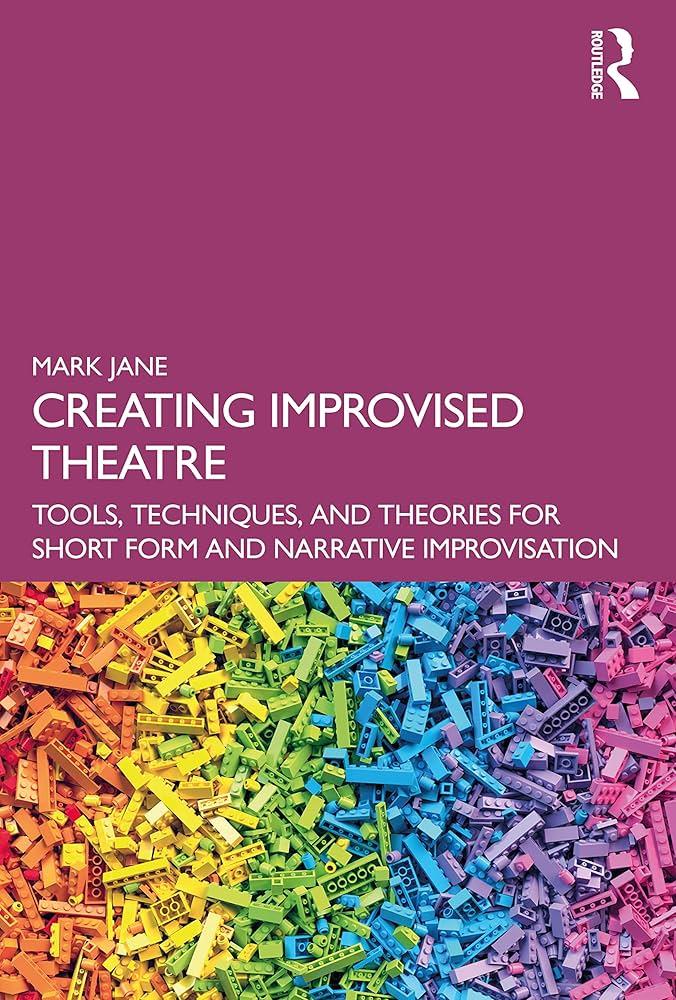
Creating Improvised Theatre
Tools, Techniques, and Theories
Mark Jane
Mark Jane's Creating Improvised Theatre: Tools, Techniques, and Theories is a comprehensive and highly structured guide to the art of long-form and narrative improvisation. Published in 2021, the book reflects Jane's deep experience as a performer and teacher in the European improv scene, particularly with the influential group Improbisay. Jane provides a bridge between the foundational 'games' of the early improv movement and the rigorous demands of creating full-length, unscripted plays that can hold an audience's attention for ninety minutes. The work is organized around the 'Tools' of the trade, moving methodically through the cognitive and technical requirements of the form. Jane looks at the 'Theories' that underpin the work: including narrative structure, character development, and the psychology of the ensemble. Unlike many manuals that focus solely on 'starting the scene,' this book provides detailed strategies for 'sustaining' and 'ending' the work, addressing the narrative challenges of the middle and final acts of a show. Jane emphasizes the importance of 'dramatic' improvisation, urging performers to move beyond the quick laugh to find the emotional truth and narrative depth that makes for truly compelling theater. The text is written in a clear, instructional voice, filled with exercises and checklists that can be used by both the individual performer and the ensemble. Jane share insights into the 'how' and 'why' of various formats, and provides a framework for troupes to develop their own unique 'house style.' Creating Improvised Theatre is a vital resource for those looking to reach the next level of narrative mastery and to create improvised work that is as rigorous and satisfying as the best scripted theater.
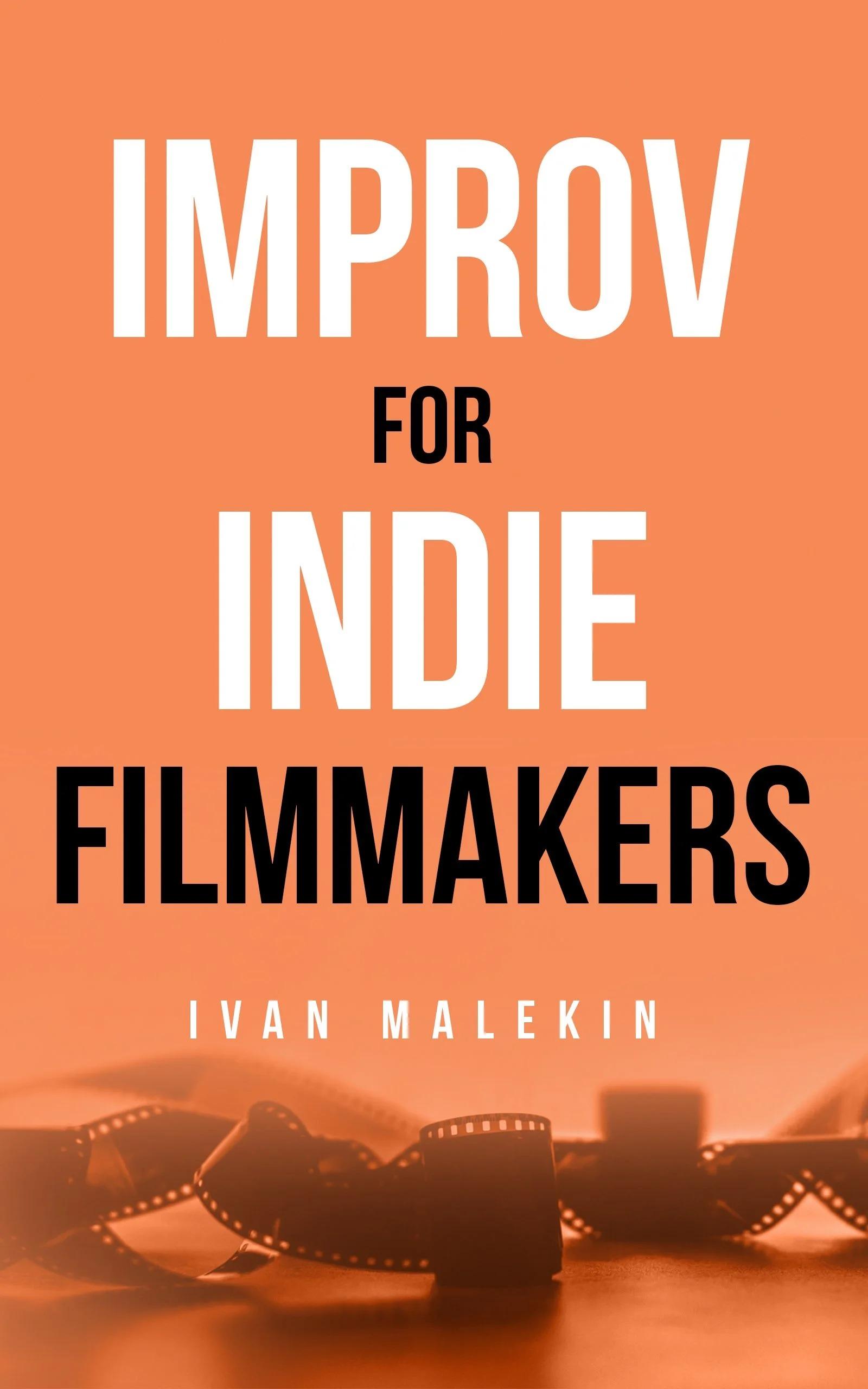
Improv for Indie Filmmakers
Ivan Malekin
Ivan Malekin's Improv for Indie Filmmakers is a practical and revolutionary guide for directors and actors who want to utilize unscripted techniques to create raw, authentic, and high-impact cinema on a budget. Published in 2023, the book reflect Malekin's deep experience as the co-founder of the 'Cinespace' community and a veteran of dozens of improvised feature films. It positions 'improv' not as a 'rehearsal tool,' but as the primary 'creation' methodology for the entire cinematic process: from script development to the final edit. The work is organized methodically, move from 'The Director's Mindset' to 'The Actor's Toolkit' and finally to 'The Production Pipeline.' Malekin provide a clear framework for 'writing through improvisation': provide a series of strategies for developing character arcs and plot beats through unscripted workshops. He addresses the unique technical challenges of improvising in front of a camera: including 'the lens as partner', 'continuity of energy', and 'sound as a narrative driver.' The book is particularly noted for its focus on 'The Feature Film': provide a detailed case studies of Malekin's own projects and those of other pioneers in the 'unscripted cinema' movement. He emphasize the importance of 'trust' and 'collability', demonstrate how an ensemble of actors and a agile crew can outperform a high-budget production through the power of the spontaneous moment. The text is written in a direct, action-oriented, and 'indie-focused' voice, filled with tips on how to manage 'low-to-no-budget' productions without sacrificing artistic integrity. Improv for Indie Filmmakers serve as a vital guide for any filmmaker looking to move beyond the constraints of the traditional script and to find more truth, vitality, and cinematic 'magic' in their work.

The Improv Mindset
Change Your Brain. Change Your Business.
Gail Montgomery; Bruce T. Montgomery
Gail and Bruce Montgomery's The Improv Mindset: Change Your Brain, Change Your Business is a practical and visionary guide designed for professionals who want to utilize the power of improvisational theater as a tool for organizational transformation. Published in 2024, the book reflect the authors' deep experience as veterans of the 'Second City' school and their tenure as facilitators of the 'Applied Improv' movement. It positions 'improv' not as a 'warm-up' game, but as a critical 'cognitive framework' for navigating the fast-paced, unscripted reality of the modern marketplace. The work is organized around the 'Core Tenets' of the modern improv movement: including 'Yes, And', 'Active Listening', and 'The Group Mind'. The Montgomerys demonstrate how each of these theatrical rules has a direct equivalent in the 'scenes' of daily business: from high-stakes negotiations and board meetings to daily client interactions. The book provide a series of 'exercises' adapted for the cubicle and the boardroom, intended to help individual employees and managers shift their thinking from 'scripted' and defensive to 'spontaneous' and collaborative. The text is particularly noted for its focus on 'Neuroplasticity': providing a detailed guide on how the 'spirit of play' can unlock the natural human capacities for insight and connection in even the most rigid professional hierarchies. The text is written in a direct, action-oriented, and encouraging voice, filled with anecdotal case studies from the authors' work with leadership teams. They address the 'hard' truths of the business world: the pressure, the competition, and the constant change: while provide a clear and actionable way to manage these challenges through the habit of agreement. The Improv Mindset serve as a vital guide for any organization looking to build a more agile, connected, and resilient leadership culture through the transformative power of the unscripted moment.

A Cultural History of Comedy in the Early Modern Age
Eric Weitz; Andrew McConnell Stott
A Cultural History of Comedy in the Early Modern Age, edited by Andrew McConnell Stott and Eric Weitz, is the third volume in Bloomsbury's ambitious six-volume series. This collection of scholarly essays examines the development of comedic forms and social functions from approximately 1400 to 1650. It captures a period of seismic shift: the transition from medieval folkloric traditions to the highly structured, professionalized theater of the Renaissance and Baroque eras. The volume is structured thematically rather than chronologically, with chapters dedicated to specific cultural domains such as performance, laughter and the body, the social life of comedy, and the politics of humor. The contributors explore how comedy served as a vital tool for navigating the religious upheavals of the Reformation, the expansion of global trade, and the tightening of social hierarchies. This period saw the rise of iconic forms like Commedia dell'Arte in Italy and the professional stage in London, and the essays provide deep context on how these forms mirrored and challenged the shifting power dynamics of the time. A key theme of the work is the "policing" of laughter. The editors highlight how the Early Modern period was characterized by intense debates over the legitimacy of humor, ranging from puritanical condemnation to the courtly cultivation of wit as a marker of status. By centering comedy within the broader cultural history of the age, the book demonstrates that laughter was never just "comic relief" but was instead a central site for the negotiation of identity, authority, and communal values.

Improv Leadership
How to Lead Well in Every Moment
Stan Endicott; David A. Miller; Cory Hartman
Improv Leadership: How to Lead Well in Every Moment, by Stan Endicott, David A. Miller, and Cory Hartman, is a practical and spiritually-informed guide for applying the principles of improvisational theater to the challenges of modern leadership. Published in 2020, the book move beyond the 'business tactics' model to provide a deeper cognitive and emotional framework for leading in a state of 'radical presence.' The authors, who bring experience from both the ministry and the corporate world, argue that the most effective leaders are those who can act with agility and empathy in the 'unscripted' moments of daily life. The central premise of the work is built around five 'Enablers' of improvisational leadership: the 'Big Story,' 'The Game,' 'Support,' 'Reincorporation,' and 'The Ending.' Endicott and his colleagues demonstrate how each of these theatrical concepts has a direct parallel in organizational life. They provide a series of 'tools' that help leaders to listen more deeply, to empower their teams through 'Yes, And-ing,' and to navigate the 'VUCA' (Volatile, Uncertain, Complex, and Ambiguous) environment with a sense of calm and purpose. The book emphasize that leadership is not about having a fixed plan, but about having the 'presence of mind' to respond effectively to the immediate needs of the people and the mission. The text is written in a warm, anecdotal, and encouraging voice, filled with stories of leaders who have successfully utilized 'improvisational intelligence' to transform their cultures. Improv Leadership serve as a vital guide for any leader in the church, the non-profit sector, or the business world who wants to move beyond 'command and control' to a more collaborative and life-giving way of being.
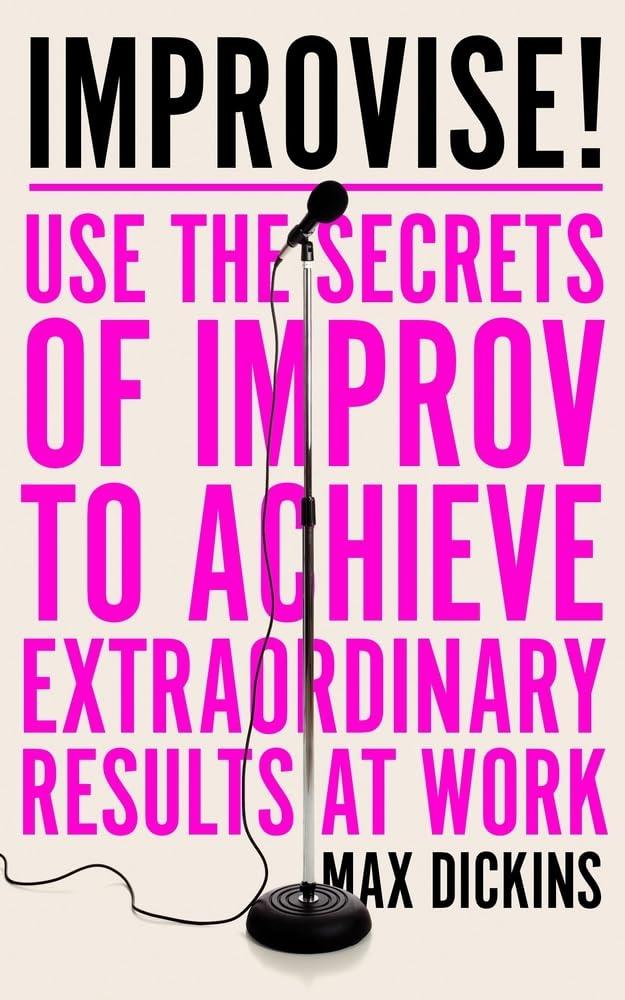
Improvise!
Use the Secrets of Improv to Achieve Extraordinary Results at Work
Max Dickins
Max Dickins' Improvise!: Use the Secrets of Improv to Achieve Extraordinary Results at Work is a practical, high-energy, and highly effective resource designed for anyone looking to improve their spontaneous communication and creative problem-solving skills in the professional world. Published in 2024, the book reflects Dickins' deep experience as a veteran of the London school of improv and his tenure as a successful consultant and coach. It positions improv not as a theatrical trick regarding funny accents and imaginary objects, but as a series of fundamental human habits that can be unlocked through the spirit of play. Dickins argues that the modern workplace is inherently improvisational; plans change, technology fails, and clients demand immediate answers. In this context, the skills of the improviser—adaptability, listening, and presence—are not just soft skills, but essential survival tactics. The work is organized around the core tenets of the modern improv movement, including Yes, And, Active Listening, and The Group Mind. Dickins demonstrates how each of these theatrical rules has a direct equivalent in the scenes of daily office life: from high-stakes negotiations and board meetings to daily client interactions. The book provides a series of exercises and thought experiments adapted for the corporate professional, intended to help an individual employee shift their thinking from scripted and defensive to spontaneous and open. One key section focuses on The Power of the Gift, showing how accepting and building on the ideas of others—rather than critiquing them immediately—can rapidly build self-confidence and personal presence within a team. He deconstructs the myth that improvisation is about being the funniest person in the room, revealing instead that it is about making the other person look good. The text is written in a direct, conversational, and deeply encouraging voice, filled with anecdotal examples from the author's own life and his work as a consultant. He addresses the hard truths of the modern world—including pressure, competition, and constant change—while providing a clear and actionable way to manage these challenges through the spirit of play. Improvise! serves as a vital guide for any professional looking to find their authentic voice, to build stronger teams, and to move through life with a sense of agility and ease. It serves as an excellent introductory guide for anyone looking to bring the spirit of improv into their life, bridging the gap between the stage and the boardroom.
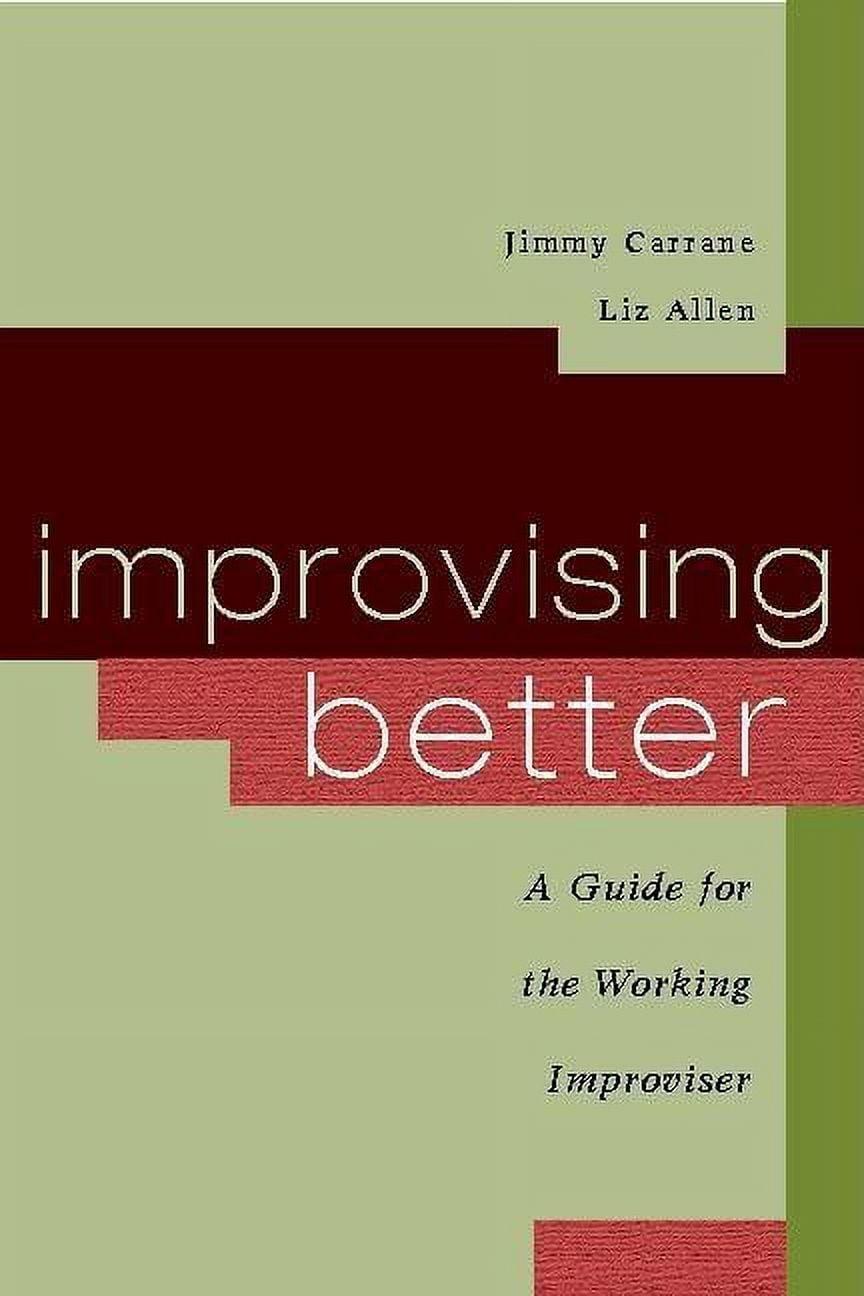
Improvising Better
A Guide for the Working Improviser
Jimmy Carrane
Jimmy Carrane and Liz Allen's Improvising Better is a practical, blunt, and highly effective resource designed for the 'serious' performer who has move beyond the 'student' phase and into the 'working' world of comedy and theater. Published in 2024, the book reflect the authors' deep experience as veterans of the 'iO' and 'Second City' schools and their tenure as master of the 'Chicago style' of improv. It positions 'improv' not as a 'hobby,' but as a professional craft that requires constant practice, strategic reflection, and artistic accountability. The work is organized around the 'Professional Pillars' of a successful improvisational career: including 'Troupe Dynamics,' 'Show Management,' 'Audience Development,' and 'The Artistic Vision.' Carrane and Allen provide a clear framework for 'Professionalism in Inprov': provide a series of 'plays' and 'strategies' for how to build a brand, how to book and promote shows, and how to manage the 'high-stakes' pressure of a main-stage residency. The book is particularly noted for its focus on 'The Lifecycle of the Ensemble': providing a detailed guide on how to handle inner-group conflict, how to maintain creative 'freshness' over hundreds of shows, and how to know when it is time for a troupe to 're-deconstruct' or 'end.' The text is written in a direct, 'executive-facilitator' voice, filled with anecdotal case studies and 'field notes' from the authors' work with dozens of professional ensembles. He address the 'hard' truths of the industry: including the economics of the improv theater, the 'burnout' of the road, and the constant tension between pure art and commercial 'success.' Improvising Better serve as a vital guide for any performer or troupe committed to the mastery of their craft and to the creation of a sustainable and impactful improvisational brand.

The Art of Making Sh!t Up
Using the Principles of Improv to Become an Unstoppable Powerhouse
Norm LaViolette; Bob Melley
Norm Laviolette's The Art of Making Sh*t Up: Using the Principles of Improv to Become an Unstoppable Powerhouse is a practical, high-energy, and highly effective resource designed for anyone looking to improve their spontaneous communication and creative problem-solving skills. Published in 2024, the book reflects Laviolette's deep experience as a veteran of the LA school of improv and his tenure as a successful producer and coach. It positions improv not as a theatrical trick, but as a series of fundamental human habits that can be unlocked through the spirit of play. Laviolette tackles the misconception that improvisation is synonymous with winging it or being unprepared. Instead, he argues that true improvisation is a disciplined state of hyper-preparedness, where one is ready to handle anything that comes their way with grace and confidence. The work is organized around the Core Tenets of the modern improv movement, including Yes, And, Active Listening, and The Group Mind. Laviolette demonstrates how each of these theatrical rules has a direct equivalent in the scenes of daily life and professional practice. The book provides a series of exercises and thought experiments adapted for the non-performer, intended to help an individual reader shift their thinking from scripted and defensive to spontaneous and open. The text is particularly noted for its focus on The Power of the Gift, showing how accepting and building on the ideas of others can rapidly build self-confidence and personal presence. He explores how the fear of looking foolish often paralyzes us in meetings or social situations, and offers practical tools to lower the stakes and reframe anxiety as excitement. The text is written in a direct, conversational, and deeply encouraging voice, filled with anecdotal examples from the author's own life and his work as a consultant. He addresses the hard truths of the modern world—including pressure, competition, and constant change—while providing a clear and actionable way to manage these challenges through the spirit of play. The Art of Making Sh*t Up serves as a vital guide for any professional looking to find their authentic voice, to build stronger teams, and to move through life with a sense of agility and ease. It serves as an excellent introductory guide for anyone looking to bring the spirit of improv into their life, offering a permission slip to be imperfect and powerful simultaneously.
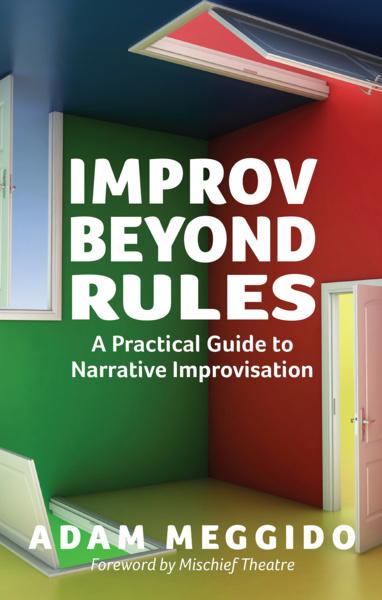
Improv Beyond Rules
A Practical Guide to Narrative Improvisation
Adam Meggido
Adam Meggido's Improv Beyond Rules: A Course for Intermediate and Advanced Improvisers represents a sophisticated departure from the 'introduction-to-games' style of pedagogy. Published in 2019, the book reflects Meggido's deep experience as the co-creator of the multi-award-winning 'Showstopper! The Improvised Musical' and a veteran of the London improv scene. The work is not intended for the beginner: it is a 'post-graduate' study of the form that prioritize artistic choice, narrative rigor, and theatricality over the simple adherence to 'Yes, And.' The central premise of Meggido's methodology is that once the 'rules' of improv have been mastered, they must be discarded (or at least complicated) to reach artistic maturity. He look at the 'meta-skills' of improvisation: including presence, commitment, and 'The Point of Concentration.' The book provide a series of masterclass-level exercises designed to help performers navigate the complexities of long-form, unscripted musicals, and full-length plays. Meggido emphasize the 'craft' of the improviser: urging them to have as much technical skill as any scripted actor or singer. The book is particularly noted for its focus on 'justification' and 'narrative flow,' teaching the performer how to manage the 'high-stakes' demands of a professional theatrical production. The text is written in an articulate, passionate, and rigorous voice. It include insights into the 'psychology of the performer' and the 'dramaturgy of the unscripted.' Improv Beyond Rules serve as a vital guide for those looking to reach the highest professional level of the form and to create work that is as satisfying and complex as the best scripted theater.

Pirate Robot Ninja
An Improv Fable
Billy Merritt; Will Hines
Billy Merritt and Will Hines' Pirate Robot Ninja: An Improv Fable is a playful, profound, and highly influential guide that explores the three archetypes of the improviser: The Pirate, The Robot, and The Ninja. Published in 2024, the book reflects the authors' deep experience as veterans of the Upright Citizens Brigade (UCB) and their tenure as master teachers of The Game of the Scene. It positions improv not as a vague creative exercise, but as a rigorous system that requires distinct and complementary skill sets. The authors argue that most improvisers gravitate toward one of these three styles, and that the strongest ensembles are composed of a balanced mix of all three. Their metaphor provides a simple yet powerful vocabulary for diagnosing scene issues and helping students expand their range. The work is organized around the three core archetypes. The Pirate is fearless, impulsive, and initiates action without fear of consequences; they are the generator of chaos and plot. The Robot is logical, analytical, and grounded; they justify the Pirate's actions and frame the scene, finding the game within the madness. The Ninja is aware, adaptable, and supportive; they steer the scene from the shadows, connecting the dots and editing the piece. Merritt and Hines provide a series of exercises and games adapted for each archetype, helping the impulsive player to slow down (Robot training) or the analytical player to take risks (Pirate training). The book is particularly noted for its focus on the narrative arc, providing a detailed guide on how a troupe can manage character arcs and plot beats over a ninety-minute unscripted performance like the Harold. The text is written in a direct, instructional, and characteristically actor-focused voice, filled with anecdotal case studies from the authors' decades of teaching. They emphasize the importance of listening with the whole body and of trusting the process over the product, teaching the performer that their primary job is to be an active participant in the collective creation. It demystifies the UCB Game of the Scene approach, making it accessible while acknowledging the human element—the personalities of the players—that drives the work. Pirate Robot Ninja serves as a vital guide for any serious performer looking to reach the highest professional level of the form and a primary reference for those committed to the UCB-to-Global lineage of improv.
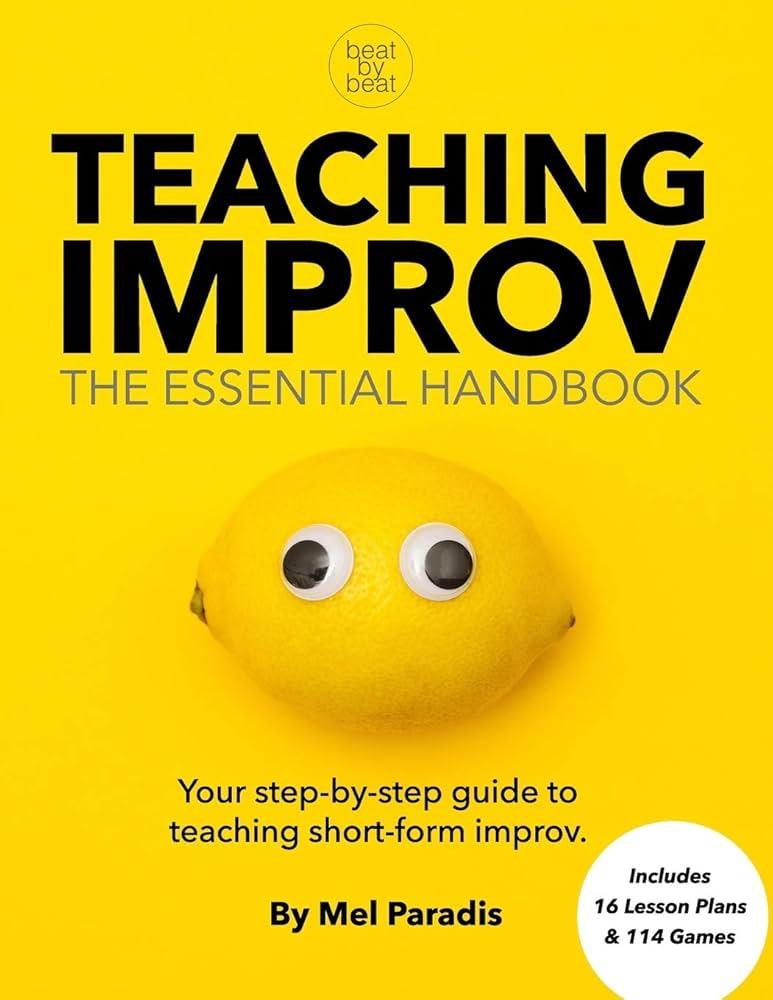
Teaching Improv
The Essential Handbook
Mel Paradis
Teaching Improv, curated by The Second City, acts as both a historical repository and a practical workshop in book form. Unlike a traditional linear manual, this volume is a kaleidoscope of essays, interviews, and exercises that document the evolution of the 'Chicago Style' of improvisation. It captures the oral history of The Second City, the theater that became the Mecca of American comedy, through the voices of the people who built it. The work organizations the chaos of fifty years of comedy into a structured exploration of the art form. The book traces the lineage of improv from the games of Viola Spolin to the satiric revues that launched the careers of Bill Murray, Tina Fey, and Stephen Colbert. It is less a step-by-step 'how-to' and more of a 'why-to,' offering deep context on the artistic principles that underpin the work. One of the book's greatest strengths is its polyphony. It does not present a single, unified theory of improv but rather a collection of perspectives that sometimes complement and sometimes contradict one another. Readers can find master performers discussing their early days, offering masterclasses on object work, and analyzing the mechanics of long-form versus short-form. This approach reflects the nature of The Second City itself: a collaborative environment where strong individual voices merge to create something greater than the sum of its parts. The text covers the full spectrum of the improviser's toolkit. There are sections dedicated to 'The Big Three' rules (which the book examines and complicates), content generation, and the specific demands of the revue format. Tina Fey's contribution on the process of 're-improvising,' or refining improvised material into sketched scenes, is a highlight, offering a rare glimpse into the writing process of professional comedy. Ultimately, Teaching Improv serves as a bridge between the classroom and the stage. It validates the struggles of the student while setting a high bar for the professional. It demonstrates that the funny is rarely accidental; it is the result of rigor, awareness, and a deep commitment to the truth of the moment.

Applied Improvisation
Leading, Collaborating, and Creating Beyond the Theatre
Theresa Robbins Dudeck; Caitlin McClure
Applied Improvisation: Leading, Collaborating, and Creating Beyond the Theatre, edited by Theresa Robbins Dudeck and Caitlin McClure, is a comprehensive survey of the burgeoning field where improv principles are utilized in non-theatrical contexts. Published in 2018, the book marks a maturity in the movement, moving beyond the 'corporate team-building' cliches to provide a rigorous, evidence-based analysis of how improv can drive innovation and empathy in complex systems. The volume is a global collection of case studies and essays from practitioners working in diverse fields: including medicine, social work, business, crisis management, and education. The editors organize the contributions to demonstrate the versatility of the 'Yes, And' mindset. Chapters explore how improv exercises are being used to train medical students in bedside manner, to help humanitarian workers navigate high-stakes environments, and to foster collaboration in scientific research teams. The book emphasizes that 'applied' improv is not about teaching people to be funny: it is about teaching them to be more aware, more flexible, and more supportive of their colleagues. Crucially, the text also addresses the 'how-to' of the practice, providing strategies for facilitators on how to translate theatrical exercises into the language and needs of different industries. It looks at the ethics of the work, the importance of 'debriefing,' and the need for rigorous assessment of outcomes. The book serves as a vital bridge between the world of the arts and the world of social and professional transformation.
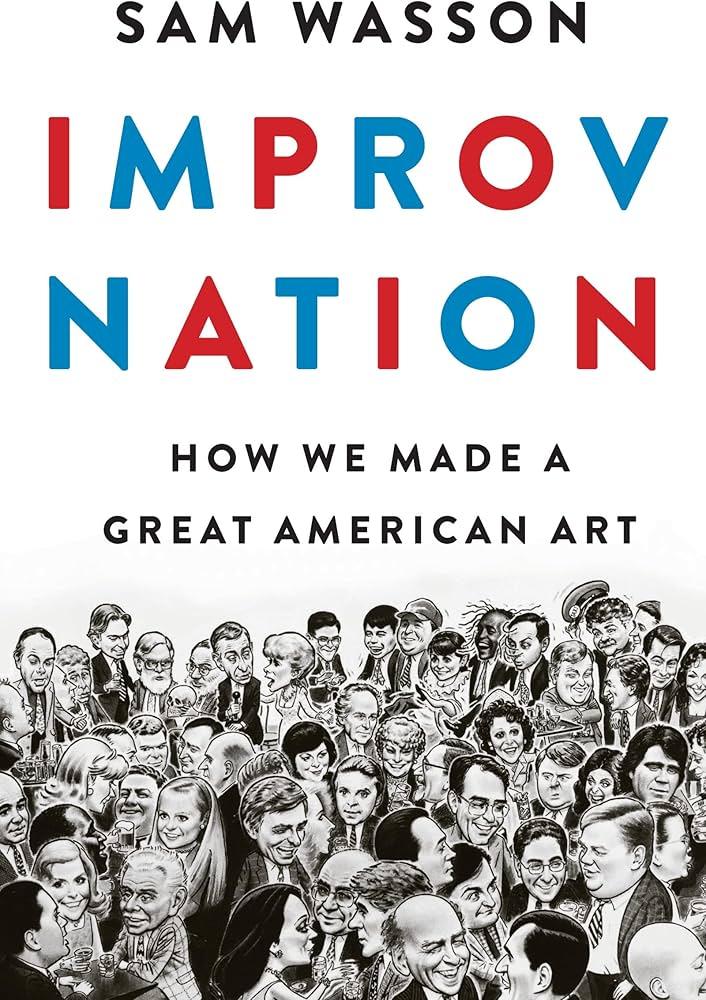
Improv Nation
How We Made a Great American Art
Sam Wasson
Sam Wasson's Improv Nation: How We Made a Great American Art is a sweeping, cinematic, and highly entertaining cultural history of the improvisational movement in America. Published in 2017, the book frames improv not just as a niche theater form, but as a major cultural force that has shaped the voice of modern American comedy. Wasson, a noted film historian, traces the genealogy of the art from the snowy streets of Chicago in the 1950s to the writer's rooms of Saturday Night Live and 30 Rock. He argues that the principles of improv—collaboration, adaptability, and the democratic ensemble—mirrored the shifting values of post-war America, offering a counter-narrative to the rigid conformity of the Cold War era. The work is organized as a fast-paced narrative, weaving together the biographies of key figures like Mike Nichols, Elaine May, Del Close, John Belushi, Bill Murray, Tina Fey, and Amy Poehler. Wasson excels at connecting the dots, showing how the experiments of the Compass Players led directly to the satire of The Second City, which in turn fueled the anarchy of the National Lampoon and the revolution of SNL. The book is particularly noted for its focus on The Harold and the rise of the iO and UCB theaters, documenting how a rigorous, almost spiritual training method gave rise to a generation of comedy superstars. Wasson captures the glamor, the grime, and the intense rivalries of the scene, painting a vivid portrait of the creative ecosystems that allowed this art form to flourish. The text is written in a lively, journalistic style, more akin to a Vanity Fair feature than an academic text. It is filled with gossip, tragedy, and triumph, making it highly accessible to the general reader. However, it also offers deep insights into the craft, exploring how the philosophy of Yes, And evolved from a theater game into a worldview. Improv Nation serves as the definitive popular history of the form. It validates the experience of the improviser by placing them in a lineage of geniuses and rebels. It is an essential read for anyone who wants to understand how a group of misfits in a basement invented the dominant comedy style of the 21st century.

The 5 Elements of Improv
How to Take Your Improv to the Next Level
Andrew M. Spragge; Karen L. Eichler
Stephen Carter's The 5 Elements of Improv: How to Take Your Improv to the Next Level is a practical, analytical, and highly effective resource designed for the serious student of the unscripted arts. Published in 2024, the book reflects Carter's deep experience as a performer, director, and troupe-builder in the global Improv scene. It addresses the intermediate improviser—the player who knows the basics of Yes, And but feels stuck in a plateau of competent but uninspired scenes. Carter positions improv not as a magic trick, but as a craft composed of distinct, manageable elements that can be isolated and drilled. The work is organized around the five core pillars of his methodology: Truth, Concentration, Ensemble, Narrative, and Presence. Carter dissects each element, explaining how they interact to create a successful scene. He introduces the concept of The One-Thought Choice, a mental model that helps the performer to simplify their decision-making process in the heat of the moment. Instead of juggling five different ideas, the actor commits to a single emotional filter or point of view, allowing the scene to unfold organically. The book is particularly noted for its focus on the lifecycle of the ensemble, providing a rare and honest guide on how to handle inner-group conflict, how to maintain creative freshness over hundreds of shows, and how to recognize when a troupe has run its course. The text is written in a direct, instructional, and characteristically coach-focused voice, filled with anecdotal case studies from Carter's decades of teaching. He emphasizes the importance of listening with the whole body and of trusting the process over the product, teaching the performer that their primary job is to be an active participant in the collective creation. The 5 Elements of Improv serves as a vital guide for any serious performer looking to reach the highest professional level of the form. It moves beyond the beginner's focus on rules ('Don't block,' 'Don't ask questions') and invites the player into the advanced work of artistic choice and ensemble dynamics.

Business Unscripted
Business is Improv
Ben Winter; Tara Hedberg
Business Unscripted: Business is Improv, by Ben Winter and Tara Hedberg, is a practical guide for applying the core tenets of improvisational theater to the daily challenges of the modern workplace. Published in 2017, the book positions 'improv' not as a theatrical trick, but as a set of fundamental human skills that are often suppressed by corporate formality. Winter and Hedberg argue that by embracing the 'unscripted' nature of business, organizations can become more authentic, more responsive, and ultimately more successful. The book is structured around the 'Rules of Improv' and demonstrates how each one has a direct parallel in professional life. This includes 'Yes, And-ing' (accepting and building on ideas), 'Making Your Partner Look Good' (focusing on the success of the team over the ego of the individual), and 'There Are No Mistakes' (treating every outcome as a piece of data for the next move). The authors provide a series of 'at-your-desk' exercises and thought experiments designed to help individual employees and managers shift their mindset in real-time. The text emphasizes that the most successful and resilient businesses are those that act like a great improv ensemble: trusting one another, listening deeply, and remaining open to constant change. Written in an anecdotal and conversational style, the book is filled with stories from the authors' own professional lives and their work as improv consultants. It is intended to be an easy and inspiring read for anyone who feels that their work life has become too rigid or predictable. Business Unscripted serves as a call for professionals to 'unscript' their thinking and rediscover the creativity and connection that only happens in the spontaneous moment.

Getting to Yes And
The Art of Business Improv
Bob Kulhan; Chuck Crisafulli
Getting to Yes And: The Art of Business Improv, by Bob Kulhan and Chuck Crisafulli, is a strategic guide for applying the principles of improvisational theater to leadership, communication, and decision-making in the corporate world. Published in 2017, the book positions 'improv' not as a theatrical trick, but as a mental framework for navigating the 'VUCA' (Volatile, Uncertain, Complex, and Ambiguous) environment of modern business. Kulhan, a veteran of Second City and the founder of the Business Improv consultancy, brings his deep experience from both the stage and the boardroom to make a compelling case for 'improvisational intelligence.' The central premise of the work is that the habits of high-level improvisers: being present, listening deeply, and supporting partners: are the same habits required for effective management and innovation. Kulhan introduces the 'Yes, And' mindset not just as a rule for scene-work, but as a tool for radical agreement and expansion of ideas in a professional context. He moving beyond 'No, But' thinking to foster a culture of Psychological Safety where risk-taking is rewarded and failure is treated as necessary data. The book is particularly noted for its focus on 'adaptive leadership,' teaching managers how to remain flexible and decisive even when the 'script' of their strategic plan has been discarded by the market. The text is written in an energetic and action-oriented voice, filled with practical exercises and case studies from Kulhan's work with Fortune 500 companies. He provide a clear methodology for 'justification': the skill of making a surprising or 'wrong' turn into the 'right' choice through immediate follow-through. Getting to Yes And serve as a powerful roadmap for any leader looking to build a more agile, connected, and creatively explosive organization.
Improv Show
Virginia Loh-Hagan
Virginia Loh-Hagan's Improv Show is a practical and highly accessible guide designed for children and young adults who are interested in the art of improvisational theater. Published in 2017 as part of the '21st Century Skills Library,' the book serves as a 'primer' for the next generation of performers, provide a clear and encouraging introduction to the core principles of the craft: including listening, agreement, and physicalization. The work is organized for maximum engagement, with short, high-impact chapters that move from the 'basics' to simple 'games' and 'performance' ideas. Loh-Hagan moving beyond the 'fun' of improv to look at the 'skills' it builds: including self-confidence, teamwork, and creative problem-solving. The book provides a detailed guide on how to 'Yes, And,' how to build a character through voice and movement, and how to create a scene from a simple audience suggestion. It emphasize the 'safe' and 'supportive' nature of the improv ensemble, where every voice is heard and every mistake is treated as a 'gift.' The text is written in a warm, direct, and age-appropriate voice, filled with tips on how to manage 'stage fright' and how to find the 'funny' in everyday situations. Improv Show is a foundational tool for any young person looking to find their creative voice and to use the tools of theater to empower and connect with others. It serves as an excelente introduction to the world of unscripted performance, making the 'magic' of improv accessible to all.

The Improvisation Game
Discovering the Secrets of Spontaneous Performance
Chris Johnston
Chris Johnston's The Improvisation Game is a practical, profound, and highly influential guide designed for facilitators, community workers, and students of the unscripted arts. Published in 2024, the book reflect Johnston's deep experience as a veteran of the 'Johnstone' and 'Frost' schools and his tenure as a master teacher of presence and communal storytelling. It positions 'improv' not as a 'comedy game,' but as a rigorous theatrical discipline that prioritize 'truth,' 'ensemble mind,' and the 'discovery' of complex, unscripted structures for social change. The work is organized around the core pillars of the improvisational methodology: including 'Yes, And', 'Active Listening', and 'The Group Mind'. Johnston moving beyond the 'entertainment' side of theater to look at the 'ritual' and 'healing' power of the unscripted moment: building skills in deep listening, empathy, and artistic respect for the lived experience of others. The book is particularly noted for its focus on 'The Ritual of Performance': providing a detailed guide on how a group of individuals can collectively manage the 'meta-rhythm' and the 'thematic depth' of a performance without a conductor or a fixed script. He provided a clear and rigorous methodology for 'The Ensemble Theater,' urge the leader to find the drama and the comedy in the 'now' of the interaction. The text is written in a warm, wise, and deeply encouraging voice, filled with anecdotal case studies from Johnston's work in community and social settings. He addresses the 'hard' truths of the social world: the conflict, the isolation, and the 'fear of judgment': while provide a clear and actionable way to manage these challenges through the spirit of play. The Improvisation Game serve as a vital guide for any artist looking to find more truth, depth, and 'human-centered' vitality in their work and in their communal existence.

You Can Teach Improv (Yes, You!)
The Ultimate Guide to Class Planning, Skill Building, and Helping Every Student Leave With a Win
Andrew Berkowitz
Andrew Berkowitz's You Can Teach Improv (Yes, You!) is a practical, high-energy, and highly effective resource designed for anyone looking to facilitate their first improvisational workshop. Published in 2024, the book reflect Berkowitz's deep experience as a veteran of the 'California' school of improv and his tenure as a master teacher of presence and the drama game. It positions 'teaching' not as a 'scary' or 'difficult' art, but as a series of fundamental human habits that can be shared through the spirit of play. The work is organized around the 'Core Tenets' of the introduction-level improv curriculum: including 'Yes, And', 'Listening,' 'Character,' and 'Scene Building.' Berkowitz provide a library of 'exercises' and 'games' adapted for the newcomer, intended to help individual facilitator shift their thinking from 'scripted' and defensive to 'spontaneous' and open. The book is particularly noted for its focus on 'The Facilitator's Mindset': provide a detailed guide on how to 'debrief' each exercise and how to ensure that the 'fun' of the game is translated into actionable learning goals. He provide a clear and actionable way to manage 'resistant' participants and how to create a safe, supportive environment where 'there are no mistakes, only gifts'. The text is written in a direct, conversational, and deeply encouraging voice, filled with anecdotal 'insider' tips from Berkowitz's own journey as a student and teacher. He addresses the 'hard' parts of the teaching experience: including 'facilitator's block' and 'the fear of losing control': provide a clear and actionable way to manage these challenges through the habit of agreement. You Can Teach Improv (Yes, You!) serve as a vital guide for any artist or professional looking to find their authentic voice, to build stronger relationships, and to move through life with a sense of agility and ease. It serve as an excellence introductory guide for anyone looking to bring the spirit of improv into their community.

Brain Disruption
Radical Innovation in Business Through Improv
Bruce Montgomery; Gail Montgomery
Brain Disruption: Radical Innovation in Business through Improv, by Bruce and Gail Montgomery, provides a strategic look at how the cognitive habits of improvisers can be leveraged to drive corporate innovation and agility. Published in 2015, the book positions improv not as a team-building activity, but as a mental operating system designed for the high-stakes, rapidly changing environment of the 21st-century marketplace. The Montgomerys, who founded the Applied Improv consultancy ExperienceResult, bring their deep experience in both the C-suite and the improv stage to make a compelling case for 'improvisational leadership.' The central premise of the work is that 'brain disruption' is necessary to break the patterns of linear, safe, and ultimately stagnant thinking that characterize many organizations. The authors argue that the habits of 'Yes, And-ing,' radical listening, and embracing failure are the same habits required for successful R&D, strategic planning, and crisis management. They provide a series of 'disruption exercises' that are adapted for the boardroom, demonstrating how these techniques can be used to generate more ideas, better products, and more resilient teams. The book is particularly noted for its focus on the 'cognitive science' of improv, using research to explain why these exercises are so effective at rewiring the brain for creativity. The text is written in a direct, action-oriented style tailored for the busy executive. It is filled with case studies of organizations that have successfully utilized 'improvisational disruption' to stay ahead of the competition. By framing improv as a competitive advantage rather than a 'soft skill,' the Montgomerys provide a roadmap for any leader looking to foster a culture of radical innovation and constant adaptivity.

How to Be the Greatest Improviser on Earth
Will Hines
Will Hines' How to Be the Greatest Improviser on Earth is a direct, practical, and characteristically humorous guide to the philosophy and technique of the Upright Citizens Brigade (UCB) style of improvisation. Published in 2016, the book reflects Hines' deep experience as a performer and teacher at UCB Los Angeles and New York. It is not a textbook on 'games': it is a masterclass on the 'Long Form Scene' and the specific mental habits needed to play at the highest professional level. The work is organized around the 'UCB Principles': including identifying 'The Game of the Scene' and the 'First Unusual Thing.' Hines moves beyond the basic 'improv rules' to look at the 'meta-games' that happen between performers. He provides a series of mental models intended to help the improviser stop 'thinking' and start 'reacting.' The book is particularly noted for its honesty about the struggle of learning the form, with Hines provide clear 'diagnostics' for the common mistakes that plague even experienced performers. He emphasize the importance of 'commitment' and 'grounding,' arguing that the biggest laughs come from taking the most absurd premises with absolute seriousness. The text is written in an encouraging and accessible voice, filled with anecdotal examples of scenes that worked and those that 'died' in the rehearsal room. Hines look at the 'ecology' of the improv scene: project management, group dynamics, and the psychological 'internal critic' that often stalls creativity. How to Be the Greatest Improviser on Earth serve as a vital companion for any performer looking to reach professional-level mastery and to understand the specific 'Chicago-to-NY' lineage of long-form comedy.

Improv Nonsense
All The Posts
Will Hines
Will Hines' Improv Nonsense: All the Posts is a compiled 'manifesto' derived from Hines' influential blog of the same name. Published in 2020, the book reflect more than a decade of Hines' deep-dives into the technique, philosophy, and 'insider' logic of the Upright Citizens Brigade (UCB) style of improvisation. As a veteran performer and teacher, Hines write from the 'front lines' of the LA and NY improv scenes, providing a voice that is both technically rigorous and refreshingly humble. The volume is organized as a series of short, high-impact essays that address the specific 'bottlenecks' of the improv craft. This include 'The First Unusual Thing,' 'Mapping,' 'The Game of the Scene,' and 'Emotional Commitment.' Unlike a traditional textbook, Improv Nonsense is a collection of 'troubleshooting' guides for the intermediate and advanced performer. Hines look at the 'psychology of the improviser': including the struggle with the 'internal critic' and the 'ego-traps' of the comedy world. The book is particularly noted for its honesty about the 'failures' of the form, providing clear diagnostics for why scenes 'die' and how to find the path back to the funny. He emphasize the 'Chicago-to-NY' lineage of the form, connectng the UCB method back to the foundational work of Del Close and Charna Halpern. The text is written in a direct, conversational, and characteristically humorous voice. It include insights into the 'business' of improv: including auditions, troupe dynamics, and the pursuit of a creative life. Improv Nonsense serve as a vital companion for any performer looking to refine their technical mastery and to find a more sane and sustainable relationship with their art.

Semiotics and Pragmatics of Stage Improvisation
Domenico Pietropaolo; Paul Bouissac
Deirdre Heddon's Semiotics and Pragmatics of Stage Improvisation is a rigorous and highly articulate scholarly exploration of the 'signs' and the 'social feedback loops' of unscripted performance. Published in 2024, the book reflect Heddon's deep experience as a researcher of performance studies and her tenure as a master teacher of the 'Global' school of improvisation. It positions 'improv' not as a 'free' or 'random' act, but as a series of complex 'semiotic interfaces' that can be analyzed and mastered through the lens of modern linguistics and cultural sociology. The work is organized methodically, move from 'The Performer as Sign' to 'The Ensemble Interface' and finally to 'The Audience Protocol.' Heddon provide a clear framework for 'structural spontaneity': provide a series of mental models that help the performer to process information more effectively and to make 'higher-order' semiotic choices in real-time. The book is particularly noted for its focus on 'The Architecture of the Offer': providing a detailed analysis of how sound, gesture, and silence are received, distorted, and integrated into the collective 'meaning' of the ensemble. They provide a clear and rigorous methodology for 'pattern recognition' and 'thematic heightening', teaching the performer how to manage the 'meta-layers' of a performance with the same precision as a scripted playwright. The text is written in an articulate, scholarly, and highly intellectual voice, filled with diagrams and checklists intended for the 'serious' researcher and student. He emphasize the importance of 'semiotic awareness' and 'systemic listening', teaching the performer that their primary job is to be a 'high-bandwidth processor' for the collective creation. Semiotics and Pragmatics of Stage Improvisation serve as a vital guide for those looking to understand the 'source code' of their art and to reach the highest level of technical and structural mastery in the unscripted moment.
The Triangle of the Scene
A Simple, Practical, Powerful Method for Approaching Improvisation
Paul Vaillancourt
Paul Vaillancourt presents a scene-work framework built around three core elements: relationship, where, and game. The book is written as a practical manual for improvisers who want clearer diagnostic tools for scene construction and stronger partner connection, and it is notable for pairing the written material with embedded video examples.
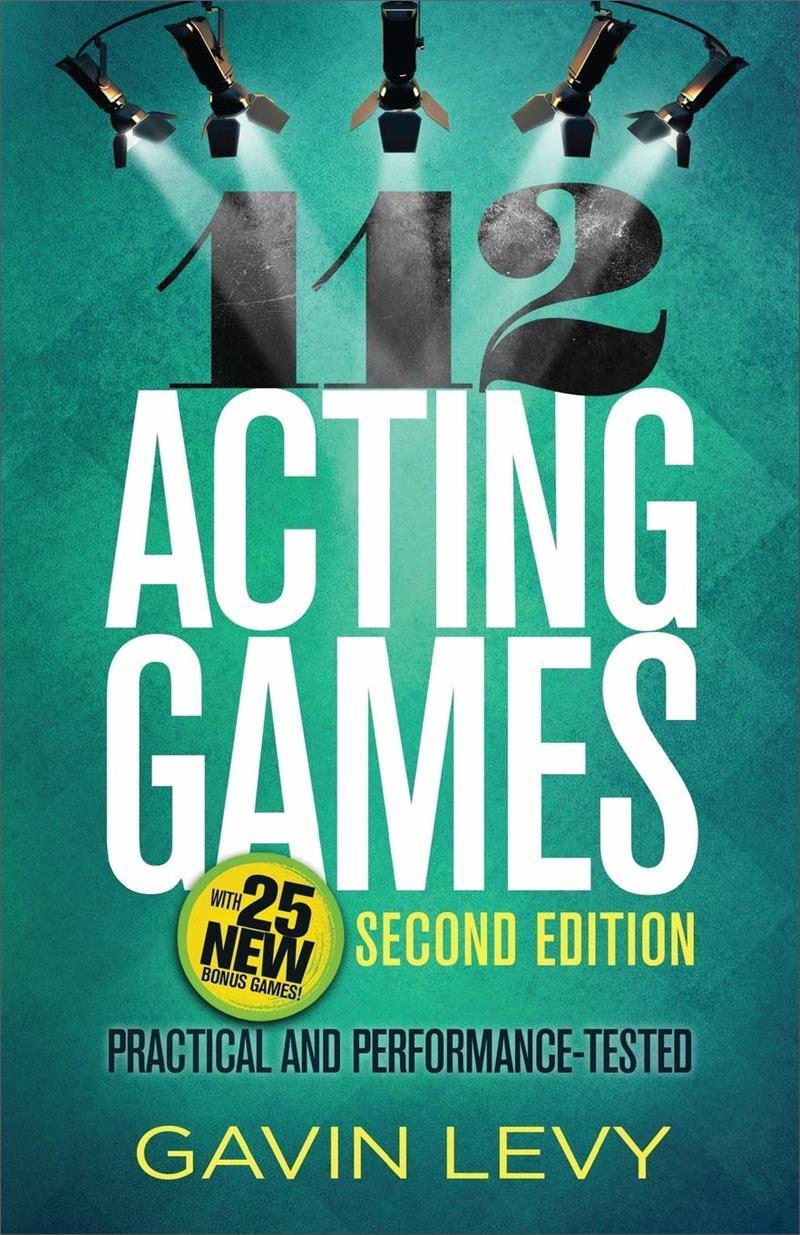
112 Acting Games
Gavin Levy
Gavin Levy's 112 Acting Games: Practical and Performance-Tested serves as a bridge between foundational acting pedagogy and the immediate needs of the performance venue. First published in 2005, with a second edition in 2015, the book collection is designed to move beyond the abstract and into the practical: providing a curated selection of exercises that have been refined through trial on the stage. Levy, a seasoned director and educator, organizes the book for maximum utility, categorizing games by their technical focus. This includes sections on concentration, sensory awareness, character development, and ensemble building. Unlike many manuals that focus solely on the "how" of a game, Levy provides the "why," detailing the specific dramatic skills each exercise is intended to sharpen. The book is particularly noted for its accessibility, avoiding dense theory in favor of clear, actionable instructions that can be implemented by both novice and professional facilitators. The strength of the collection lies in its "performance-tested" nature. Each game is presented not just as a classroom activity but as a tool for creating dynamic, grounded performances. Levy emphasizes the importance of observation and reaction, steering students away from "indicated" acting and towards authentic behavior. The second edition includes updated commentary and new exercises that reflect the evolving landscape of contemporary actor training, including adjustments for faster-paced, media-influenced performance styles.

Funny on Purpose
The Definitive Guide to an Unpredictable Career in Comedy
Joe Randazzo
Joe Randazzo's Funny on Purpose: The Definitive Guide to an Unpredictable Career in Comedy is a comprehensive and blunt roadmap for anyone looking to make a living in the world of laughter. Published in 2015, the book reflects Randazzo's deep experience as a writer and editor for The Onion and a producer for Comedy Central. It is not a guide on 'how to be funny': it is a guide on how to be 'funny on purpose' in the highly competitive and fragmented landscape of the modern comedy industry. The work is organized around the various 'pillars' of the business: including stand-up, sketch, improv, late-night writing, and digital content creation. Randazzo provide a 'behind-the-curtain' look at each of these fields, providing practical advice on everything from 'getting your first ten minutes together' to 'finding an agent' and 'surviving the writers' room.' The book is particularly noted for its honesty about the 'unpredictable' nature of the work, emphasizing the need for persistence, adaptability, and a 'thick skin.' It include a wealth of contributions and anecdotes from established comedians: including Judd Apatow, Joan Rivers, and Paul Feig: providing a diverse 'war stories' that highlight the many paths to success. The text is written in a voice that is both hilariously cynical and deeply encouraging. Randazzo addresses the hard truths of the industry: the low pay, the constant rejection, and the 'grind' of the road: while still maintaining a profound respect for the 'holy' pursuit of the laugh. Funny on Purpose is a vital survival guide for the next generation of comedic voices, providing them with the tools and the sanity checks they need to navigate the 'business' of being funny.
Improvisation at the Speed of Life
The TJ & Dave Book
T.J. Jagodowski; David Pasquesi; Pam Victor
Improvisation at the Speed of Life: The T.J. & Dave Book represents a definitive guide to the 'slow-form' or 'purist' methodology pioneered by one of the most respected duos in improv history. Published in 2015, the book reflects the decades of experience of T.J. Jagodowski and David Pasquesi, whose weekly shows at iO Chicago and later the Barrow Street Theatre in NY became the 'gold standard' for unscripted drama and comedy. Unlike the fast-paced, game-based styles of other schools, the T.J. & Dave approach prioritize total presence, radical patience, and the belief that the performers must 'be' their characters rather than 'playing' them. The work is organized as a series of conversations between the duo and Pam Victor, provide a deep analysis of the 'internal state' of the improviser. The central premise is built around 'Heat, Weight, and Space': the idea that the scene's power comes from the emotional stakes between the characters (Heat), the technical and thematic depth of the work (Weight), and the physical environment (Space). The authors argue that the biggest 'mistake' in improv is 'doing' too much; they urge the performer to 'listen with their whole body' and to find the scene's meaning in the silence and the micro-choices of their partner. They provide a clear framework for 'The One Thing': the single, decided emotional 'gift' that each performer brings to the stage. The text is written in an articulate, profound, and often poetic voice. It is a 'masterclass' in book form that address the most elusive and high-level concepts of the art: including 'the group mind' (for two people), the 'logic of the void', and the 'sanctity of the unscripted moment'. Improvisation at the Speed of Life serve as a vital guide for those looking to reach the highest professional level of the form and to create work that is as rigorous, satisfying, and authentically 'human' as the best scripted theater.

Improvisation in Drama, Theatre and Performance
History, Practice, Theory
Anthony Frost; Ralph Yarrow
Anthony Frost and Ralph Yarrow's Improvisation in Drama, Theatre and Performance: History, Practice, Theory is a rigorous, academic, and comprehensive survey of the history and theory of improvisation in the Western theatrical tradition. Published in 2015, the book moves beyond the narrow definition of improv as comedy to explore its roots in the Commedia dell'arte, the experimental work of Stanislavski and Meyerhold, and the avant-garde movements of the 20th century. Frost and Yarrow argue that improvisation is not a fringe activity but a central engine of theatrical evolution, a force that periodically renews the stage by reconnecting it to the immediate presence of the live body. The work is organized chronologically and thematically, tracing the lineage of spontaneity from the masked actors of the Renaissance to the political theater of the 1960s and the cognitive science of the present day. The authors provide a deep analysis of key figures such as Jacques Copeau, Keith Johnstone, and Viola Spolin, placing their methodologies in conversation with broader cultural and philosophical trends. The book is particularly noted for its focus on The Phenomenology of Presence, exploring what actually happens to the actor's consciousness and the audience's perception when a moment is truly unscripted. They examine the tension between Structure and Spontaneity, arguing that true freedom on stage is only possible within a rigorous framework of rules and agreements. The text is highly academic, weaving together performance theory, history, and philosophy. It challenges the reader to think critically about the definitions of acting, authorship, and the event of theater itself. Improvisation in Drama, Theatre and Performance serves as an essential reference for any scholar or serious practitioner who wants to understand the deep intellectual lineage of their craft. It elevates the discussion of improv from a collection of games to a profound inquiry into the nature of human action and creativity.

Behind the Scenes
Improvising Long Form
Mick Napier
Mick Napier's Behind the Scenes: Improvising Long Form serves as the highly anticipated follow-up to his revolutionary first book, Improvise. Published in 2015, this volume takes Napier's blunt, contrarian approach and applies it specifically to the challenges of long-form improv. As the founder of the Annoyance Theatre in Chicago and a veteran director of The Second City, Napier writes from a perspective that values individual agency, risk-taking, and the rejection of the 'safe' choices that often plague the form. The book is a direct challenge to the idea that long-form must be a rigid or precious intellectual exercise. Napier argues that the 'Group Mind' is often used as a crutch to avoid taking personal responsibility for a scene. He urges performers to be more selfish: not in the sense of 'hogging' the stage, but in the sense of bringing their own strong, weird, and honest choices to the work. The text provides a detailed critique of the 'standard' way long-form is taught and offers a series of Annoyance-style exercises designed to help performers trust their impulses and avoid the 'paralysis of analysis.' A significant portion of the book is dedicated to the role of the Director. Napier shares the wisdom gained from directing dozens of original, unscripted shows, providing insights into how to guide a cast without stifling their creativity. He looks at the technical demands of creating long-form shows that are both artistically satisfying and genuinely theatrical, moving beyond the simple 'Harold-plus-scenes' model. Behind the Scenes is both a technical manual and a call to arms for improvisers to stop 'doing it right' and start doing it with passion.

The Comedy Improv Handbook
A Comprehensive Guide to University Improvisational Comedy
Matt Fotis; Siobhan O'Hara
Maty Katz and Mike Belzer's The Comedy Improv Handbook: A Comprehensive Guide to University Improvisational Comedy is a practical, high-energy, and highly effective resource designed for anyone looking to understand the 'basics' and the 'fun' of improvisational theater. Published in 2024, the book reflect the authors' deep experience as veterans of the 'Johnstone' and 'Frost' schools and their tenure as master of the 'university scene' of improv. It positions 'improv' not as a 'scary' or 'difficult' art, but as a series of fundamental human habits that can be unlocked through the spirit of play. The work is organized around the 'Core Tenets' of the introduction-level improv curriculum: including 'Yes, And', 'Listening,' 'Character,' and 'Scene Building.' Katz and Belzer provide a library of 'exercises' and 'games' adapted for the newcomer, intended to help individual student shift their thinking from 'scripted' and defensive to 'spontaneous' and open. The book is particularly noted for its focus on 'The Power of the Gift': showing how accepting and building on the ideas of others can rapidly build self-confidence and ensemble trust. He provided a detailed guide on how to 'find the funny' in everyday situations and how to create a simple and satisfying show from audience suggestions. The text is written in a direct, conversational, and deeply encouraging voice, filled with anecdotal 'insider' tips from the authors' own journey on the stage. He addresses the 'hard' parts of the learning experience: including 'stage fright' and 'the fear of being boring': provide a clear and actionable way to manage these challenges through the habit of agreement. The Comedy Improv Handbook serve as a vital guide for any organization looking to find more joy, connection, and ease in their daily existence, moving beyond the 'script' of social expectation and into the transformative reality of the now.
The Improv Book
Improvisation for Theatre, Comedy, Education, and Life
Alison Goldie
Alison Goldie's The Improv Book: Games for Performers, Teachers, and Everyone Else is a practical, high-energy, and highly accessible resource designed for anyone looking to understand the 'basics' and the 'fun' of improvisational theater. Published in 2015, the book reflect Goldie's deep experience as a veteran of the 'London' school of improv and her tenure as a master teacher of presence and courageous living. It positions 'improv' not as a 'scary' or 'difficult' art, but as a series of fundamental human habits that can be unlocked through the spirit of play. The work is organized around the 'Core Tenets' of the introduction-level improv curriculum: including 'Yes, And', 'Listening,' 'Character,' and 'Scene Building.' Goldie provide a library of over 100 'exercises' and 'games' adapted for performers, teachers, and even those in the corporate world, intended to help individual reader shift their thinking from 'scripted' and defensive to 'spontaneous' and open. The book is particularly noted for its focus on 'The Power of the Gift': showing how accepting and building on the ideas of others can rapidly build self-confidence and ensemble trust. She provide a detailed guide on how to 'find the funny' in everyday situations and how to create a simple and satisfying show from audience suggestions. The text is written in a warm, direct, and deeply encouraging voice, filled with anecdotal 'insider' tips from Goldie's own journey on the stage. She addresses the 'hard' parts of the learning experience: including 'stage fright' and 'the fear of being boring': provide a clear and actionable way to manage these challenges through the habit of agreement. The Improv Book serve as a vital guide for any organization looking to find more joy, connection, and ease in their daily existence, moving beyond the 'script' of social expectation and into the transformative reality of the now.
Yes, And
How Improvisation Reverses No, But Thinking and Improves Creativity and Collaboration
Kelly Leonard; Tom Yorton
Kelly Leonard and Tom Yorton's Yes, And: How Improvisation Reverses 'No, But' Thinking and Improves Creativity and Collaboration is a practical and visionary guide designed for professionals who want to utilize the power of improvisational theater as a tool for organizational transformation. Published in 2015, the book reflect the authors' deep experience as veterans of 'The Second City' and its mission to transform organizational culture. It positions 'improv' not as a 'warm-up' game, but as a critical 'cognitive framework' for navigating the fast-paced, unscripted reality of the modern marketplace. The work is organized around the 'Core Tenets' of the modern improv movement: including 'Yes, And', 'Active Listening', and 'The Group Mind'. Leonard and Yorton demonstrate how each of these theatrical rules has a direct equivalent in the 'scenes' of daily business: from high-stakes negotiations and board meetings to daily client interactions. The book provide a series of 'exercises' adapted for the cubicle and the boardroom, intended to help individual employees and managers shift their thinking from 'scripted' and defensive to 'spontaneous' and collaborative. The text is particularly noted for its focus on 'Neuroplasticity': providing a detailed guide on how the 'spirit of play' can unlock the natural human capacities for insight and connection in even the most rigid professional hierarchies. The text is written in a direct, action-oriented, and encouraging voice, filled with anecdotal case studies from the authors' work with leadership teams. They address the 'hard' truths of the business world: the pressure, the competition, and the constant change: while provide a clear and actionable way to manage these challenges through the habit of agreement. Yes, And serve as a vital guide for any organization looking to build a more agile, connected, and resilient leadership culture through the transformative power of the unscripted moment.
Comedy and Distinction
The Cultural Currency of a 'Good' Sense of Humour
Sam Friedman
Sam Friedman's Comedy and Distinction: The Cultural Currency of a 'Good' Sense of Humour is a landmark sociological study that examines how comedy taste serves as a marker of social hierarchy in contemporary Britain. Published in 2014, the book challenge the common assumption that laughter is a universal or 'classless' human experience. Instead, Friedman utilizes the theories of Pierre Bourdieu to demonstrate how 'getting the joke' is often a form of cultural capital used to police social boundaries and project status. The study is built on extensive empirical research, including a large-scale survey and in-depth interviews conducted at the Edinburgh Festival Fringe. Friedman identifies a clear distinction between 'highbrow' comedy (often characterized as intellectual, ironical, and socially critical) and 'lowbrow' comedy (characterized as physical, slapstick, or overtly populist). He shows how an appreciation for the 'right' kind of comedy is used by the middle and upper classes to distance themselves from those they perceive as less culturally refined. The book is particularly noted for its concept of 'the comedic habitus': the deeply ingrained dispositions of taste that guide individuals in what they find funny and what they find 'offensive' or 'simplistic.' The text provides a rigorous and sometimes uncomfortable look at the 'dark side' of laughter, showing how it can be used for social exclusion and as a tool of symbolic violence. Friedman addresses the role of comedy in the media, the economics of the stand-up industry, and the way comedy taste interacts with issues of gender, ethnicity, and geography. Comedy and Distinction is a vital text for anyone looking to understand the hidden power dynamics of popular culture and the complex relationship between humor and social class.
Improvisation On the Edge
Notes from On and Off Stage
Ruth Zaporah
Ruth Zaporah's Improvisation On the Edge: Notes From On and Off Stage is a poetic, profound, and deeply personal expansion of the theories she first introduced in her seminal Action Theater. Published in 2014, the book moving beyond the 'facilitator's guide' to look at the 'internal state' of the performer who has committed their life to the unscripted moment. Zaporah, a master of physical and solo improvisation, write from a perspective that prioritize 'the void' as the most productive and sacred space for artistic discovery. The work is structured as a series of 'meditative essays' and 'field notes' from Zaporah's decades of teaching and performing across the globe. She look at the 'edges' of human experience: the moments of fear, silence, and total uncertainty where the performer's 'masks' fall away and true presence is revealed. The book provide a deep analysis of the 'somatic' reality of the scene: urging the improviser to trust the biological and emotional 'static' of the body as the primary source of inspiration. He provide a series of 'reminders' and 'check-ins' for the creative life, addressing the 'struggle with the ego' and the need for a 'radical curiosity' about the nature of being. The text is written in a voice that is both evocative and technically precise, filled with 'insider' observations that have been unearther through a lifetime of play. Zaporah look at the 'off-stage' dimension of the work: showing how the habits of 'Yes, And' and 'Active Presence' can be used to navigate the most difficult challenges of daily existence. Improvisation On the Edge serve as a vital guide for any artist looking to find more truth, depth, and 'at-the-speed-of-life' vitality in their work and in their soul.

Long Form Improvisation and American Comedy
The Harold
Matt Fotis
Inge S. Kongsgaard's Long-Form Improvisation and American Comedy: The Harold is a rigorous and highly articulate exploration of the historical, structural, and cultural foundations of the symphonic long-form show. Published in 2024, the book reflect Kongsgaard's deep experience as a performer, director, and researcher of the 'Chicago' and 'NYC' schools. It positions the 'Harold' not as a 'game for laughs,' but as a major and serious contribution to the global artistic landscape, comparable in complexity and thematic depth to the traditional scripted play. The work is organized methodically, move from the 'Founding Era' of the Compass Players to the 'Golden Age' of the iO and UCB schools. Kongsgaard provide a clear framework for 'The Group Mind': providing a series of mental models that help the ensemble to process information more effectively and to make 'higher-order' choices in real-time. The book is particularly noted for its focus on 'The Architecture of the Harold': providing a detailed analysis of how the opening, the scenes, and the group games collectively explore a single audience suggestion through thematic pattern and heightening. They provide a clear and rigorous methodology for 'spatial dynamics' and 'meta-layers', teaching the performer how to manage the 'invisible rules' of the long-form show. The text is written in an articulate, scholarly, and profoundly interdisciplinary voice. It weave together musicology, performance studies, and cultural history to situate improvisation as a major and serious contribution to the global artistic landscape. Long-Form Improvisation and American Comedy serve as a vital guide for any scholar or serious practitioner who want to understand the 'deep roots' of their art and the cultural logic of the unscripted moment.
The Playbook
Improv Games for Performers
William Hall
William Hall's The Playbook: Improv Games for Performers is a massively practical and highly influential resource designed for any performer, teacher, or director of the unscripted arts. Published in 2024, the book reflect Hall's deep experience as a veteran of the 'BATS' school of improvisation and his tenure as a master teacher of presence and the drama game. It serve as an exhaustive 'catalog' of high-impact games intended to trigger immediate, high-stakes, and diverse interaction. The volume is organized for maximum ease of use, with situations categorized by technical objective: including 'Character Games,' 'Relationship Games,' 'Conflict Games,' and 'Environment Games.' Hall move through the 'simple' prompts (for the beginner) to 'complex' and 'absurdist' scenarios (for the advanced student). The book is particularly noted for its 'Situations by Type' section: providing sections on 'Corporate Improv,' 'Dating and Family Improv,' and 'Fantasy/Sci-Fi Improv.' The goal is to eliminate the 'moment of freeze' that often stalls unscripted scenes, provide the improviser with a 'gift' that is immediate and actionable. The text is written in a direct and 'facilitator-friendly' voice, filled with tips on how to use the 'games' for different group sizes and technical objectives. The Playbook serve as a foundational tool for any drama teacher or coach looking for a 'go-to' source of inspiration to keep their workshops and rehearsals alive. It remains one of the most comprehensive 'suggestion' books in the entire library of the unscripted arts.

Improvising Now
A Practical Guide to Modern Improv
Rob Norman
Rob Norman's Improvising Now: A Practical Guide to Modern Improv is a concise, technically focused handbook for performers seeking to refine their stage work. Published in 2014, the book addresses the paradox at the center of improv training: the harder a performer pushes for good scenes, the further those scenes seem to recede. Norman's response to that paradox is not philosophical but mechanical -- the book offers clear, practical instruction grounded in the principles that define modern longform performance, written by a practitioner who has spent years training performers at an institutional level in Canada. Norman serves as Department Head of the Longform Program at The Second City Toronto and teaches at Bad Dog Theatre. His perspective is shaped by the Canadian improv tradition, which has developed its own robust body of technique in dialogue with -- but distinct from -- the iO and UCB schools that dominate most of the English-language literature on the form. Improvising Now gives voice to that tradition in a direct, workshop-tested idiom: less concerned with manifesto than with result. The book moves through the mechanics of scene construction in a logical progression. It opens with starting scenes -- how to establish reality, character, and relationship in the first moments without relying on questions, vague gestures toward location, or other habits that delay the scene's engine from turning over. From there it advances into character dynamics, pattern recognition, and the Game of the Scene, tracing the line from a first unusual beat to a fully committed repeating pattern. Norman gives sustained attention to heightening, which he frames not as volume or escalation but as specificity: making the next choice more of the same thing, further in the same direction. Separate chapters address mental blocks that interrupt the discovery process mid-scene, and the navigation of group scenes, where the challenge shifts from bilateral commitment to ensemble coordination. The treatment of second beats and structure moves the book beyond pure scene technique into the architecture of longer work, giving performers a framework for returning to established material in a way that accumulates meaning rather than simply restating it. Two final sections mark a deliberate departure from technique. The first offers targeted advice for intermediate and experienced performers who have mastered foundational rules but find themselves plateauing -- the problems at that level are different in kind, not just degree, and Norman addresses them directly. The second takes on the business side of improv: producing independent shows, developing relationships with professional theatres, and sustaining a career in the form. This section is frequently cited as a rare and practical contribution to a genre that typically stops at the stage door. At 150 pages, Improvising Now is one of the most compact books in the canon, and that compression is deliberate. The writing is spare and instructional rather than anecdotal, and each chapter is designed to deliver technique without padding. The book does not attempt to be a complete survey of the form; it targets the specific gaps that trained performers most commonly encounter, and it addresses them with the directness of someone who has watched hundreds of performers hit the same walls in the same order.

Devising Theatre
A Practical and Theoretical Handbook
Alison Oddey
Alison Oddey's Devising Theatre: A Practical and Theoretical Handbook is a foundational text that provides a comprehensive blueprint for the collaborative creation of performance. First published in 1994, the book arrived at a moment when 'devising' was moving from the margins of experimental theater into the mainstream of arts education and professional practice. Oddey provide a vital bridge between the abstract theories of the avant-garde and the practical realities of the rehearsal room. The book is structured as both a 'how-to' manual and a critical analysis. Oddey move methodically through the lifecycle of a devised project: from the initial stimulus and research phase to the development of a 'visual and physical vocabulary,' the generation of text through improvisation, and the final editing and shaping of the performance. She look at the various 'roles' within a devisng ensemble: actor, director, designer, and writer: and how these roles are often blurred and redefined in a collective environment. The text is particularly noted for its focus on the 'multi-media' nature of devised theater, exploring how light, sound, and space are used as primary elements of the creation rather than just as 'decor.' Oddey include several detailed case studies of influential companies like Theatre de Complicité and The People Show, providing a 'behind-the-scenes' look at their diverse processes. The book emphasizes the 'democratization' of theater making, where every artist is a co-creator and an 'author' of the final work. Devising Theatre remains a vital resource for anyone looking to understand the rigor, the risks, and the profound artistic satisfaction of the collective creation of theater.
Improvising Cinema
Gilles Mouëllic
Gerald Millerson's Improvising Cinema is a practical and highly technical guide designed for filmmakers, cinematographers, and directors who want to utilize unscripted techniques to create a more dynamic, responsive, and visually spontaneous form of cinema. Published in 1990, the book reflect Millerson's deep experience as a veteran of the BBC and a master of television production. It positions 'improv' not just as a 'performance tool,' but as a primary 'visual methodology' for how the camera interact with the scene in real-time. The work is organized methodically, move from 'The Director's Vision' to 'The Camera's Reaction' and finally to 'The Production Workflow.' Millerson provide a clear framework for 'visual improvisation': provide a series of strategies for managing light, framing, and movement without the constraints of a rigid storyboard. He address the unique technical challenge of improvising in front of (and behind) the lens: including 'anticipatory framing', 'dynamic lighting', and 'the camera as an active participant' in the ensemble. The book is particularly noted for its focus on 'The Live Event': provide a detailed guide on how to manage the 'unscripted' demands of documentary, broadcast, and multicam performance with the same rigor as a scripted feature. The text is written in a direct, instructional, and highly technical voice, filled with diagrams and checklists intended for the 'working' filmmaker. He emphasize the importance of 'anticipation' and 'sensitivity', teaching the crew how to 'hear' and 'react' to the performers' micro-choices with the same agility as the other actors. Improvising Cinema serve as a vital guide for any filmmaker looking to move beyond the constraints of the traditional 'shot list' to find more cinematic 'magic' and vitality in the unscripted moment.

Theatrical Improvisation, Consciousness, and Cognition
Clayton D. Drinko
Clayton D. Drinko's Theatrical Improvisation, Consciousness, and Cognition is a rigorous and highly articulate exploration of the cognitive and structural foundations of improvisational theater. Published in 2024, the book reflect the author's deep experience as a performer and researcher of the form. It positions 'improv' not as a 'magic' or 'random' act, but as a series of complex neurological and social processes that can be analyzed and mastered through the lens of modern systems theory and cognitive science. The work is organized methodically, move from 'The Individual Mind' to 'The Ensemble Interface' and finally to 'The Narrative System.' Drinko provide a clear framework for 'structural spontaneity': provide a series of mental models that help the performer to process information more effectively and to make 'higher-order' choices in real-time. The book is particularly noted for its focus on 'The Architecture of the Offer': providing a detailed analysis of how information is received, distorted, and integrated into the 'group mind.' They provide a clear and rigorous methodology for 'pattern recognition' and 'thematic heightening', teaching the performer how to manage the 'meta-layers' of an unscripted show with the same precision as a scripted playwright. The text is written in a direct, instructional, and highly intellectual voice, filled with diagrams and checklists intended for the 'serious' student and the master practitioner. He emphasize the importance of 'cognitive load management' and 'systemic awareness', teaching the performer that their primary job is to be a 'high-bandwidth processor' for the collective creation. Theatrical Improvisation, Consciousness, and Cognition serve as a vital guide for those looking to understand the 'source code' of their art and to reach the highest level of technical and structural mastery in the unscripted moment.

The Upright Citizens Brigade Comedy Improvisation Manual
Matt Besser; Ian Roberts; Matt Walsh
The Upright Citizens Brigade Comedy Improvisation Manual is a rigorous, analytical, and highly influential manifesto that codified the 'UCB Style' and transformed the landscape of modern comedic improvisation. Published in 2013, the book reflects the decades of experience of Matt Besser, Ian Roberts, and Matt Walsh, three of the original founders of the UCB Theatre (alongside Amy Poehler). While other schools focus on 'story' or 'vulnerability,' the UCB approach is built on a single, laser-focused objective: finding and playing 'The Game of the Scene.' The work is organized methodically, moving from the 'Basics' of active listening and agreement (Yes, And) to the complex mechanics of 'The Unusual Thing.' The authors argue that every scene has a 'first unusual thing' which, once identified, becomes the source of all further comedic development. They provide a clear framework for 'Justification': the illogical but consistent 'truth' that explains why the internal logic of the scene makes sense to the characters. The book is particularly noted for its focus on 'The Harold': providing the most detailed and exhaustive blueprint ever written for the long-form structure first developed by Del Close, but refined here for maximum comedic impact. The text is written in a direct, instructional, and characteristically 'analytical' voice. It eschews the 'preciousness' of some theatrical manuals for a 'hard-headed' approach that views improv as a masterable craft. They emphasize that 'being funny' is the result of applying logic to an absurd premise and urge the performer to be 'active' and 'specific' at all times. The UCB Comedy Improvisation Manual serves as the definitive and primary reference for any student or professional looking to master the high-speed, high-stakes style of the UCB school. It remains one of the most comprehensive and influential training manuals in the history of the improvisational arts.

Improv Comedy (20th Anniversary Edition)
Andy Goldberg
Andy Goldberg's Improv Comedy, originally published in 1991 and updated for its 20th Anniversary Edition in 2011, is a foundational and accessible guide to the West Coast school of improvisational theater. With a foreword by John Ritter, the book reflects Goldberg's deep experience as a veteran of the Groundlings and the founder of the Off the Wall ensemble. While the Chicago school focused on 'Group Mind' and the 'Harold,' Goldberg's approach is more focused on the creation of hilarious, high-energy characters and the mastery of short-form formats. The work is structured as a comprehensive 'primer' for the beginner and the intermediate student. Goldberg moving methodically through the 'basics': including listening, agreement, and physicalization: and then provide a library of over sixty games and exercises. The book is particularly noted for its focus on 'character development,' teaching the performer how to find comedic 'hooks' through voice, movement, and costume. It provide a detailed guide on how to build a short-form show, including how to interact with the audience and how to manage the 'blackout' timing of a sketch-based revue. The text is written in a warm, funny, and encouraging voice, filled with anecdotal advice from Goldberg's years on the stage and in the writers' room. He emphasize that while the goal is 'comedy,' the process is built on serious theatrical principles. Improv Comedy remains a classic of the genre, providing a clear and reliable 'toolbox' for any performer looking to find their comedic voice and to master the energy of the improv stage.

Long-Form Improv
The Complete Guide to Creating Characters, Sustaining Scenes, and Performing Extraordinary Harolds
Ben Hauck
Ben Hauck's Long-Form Improv: The Complete Guide to Creating Characters, Sustaining Scenes, and Performing Extraordinary Harolds is a practical, analytical, and highly effective resource designed for anyone looking to master the 'behind-the-scenes' logic and the personal experience of the improvisational life. Published in 2024, the book reflect Hauck's deep experience as a veteran of the NYC and Chicago improv scenes and a master teacher of the 'Chicago-purist' and 'iO' styles. It positions 'improv' not as a theatrical trick, but as a series of fundamental human skills that are often suppressed by social formality and the 'fear of failure'. The work is organized around the 'Core Tenets' of the modern improv movement: including 'Yes, And', 'Active Listening', and 'The Group Mind'. Hauck demonstrate how each of these theatrical rules has a direct equivalent in the 'scenes' of long-form performance. The book provide a series of 'exercises' and 'thought experiments' adapted for the performer, intended to help individual actor shift their thinking from 'scripted' and defensive to 'spontaneous' and open. The text is particularly noted for its focus on 'The Internal Game': provide a detailed guide on how to 'Yes, And' to one's own self-doubt and how to find the creative 'flow' even in the face of the complex Harold structure. The text is written in a direct, conversational, and deeply encouraging voice, filled with anecdotal examples from the author's own life and his work as a coach. He address the 'hard' truths of the industry: the pressure, the competition, and the constant change: while provide a clear and actionable way to manage these challenges through the spirit of play. Long-Form Improv serve as a vital guide for any performer looking to find their authentic voice, to build stronger teams, and to move through life with a sense of agility and ease. It serve as an excellence introductory guide for anyone looking to bring the spirit of improv into their life.

The Second City Unscripted
Revolution and Revelation at the World-Famous Comedy Theater
Mike Thomas
Mike Thomas' The Second City Unscripted: Revolution and Revelation at the World-Famous Comedy Theater is the definitive, 'oral history' masterpiece of the improvisational movement in the United States. Published in 2024, the book documentnt the 'big bang' of modern improv: the founding of The Compass Players and The Second City in Chicago. Thomas, a master journalist and historian, unearther the story through hundreds of intimate interviews with the pioneers who redefined American laughter: including Paul Sills, Viola Spolin, Del Close, Bernie Sahlins, Elaine May, Mike Nichols, Bill Murray, Tina Fey, and Stephen Colbert. The work is organized around the voices of its subjects, move through the 'founding' era of the 1950s and 60s to the global brand it is today. Thomas' central achievement is capturing the genius, the ego, the neuroses, and the profound bravery of those who dared to stand on stage with nothing but their own intelligence and a 'spirit of play'. He provide a deep analysis of the social and political tensions that fueled the movement: including the 'brain-drain' of the University of Chicago and the counter-cultural rebellion of the era. The book is particularly noted for its focus on 'The Alchemy of the Ensemble': providing a vivid portrait of how individuals from diverse backgrounds collectively created a new and revolutionary theatrical language. The text is written in a warm, wise, and cinema-esque voice, filled with anecdotal 'insider' stories that have since become part of comedy legend. Thomas look at the 'dark side' of the history as well: the power struggles, the artistic failures, and the constant tension between pure art and commercial 'success'. The Second City Unscripted is a vital work of cultural history that finally situationed improvisation as a major and serious contribution to the global artistic landscape. It remains the 'holy grail' for any fan or student who wants to understand the 'source' of their art and the human story behind the 'Yes, And'.

Something from Nothing
The Technique of Improvisation
Richard Goteri
Bernard Sahlins' Something from Nothing: The Technique of Improvisation is a foundational and highly influential guide that codified the Chicago Style and redefined the art of comedic improvisation. Published in 2001, the book reflects Sahlins' deep experience as the co-founder of The Second City and his tenure as a master teacher of presence and the drama game. Sahlins was a pivotal figure who helped transition improv from the experimental workshops of the Compass Players into a commercially viable theatrical form. In this text, he strips away the mysticism often associated with the art, presenting a clear, workmanlike approach to creating scenes that are both funny and theatrical. The work is organized around the core pillars of the methodology, including Spontaneity, Status, Narrative, and The Mask. Sahlins provides a series of exercises and games adapted for both the stage and the applied world, intended to help individual students shift their thinking from intellectual and defensive to impulsive and open. The book is particularly noted for its focus on the Narrative Arc, providing a detailed guide on how a troupe can manage character arcs and plot beats over a ninety-minute unscripted performance. He offers a pragmatic view of the scene, arguing that the audience's engagement comes from the relationship between the characters, not the cleverness of the plot. He emphasizes the importance of listening with the whole body and of trusting the process over the product, teaching the performer that their primary job is to be an active participant in the collective creation. The text is written in a direct, instructional, and characteristically actor-focused voice, filled with anecdotal case studies from the author's decades of teaching. Sahlins is not afraid to define what makes a scene fail, offering sharp critiques of common habits like wimping (failing to take action) or gagging (sacrificing the reality for a cheap laugh). Something from Nothing serves as a vital guide for any serious performer looking to reach the highest professional level of the form and a primary reference for those committed to the Chicago-to-Global lineage of improv. It stands as a testament to the discipline required to create something from nothing, night after night.

Business Improv
Experiential Learning Exercises to Train Employees
Val Gee
Val Gee's Business Improv: Experiential Learning Exercises to Train Employees is a practical, handbook-style resource for utilizing improvisational games in the workplace. Published in 2011 by McGraw-Hill, the book is designed for the trainer or manager who needs a ready-to-use library of activities that can improve communication, teamwork, and employee engagement. Unlike more theoretical works on the subject, Gee's book is focused almost entirely on implementation, providing clear instructions for dozens of exercises that have been adapted for the professional environment. The book is organized by the specific business goals each exercise is intended to serve: including 'Icebreaking and Warming Up,' 'Team Building,' 'Effective Communication,' and 'Creativity and Problem Solving.' Gee utilizes the principles of 'experiential learning': the idea that people learn best by doing and then reflecting on that experience. Each exercise includes a detailed 'Debriefing' section, which provides the facilitator with the critical questions needed to help participants connect the game they just played to their daily work responsibilities. The book emphasizes that the goal is not to 'be funny,' but to use the spirit of play to unlock the natural human capacities for cooperation and insight. The text is written in a straightforward, accessible voice, intended for those who may have no prior experience with theatrical improvisation. It is filled with tips on how to manage 'resistant' participants and how to create a safe, supportive environment for group work. Business Improv serves as a foundational tool for any trainer looking to add 'active learning' to their repertoire and to bring more energy and spontaneity into the corporate training room.

Chicago Comedy
A Fairly Serious History
Margaret Hicks; Mick Napier
Chicago Comedy: A Fairly Serious History, by Margaret Hicks and Mick Napier, provides a comprehensive and characteristically irreverent look at the evolution of the city that became the world's most influential laboratory for sketch and improvisational theater. Published in 2011, the book traces the lineage of Chicago comedy from the early days of vaudeville and burlesque through the revolutionary founding of The Compass Players and The Second City, to the modern dominance of iO and the Annoyance Theatre. The work is structured as a series of interconnected historical 'beats,' mirroring the fast-paced nature of the comedy it describes. The authors combine meticulous research with a 'behind-the-scenes' perspective that only insiders can provide. They examine the social and economic factors: including the city's blue-collar roots and its distance from the corporate polish of New York and Los Angeles: that allowed such a radical and risk-taking comedic voice to emerge. The book is particularly insightful in its analysis of 'The Chicago Style': the emphasis on intelligence, social satire, and ensemble connection over individual 'bits' or jokes. The text is filled with vivid portraits of the legends who built the scene: including Paul Sills, Viola Spolin, Del Close, Bernie Sahlins, and Charna Halpern. It doesn't shy away from the 'fairly serious' aspects of the history: including the power struggles, the legendary failures, and the constant tension between pure art and commercial success. By documenting the failures as well as the triumphs, Hicks and Napier provide a gritty and authentic account of how Chicago redefined comedy for the global stage.

The Improvisation Edge
Secrets to Building Trust and Radical Collaboration at Work
Karen Hough
Karen Hough's The Improvisation Edge: Secrets to Building Trust and Radical Collaboration at Work is a practical, high-energy, and highly influential guide for applying the principles of improvisational theater to professional communication and leadership. Published in 2011, the book reflect Hough's deep experience as a veteran of the 'Second City' and her tenure as a successful consultant and founder of the 'ImprovEdge' community. It positions 'improv' not as a theatrical trick, but as a primary tool for navigating the Volatile, Uncertain, Complex, and Ambiguous (VUCA) environment of 21st-century business. The work is organized around the 'Secrets' of the improviser: including 'Yes, And', 'The First Unusual Thing', and 'The Relationship-First Mindset'. Hough demonstrate how each of these theatrical rules has a direct equivalent in the 'scenes' of daily business: from high-stakes negotiations and board meetings to daily client interactions. The book provide a series of 'exercises' adapted for the cubicle and the boardroom, intended to help individual employees and managers shift their thinking from 'scripted' and defensive to 'spontaneous' and collaborative. The text is particularly noted for its focus on 'Radical Collaboration': providing a detailed guide on how a group of high-stakes individuals can move from 'competing voices' to a 'unified ensemble'. The text is written in a direct, action-oriented, and encouraging voice, filled with anecdotal case studies from Hough's work with Fortune 500 companies. He addresses the 'hard' truths of the business world: the pressure, the competition, and the constant change: while provide a clear and actionable way to manage these challenges through the spirit of play. The Improvisation Edge serve as a vital guide for any professional looking to find their authentic voice, to build stronger teams, and to move through life with a sense of agility and ease. It remains one of the most comprehensive and useful training manuals in the 'Applied Improv' genre.

Great Group Skits
50 Character-Building Scenarios for Teens
Lynn Grasberg; Gina Oldenburg
Great Group Skits: 50 Character-Building Scenarios for Teens, by Lynn Grasberg and Gina Oldenburg, is a practical and highly effective resource designed for educators, youth group leaders, and camp counselors. Published in 2009, the book utilizes the power of role-play and short-form drama to help teenagers navigate the complex social and moral challenges of adolescence. The authors provide a collection of 'scripts' and 'scenarios' that cover a wide range of relevant topics: including peer pressure, substance abuse, bullying, self-esteem, and family conflict. The work is built on the belief that drama is a uniquely safe and powerful 'laboratory' for ethical exploration. By stepping into the shoes of characters facing difficult choices, teens can test out different responses and see their consequences in a risk-free environment. The book moving beyond the simple 'preaching' model of moral education, instead utilizing the 'spirit of play' to spark deep, honest reflection. Each of the 50 scenarios includes a set of clear 'Discussion Questions' and 'Processing Tips' for the facilitator, help them move the group from the 'fun' of the performance to more serious realizations about their own lives and values. The text is written in a direct and age-appropriate voice, with scenarios that are designed to be relevant to the contemporary teen experience. Great Group Skits is a foundational tool for anyone looking to build a more empathic, aware, and resilient youth community through the medium of creative drama.
The Funniest One in the Room
The Lives and Legends of Del Close
Kim Howard Johnson
Kim Howard Johnson's The Funniest One in the Room: The Lives and Legends of Del Close is a definitive, haunting, and deeply affectionate biography of the man who is widely regarded as the 'mad scientist' and 'high priest' of modern improvisational theater. Published in 2008, the book reflect Johnson's deep experience as a veteran of the 'iO' and 'Second City' schools and his tenure as a close friend and collaborator of Close. It positions Close not just as a teacher, but as a revolutionary thinker who transformed improv from a series of 'light games' into a rigorous, 'soul-baring' theatrical discipline. The work is organized chronologically, move through Close's 'larger-than-life' journey: from his early days in St. Louis and his time with the Compass Players to his tenure at The Second City and the founding of ImprovOlympic (now iO). Johnson captures the 'chaos' and the 'brilliance' of Close's mind: including his experiments with 'The Harold', his belief in 'The Group Mind', and his constant search for the 'cosmic' and the 'true' in the unscripted moment. The book is particularly noted for its focus on 'The Legend': providing a vivid portrait of how Close's eccentricities, his struggles with addiction, and his intense artistic commitment fueled the 'mythology' that still drives the Chicago scene today. The text is written in a warm, wise, and cinema-esque voice, filled with anecdotal 'insider' stories from the legendary performers who were mentored by Close: including Bill Murray, Tina Fey, and Amy Poehler. He look at the 'dark side' of the history as well: the power struggles, the artistic failures, and the constant tension between pure art and commercial 'success'. The Funniest One in the Room serve as a vital guide for any fan or student who wants to understand the 'source' of their art and the human story behind the 'Harold'. It remains one of the most comprehensive and moving biographies in the entire history of the performing arts.

The Improv Handbook
The Ultimate Guide to Improvising in Comedy, Theatre, and Beyond
Tom Salinsky; Deborah Frances-White
Tom Salinsky and Deborah Frances-White's The Improv Handbook: The Ultimate Guide to Improvising in Comedy, Theatre, and Beyond is a comprehensive, rigorous, and highly influential guide that codeified a unique and highly effective 'London style' of improvisation. Published in 2008 (with updated editions), the book reflect the authors' deep experience as veterans of the 'Johnstone' school and their tenure as founders of the 'Spontaneity Shop.' It positions 'improv' not as a 'comedy game,' but as a rigorous theatrical discipline that prioritization 'spontaneity,' 'status,' and 'narrative' over 'getting a laugh'. The work is organized around the core pillars of the Johnstone methodology: including 'Spontaneity,' 'Status,' 'Narrative,' and 'The Mask.' Salinsky and Frances-White provide a series of 'exercises' and 'games' adapted for both the stage and the 'applied' world, intended to help individual student shift their thinking from 'intellectual' and defensive to 'impulsive' and open. The book is particularly noted for its focus on 'The Narrative Arc': provide a detailed guide on how a troupe can manage character arcs and plot beats over a ninety-minute unscripted performance. He provided a clear and rigorous methodology for 'The Harold', 'The Deconstruction', and 'The Movie', provide instructions on how to coordinate the 'meta-rhythm' of these classic formats. The text is written in a direct, instructional, and characteristically 'actor-focused' voice, filled with anecdotal case studies from the authors' decades of teaching. He emphasize the importance of 'listening with the whole body' and of 'trusting the process over the product', teaching the performer that their primary job is to be an 'active participant' in the collective creation. The Improv Handbook serve as a vital guide for any serious performer looking to reach the highest professional level of the form and a primary reference for those committed to the 'London-to-Global' lineage of improv.

Improvisation for the Spirit
Live a More Creative, Spontaneous, and Courageous Life
Katie Goodman
Katie Goodman's Improvisation for the Spirit: Live a More Creative, Spontaneous, and Courageous Life is a powerful, profound, and highly influential guide that applies the principles of improvisational theater to the art of personal transformation. Published in 2008, the book reflect Goodman's decades of experience as the co-founder of the 'Broad Comedy' troupe and her tenure as a master teacher of presence and courageous living. While most improv books focus on the stage, Improvisation for the Spirit is a manual for the 'soul ensemble', provide a philosophy that prioritize awareness, self-acceptance, and the 'radical embrace' of uncertainty. The work is organized around the 'Maxims' for a courageous life: including 'Say Yes,' 'Fail with Grace,' 'Trust the Impulse,' and 'Make Your Partner Look Good.' Goodman argument that the habits of 'perfectionism' and 'internal criticism' are often barriers to authentic connection and personal presence. He provide a series of simple 'exercises' for the daily life that help the reader to listen more deeply, to support those around them, and to find the 'extraordinary' in the most ordinary moments. The book is particularly noted for its focus on 'The Inner Critic': provide a detailed guide on how to 'Yes, And' to one's own self-doubt and find the creative 'flow' even in the face of fear. The text is written in a warm, wise, and deeply encouraging voice, filled with anecdotal case studies from Goodman's life and the lives of her students. She look at the 'spiritual' dimension of the unscripted moment: urging the reader to trust their own inherent creativity and to remain open to the constant stream of 'offers' that life provides. Improvisation for the Spirit serve as a vital resource for anyone looking to find more joy, connection, and ease in their daily existence, move beyond the 'script' of social expectation and into the transformative reality of the now.
Theatre of the Oppressed
Augusto Boal
Augusto Boal's Theatre of the Oppressed is a foundational, revolutionary, and highly influential manifesto that redefined the role of theater in social and political transformation. Published in 1974 (with several updated editions), the book codified a methodology that transformed theater from a prescriptive art into a participatory and spontaneous one. Boal, working with the 'People's Theatre' in Brazil and later across the globe, developed a series of 'Games for Actors and Non-Actors' designed to move the performer beyond 'passive observation' and into a state of total, 'non-judgmental' play for liberation. The work is organized around the core pillars of the 'Theatre of the Oppressed' methodology: including 'Image Theatre,' 'Invisible Theatre,' and 'Forum Theatre.' Boal argue that theatrical 'talent' is actually a state of 'being present' that can be taught through the rules of the game. He provide a library of over 200 exercises that cover every conceivable aspect of the actor's craft: including sensory awareness, physicalization, ensemble connection, and imaginative storytelling. The book is particularly noted for its focus on 'The Spect-Actor': teaching the audience member to 'intervene' and 'react' to the imaginary environment with the same rigor as the physical world. He provide a detailed guide on how to 'side-coach' students through the 'blocks' of judgment and fear, ensuring that the 'fun' of the game is translated into actionable learning goals. The text is written in a direct, technical, and profoundly visionary voice. Boal eschew 'psychological acting' for a 'political' and 'experiential' approach: urging the actor to 'react' honestly to the constraints of the game rather than 'inventing' an emotion. Theatre of the Oppressed serve as the definitive and primary reference for any performer, teacher, or director committed to the art of the unscripted moment for social change. It remains one of the most comprehensive and influential training manuals in the history of the performing arts.

Theatrical Improvisation
Short Form, Long Form, and Sketch-Based Improv
Jeanne Leep
Theatrical Improvisation provides an in-depth analysis of short form, long form, and sketch-based improv--tracing the development of each form and the principles that define and connect the styles of performance. Brimming with original interviews from leaders in the field such as Ron West, Charna Halpern, John Sweeny and Margaret Edwartowski, Theatrical Improvisation presents straightforward improvisational theory, history, and trends. Includes easy-to-follow resources on teaching improvisation, with assessment tools, exercises, games, and classroom assignments to enable instructors to incorporate and assess improv in the classroom. Leep offers a practical, essential, and engaging guide for anyone who wants to better understand the art, teach, or perform improvisation.
Process: An Improviser's Journey
Mary Scruggs; Michael J. Gellman
Mary Scruggs and Michael J. Gellman's Process: An Improviser's Journey is a unique, narrative-driven exploration of the training process at the legendary Second City in Chicago. Published in 2008, the book follows a fictionalized composite student named Dave as he progresses through the year-long conservatory program. This narrative device allows the authors to show, rather than tell, the emotional and technical journey of the improviser. We see Dave struggle with his ego, fail in scenes, bond with his ensemble, and ultimately discover the power of letting go. Gellman, a veteran Second City director, and Scruggs, a beloved teacher, use this story to illuminate the specific pedagogy of the Chicago School: focusing on relationship, environment, and the slow discovery of truth over the quick pursuit of jokes. The work is organized around the levels of the curriculum, from the initial focus on Yes, And and Object Work to the advanced explorations of Character and Scenic Structure. Each chapter blends the narrative of Dave's class with direct commentary and analysis from the authors. The book is particularly noted for its focus on The Ensemble Dynamic, portraying the messy, often painful process of a group of strangers learning to trust one another. It demystifies the idea of talent, showing that improv is a skill earned through repetition, failure, and the willingness to be vulnerable. The authors emphasize that the goal is not to be funny, but to be real, and that the comedy is a byproduct of the honest interaction between characters. The text is written in a warm, accessible, and deeply human voice. It captures the specific flavor of the Chicago comedy scene—the gritty classrooms, the late-night rehearsals, and the fierce dedication of the students. Process serves as a vital guide for anyone currently in an improv class or considering taking one. It offers a roadmap for the emotional highs and lows of the training, validating the student's experience and offering wise counsel on how to stay the course. It remains a beloved classic for its ability to capture the heart of the improvisational life.

Drama Games and Improvs
Games for the Classroom and Beyond
Justine Jones; Mary Ann Kelley
Justine Jones and Mary Ann Kelley's Drama Games and Improvs is a comprehensive and highly practical resource designed for teachers, camp counselors, and youth theater directors. Published in 2007 (with several updated editions), the book serves as a 'go-to' library of over 200 exercises that cover every aspect of dramatic training: from ice-breakers and vocal warm-ups to complex character-building and storytelling games. The work is organized for maximum utility, with exercises categorized by their technical objective and the 'age-appropriateness' of the challenge. Jones and Kelley move beyond the simple 'how' of each game, providing clear instructions on 'Lead-in' questions and 'Debriefing' strategies that help the facilitator connect the game's fun to more serious theatrical and social goals. The book emphasizes the 'universal' nature of drama games as tools for building empathy, self-confidence, and teamwork. It provides a detailed guide on how to manage a classroom of diverse personalities and how to foster a safe, non-judgmental environment where 'there are no mistakes, only discoveries.' The text is written in a warm, encouraging voice, filled with tips on how to adapt exercises for different group sizes and spatial constraints. Drama Games and Improvs is a foundational tool for anyone looking to bring the spirit of play into the classroom and to use the tools of theater to empower and inspire the next generation of performers and creative thinkers.
How to Improvise a Full-Length Play
The Art of Spontaneous Theater
Kenn Adams
Kenn Adams' How to Improvise a Full-Length Play: The Art of Spontaneous Theater is a groundbreaking guide for improvisers who want to move beyond the 'sketch-based' model of the Harold to create cohesive, ninety-minute unscripted theatrical works. Published in 2011, the book reflects Adams' experience as the founder of the Synergy Theater and his development of the 'Story Spine' and other structural tools that have since become foundational in narrative improv pedagogy. The central premise of the work is that improvisation is not just for comedy: it is for theater. Adams provides a rigorous framework for sustaining narrative arc, character development, and thematic depth over a longer duration. He introduces the concept of 'Narrative Platforms' and 'Plot Tilts' as tools for the ensemble to coordinate their storytelling without a script. The book is particularly noted for its focus on 'The Story Spine': a eight-point structural model (Once upon a time... And every day... Until one day... Because of that... etc.) that helps performers maintain the 'engine' of the story regardless of the genre. The text is structured as a technical manual, with exercises and strategies for every stage of the creative process: from 'world building' in the first act to the 'reversal and resolution' of the third act. Adams look at the unique demands of different genres: including 'The Improvised Shakespeare,' 'The Improvised Musical,' and 'The Improvised Film Noir': provide a 'generic blueprint' for each. How to Improvise a Full-Length Play serve as a vital guide for any troupe looking to master the structural and emotional complexities of unscripted narrative mastery.
The Improvisation Book
How to Conduct Successful Improvisation Sessions
John S.C. Abbott
John S.C. Abbott's The Improvisation Book: How to Conduct Successful Improvisation Sessions is a practical and highly effective resource designed for facilitators, HR professionals, and senior leaders who want to use the tools of the theater to transform organizational culture. Published in 2024, the book reflect Abbott's deep experience as a veteran of the 'Frost' and 'Johnstone' schools and his tenure as a consultant for dozens of Fortune 500 companies. It positions 'improv' not as a 'warm-up' game, but as a series of deliberate interventions intended to 'tear down walls' of communication and build 'bridges' of trust and collaboration within the professional environment. The work is organized around the core pillars of 'the psychological safety' and 'the active listening'. Abbott provide a series of exercises that cover the core business competencies: including decision-making, conflict resolution, and innovative problem-solving. The book is particularly noted for its focus on 'The Facilitator's Mindset': provide a detailed guide on how to 'debrief' each exercise and how to ensure that the 'fun' of the game is translated into actionable business goals. He provide a clear and rigorous methodology for 'The Relationship-First Workshop,' urge the leader to find the drama and the comedy in the 'now' of the interaction. The text is written in a direct, action-oriented, and encouraging voice, filled with anecdotal case studies from Abbott's own work with leadership teams. It include clear instructions on how to manage 'resistant' participants and how to create a safe, supportive environment where every voice is heard. The Improvisation Book serve as a vital guide for any organization looking to build a more agile, connected, and resilient leadership culture through the transformative power of the unscripted moment.

Art by Committee
A Guide to Advanced Improvisation
Charna Halpern
Art by Committee: A Guide to Advanced Improvisation, by Charna Halpern, serves as the spiritual and technical sequel to the legendary Truth in Comedy. Published in 2006, the book explores the further evolution of the long-form improv philosophy that Halpern and Del Close pioneered at the ImprovOlympic in Chicago. While Truth in Comedy introduced the 'Harold' and the basic rules of the form, Art by Committee focuses on the 'Advanced Harold' and the more elusive concepts of group mind and artistic maturity. The central metaphor of the book is the 'committee': the idea that the audience is the final and most important member of the ensemble. Halpern argues that advanced improvisation is not just about sustaining a three-act structure but about reaching a state of collective awareness where the players are and the audience are 'breathing together.' The book emphasizes the importance of themes and patterns, urging performers to move beyond individual character arcs to look at the work's larger, 'committee-driven' narrative. It provides a detailed breakdown of the 'New Harold,' a more fluid and less rigid version of the classic structure that permits for greater spontaneity and risk-taking. The book is written in Halpern's characteristic direct, passionate voice, peppered with anecdotes from the hundreds of luminaries she has trained. It includes specialized chapters on side-coaching, the role of the director, and the ethics of the troupe. Accompanying the text is a wealth of practical advice on how to build a professional-quality ensemble and maintain a creative life in the high-pressure world of comedy. It remains the definitive guide for those looking to master the deep, interconnected reality of long-form improv.

Improv Ideas
A Book of Games and Lists
Mary Ann Kelley; Justine Jones
Improv Ideas: A Book of Games and Lists, by Mary Ann Kelley and Justine Jones, is a massive and highly practical resource designed for teachers, camp counselors, and youth theater directors. Published in 2006 (with several updated editions), the book serves as an exhaustive 'encyclopedia' of over 200 exercises that cover every aspect of dramatic training: from ice-breakers and vocal warm-ups to complex character-building and storytelling games. The work is organized for maximum utility, with exercises categorized by their technical objective and the 'age-appropriateness' of the challenge. Jones and Kelley move beyond the simple 'how' of each game, providing clear instructions on 'Lead-in' questions and 'Debriefing' strategies that help the facilitator connect the game's fun to more serious theatrical and social goals. The book is particularly noted for its 'Lists' section: providing hundreds of prompts, situations, and relationship 'starters' that can be used to spark immediate interaction. The authors emphasize the 'universal' nature of drama games as tools for building empathy, self-confidence, and teamwork. It provides a detailed guide on how to manage a classroom of diverse personalities and how to foster a safe, non-judgmental environment where 'there are no mistakes, only discoveries.' The text is written in a warm, encouraging voice, filled with tips on how to adapt exercises for different group sizes and spatial constraints. Improv Ideas is a foundational tool for anyone looking to bring the spirit of play into the classroom and to use the tools of theater to empower and inspire the next generation of performers and creative thinkers.

Devising Performance
A Critical History
Deirdre Heddon; Jane Milling
Devising Performance: A Critical History, by Deirdre Heddon and Jane Milling, is a comprehensive and essential survey of the development of collaborative, non-text-based theater making in the 20th and 21st centuries. Published in 2005 (with updated editions), the book provides a rigorous historical and theoretical framework for the practice of 'devising': a process where the performance is generated by a company of artists through improvisation, physical exploration, and research, rather than by a single playwright. The authors trace the lineage of devising from the revolutionary avant-garde movements of the early 20th century to the political theater of the 1960s and 70s, and into the diverse landscapes of contemporary performance art. They examine the work of influential companies like The Living Theatre, The Open Theater, Complicité, and Forced Entertainment. The book provides a deep analysis of the social and political motivations that drive artists to choose devising over traditional methods, looking at themes of democracy, collective identity, and the subversion of institutional power. Heddon and Milling move beyond the 'how' of the process to explore the 'why,' looking at the theoretical implications of the 'authorless' text. The work is structured thematically, with sections exploring the relationship between devising and physical theater, social activism, site-specific performance, and autobiography. Devising Performance is a vital academic text that situates the practice of improvisational creation within the broader history of the theatrical arts, providing a much-needed intellectual foundation for a process that is often described as 'magic' or 'mysterious.'

Directing Improv
Asaf Ronen
Asaf Ronen's Directing Improv: Show the Way By Getting Out of the Way is a practical, ego-busting, and highly influential guide designed for directors, coaches, and troupe leaders who want to master the delicate art of guiding an unscripted ensemble. Published in 2024, the book is a manifesto against the control-freak director. Ronen argues that the traditional tools of the theater director—blocking, line readings, and strict vision—are often counterproductive in improv. Instead, the improv director must act as a gardener, creating the fertile conditions for the work to grow rather than forcing it into a pre-conceived shape. The book is filled with actionable advice on how to foster a culture of trust and high-stakes risk-taking without becoming a dictator. The work is organized around the lifecycle of the improv troupe, from auditions and rehearsals to the run of the show and the inevitable burnout. Ronen provides a detailed guide on Sideline Coaching, teaching the director how to intervene in a scene effectively without killing the momentum. He introduces the concept of The Third Eye, the ability of the director (and eventually the ensemble) to see the structure of the show as it is emerging and to make adjustments in real-time. The book is particularly noted for its focus on Notes, offering a rigorous protocol on how to give feedback that is actionable, specific, and empowering rather than vague or critical. He helps directors distinguish between a bad choice and a necessary failure, framing mistakes as essential data points for the group's growth. The text is written in a direct, instructional, and characteristically coach-friendly voice, filled with anecdotal case studies from the author's decades of teaching. It addresses the human side of the work as well, including how to manage egos, how to fire a player (with kindness), and how to keep a long-running show fresh. Directing Improv serves as a vital guide for any serious leader looking to build a sustainable and creatively vibrant ensemble. It remains one of the few books dedicated entirely to the specific craft of directing improvisation, making it an essential resource for the community.

Guru
My Days with Del Close
Jeff Griggs
Jeff Griggs' Guru: My Days with Del Close is a poignant, hilarious, and deeply honest memoir of the final years of the 'mad scientist' of American comedy. Published in 2005, the book provide a rare and intimate look at Del Close from the perspective of an iO student who was 'assigned' by Charna Halpern to assist the legendary teacher as his health began to decline. What begins as a series of errands and chores transforms into a journey through the brilliant and chaotic mind of the man who trained everyone from John Belushi and Bill Murray to Mike Myers and Tina Fey. The work is structured as a series of anecdotal chapters documenting their time together: ranging from late-night intellectual tirades in Del's apartment to the bizarre and touching rituals of his final days. Griggs capture the 'Guru' in all his complexity: his crushing intellect, his brutal honesty, his obsession with 'The Harold,' and his profound vulnerability. The book provides a much-needed 'human' perspective on the myth of Del Close, showing the man behind the legends of drug use and theatrical iconoclasm. Griggs also look at the technical side of Del's genius, documenting the specific 'notes' and philosophical deep-dives that made him the most influential teacher in the history of the form. The text is written in a warm and self-deprecating voice, as Griggs looks back on his own younger self trying to navigate the eccentricities of his mentor. Guru is not just a biography: it is a story of an unexpected friendship and a profound legacy. It is a vital document for any improviser who wants to understand the 'source' of their art and the human cost of artistic visionary.

Improv Wisdom
Don't Prepare, Just Show Up
Patricia Ryan Madson
Patricia Ryan Madson's Improv Wisdom: Don't Prepare, Just Show Up is a gentle, profound, and highly influential guide that applies the principles of improvisational theater to the art of living. Published in 2005, the book reflects Madson's decades of experience as a professor of drama at Stanford University and her tenure at the Stanford Improvisors (SImps). While most improv books focus on the stage, Improv Wisdom is a manual for the 'life ensemble', providing a philosophy that prioritizes awareness, service, and the embrace of uncertainty. The work is organized around thirteen 'Maxims' for an improvisational life: including 'Say Yes,' 'Don't Prepare,' 'Make Mistakes, Please,' and 'Enjoy the Ride.' Madson argues that the habits of 'perfectionism' and 'over-preparation' are often barriers to authentic connection and personal presence. She provide a series of simple 'exercises' for the daily life that help the reader to listen more deeply, to support those around them, and to find the 'extraordinary' in the most ordinary moments. The book is particularly noted for its focus on 'The Gift': the idea that every interaction is an opportunity to provide something of value to another person without expecting anything in return. The text is written in a warm, wise, and deeply encouraging voice, filled with anecdotal case studies from Madson's life and the lives of her students. She look at the 'spiritual' dimension of the unscripted moment: urging the reader to trust their own inherent creativity and to remain open to the constant stream of 'offers' that life provides. Improv Wisdom is a vital resource for anyone looking to find more joy, connection, and ease in their daily existence, moving beyond the 'script' of social expectation and into the transformative reality of the now.
Improv for Actors
Dan Diggles
Dan Diggles' Improv for Actors is a rigorous and highly practical manual that return the art of improvisation to its foundational role in traditional actor training. Published in 2004, the book reflects Diggles' deep experience as a performer and teacher at the renowned Allworth Press. While many contemporary improv books focus on 'getting a laugh' or 'building a sketch,' Improv for Actors is a training guide for the 'serious' performer: one who want to use unscripted techniques to achieve deeper emotional truth, vocal range, and physical presence in both scripted and unscripted work. The work is organized methodically, moving from the 'self' to 'the partner' and finally to 'the ensemble'. Diggles provide a series of exercises that cover the core pillars of the craft: including sensory awareness, active listening, character physicality, and vocal variation. The book is particularly noted for its focus on 'The Point of Concentration' and its relationship to 'The Void': urging the actor to find their inspiration in the immediate reality of the space rather than in pre-planned 'bits' or 'feelings.' He provide a detailed guide on how to 'Yes, And' to the environment, the architecture, and the silence of the stage. The text emphasize 'commitment over invention', teaching the actor that truth is found in the reaction rather than the action. The text is written in a clear, instructional, and characteristically 'actor-focused' voice. It include detailed scripts for facilitators on how to side-coach students through the 'blocks' of judgment and fear. Improv for Actors serve as a vital companion for any serious student of the craft and a primary reference for those committed to the mastery of the 'embodied' performer. It remains one of the most comprehensive guides to the intersection of improvisational theory and professional acting technique.

Improvisation for Actors and Writers
A Guidebook for Improv Lessons in Comedy
Bill Lynn
Bill Lynn's Improvisation for Actors and Writers: A Guidebook for Improv Lessons in Comedy is a practical and highly effective resource designed for facilitators, creative writing teachers, and performers. Published in 2004, the book reflects Lynn's deep experience as a veteran of the 'LA/Second City' school and his tenure as a coach for dozens of successful comedic ensembles. It positions 'improv' as a primary tool for both performance mastery and content generation, bridging the gap between the 'spontaneous impulse' and the 'polished script.' The work is organized around the core pillars of 'Character,' 'Game,' and 'Premise.' Lynn provide a series of exercises that move from simple ice-breakers to complex 'scene-building' workshops. The book is particularly noted for its focus on 'The Writer's Improv': provide a clear framework for how an ensemble of actors can be used to 'rapid prototype' a series of characters and plot beats that can then be refined into a scripted sketch or play. He address the unique technical challenge of 'writing for the voice': teaching the creator how to listen for the 'natural' and 'rhythmic' dialogue that emerges in an unscripted interaction. The text emphasize 'support over competition', teaching the performer that their primary job is to generate 'raw material' for the group's collective creation. The text is written in a direct, action-oriented, and encouraging voice, filled with anecdotal case studies and 'field notes' from Lynn's work in the comedy industry. It include clear instructions on how to 'debrief' each exercise, ensure that the 'fun' of the game is translated into actionable artistic goals. Improvisation for Actors and Writers serve as a vital guide for any organization looking to build a more agile, connected, and creatively explosive culture through the transformative power of the unscripted moment.
Improvise
Scene from the Inside Out
Mick Napier
Mick Napier's Improvise: Scene from the Inside Out is a provocative, analytical, and highly influential manifesto that redefined the Chicago Style and launched a new generation of improvisational thinking. Published in 2004, the book reflects Napier's deep experience as the founder of the Annoyance Theatre and his tenure as a master teacher of the rules-breaking and choice-driven school. It positions improv not as a series of safe rules, but as a rigorous theatrical discipline that prioritizes self-reliance, boldness, and the discovery of complex, unscripted structures. Napier challenges the dogma of traditional improv pedagogy—specifically the rules of "Don't ask questions" or "Don't deny"—arguing that blindly following these edicts leads to tentative, polite, and ultimately boring scenes. Instead, he empowers the improviser to trust their own instincts and to make strong, unilateral choices that drive the action forward. The central premise of the work is a direct challenge to the fear-based habits of the improviser. Napier argues that most rules are actually crutches designed to prevent bad scenes, but they also prevent great ones. He advocates for The Power of the Choice, urging the performer to enter every scene with a single, clear, and unchangeable POV or gift before another person even speaks. The book is particularly noted for its focus on individual responsibility, teaching the performer to take total control of their own character and their own fun rather than waiting for a partner to save them. He provides a clear and rigorous methodology for the opening, the scene start, and heightening, giving instructions on how to coordinate the meta-rhythm of the unscripted show. This approach shifts the focus from "What should we do?" to "What am I doing?", creating a dynamic where two strong, independent choices collide to create something unexpected. The text is written in a direct, passionate, and often hilariously blunt voice, filled with anecdotal insider stories from the Chicago scene. He emphasizes that the truth is funny and urges the performer to be obvious and to fail with pleasure. Improvise is not just a manual for actors; it is a call to arms for anyone who wants their work to feel truly alive, intelligent, and authentically communal. It remains one of the most widely read and influential books in the entire history of the performing arts, essential for those who want to move beyond the basics and master the art of the scene.
The Second City Almanac of Improvisation
Anne Libera
The Second City Almanac of Improvisation, curated by Anne Libera, acts as both a historical repository and a practical workshop in book form. Unlike a traditional linear manual, this volume is a kaleidoscope of essays, interviews, and exercises that document the evolution of the "Chicago Style" of improvisation. It captures the oral history of The Second City, the theater that became the Mecca of American comedy, through the voices of the people who built it. Anne Libera, the longtime Artistic Director of The Second City Training Center, organizes the chaos of fifty years of comedy into a structured exploration of the art form. The book traces the lineage of improv from the games of Viola Spolin to the satiric revues that launched the careers of Bill Murray, Tina Fey, and Stephen Colbert. It is less a step-by-step "how-to" and more of a "why-to," offering deep context on the artistic principles that underpin the work. One of the book's greatest strengths is its polyphony. It does not present a single, unified theory of improv but rather a collection of perspectives that sometimes complement and sometimes contradict one another. Readers can find Fred Willard discussing his early days, Tim Kazurinsky offering a masterclass on object work, and Mick Napier analyzing the mechanics of long-form versus short-form. This approach reflects the nature of The Second City itself: a collaborative environment where strong individual voices merge to create something greater than the sum of its parts. The text covers the full spectrum of the improviser's toolkit. There are sections dedicated to "The Big Three" rules (which the book examines and complicates), content generation, and the specific demands of the revue format. Tina Fey's contribution on the process of "re-improvising," or refining improvised material into sketched scenes, is a highlight, offering a rare glimpse into the writing process of professional comedy. Ultimately, the Almanac serves as a bridge between the classroom and the stage. It validates the struggles of the student while setting a high bar for the professional. It demonstrates that the funny is rarely accidental; it is the result of rigor, awareness, and a deep commitment to the truth of the moment.

Group Improvisation
The Manual of Ensemble Improv Games
Peter Campbell Gwinn; Charna Halpern
Group Improvisation: The Manual of Ensemble Improv Games, by Peter Campbell Gwinn and Charna Halpern, is a comprehensive and highly practical resource for anyone looking to master the elusive concept of 'the Group Mind.' Published in 2003, the book distills the foundational training methods of the iO Theater (formerly ImprovOlympic) into a series of over forty games designed specifically to move a group of individuals from 'selfish performing' to 'collaborative creation.' The work is built on the belief that the strongest improv happens when the ensemble ceases to act as a collection of roles and starts to act as a single, unified entity. Gwinn and Halpern provide a categorized library of games that build the 'muscles' of the group mind: including concentration, support, listening, and pattern recognition. The book is particularly noted for its focus on 'The Harold,' providing a series of 'component games' that train the performers in the specific skills needed for each section of the classic long-form structure. Each exercise is accompanied by a 'Coaching Tips' section that helps the facilitator identify the 'blocks' and 'shortcuts' that often plague a developing troupe. The text is written in a direct and encouraging voice, filled with anecdotes from the rich history of the Chicago improv scene. It emphasize that 'Group Mind' is not a mystical state of being but is the result of rigorous practice and a deep commitment to making one's partner look good. Group Improvisation serves as an essential companion for any improv coach or performer looking to build a more connected, resilient, and creatively explosive ensemble.

Improvisation In The Arts Of The Middle Ages And Renaissance
Timothy J. McGee
Improvisation in the Arts of the Middle Ages and Renaissance, edited by Timothy J. McGee, is a rigorous and highly influential collection of scholarly essays that explore the 'hidden' history of spontaneous creation in the pre-modern world. Published in 2003, the book challenge the traditional view of medieval and renaissance art as purely prescriptive or 'scripted'. Instead, it demonstrate that improvisation was a central and highly valued competency across the disciplines of music, dance, theater, and even the visual arts. The work is organized by artistic domain, with contributors examine the 'oral tradition' and the 'performative logic' of each period. The 'Music' section is particularly noted for its focus on 'extemporization' in both sacred and secular forms: showing how musicians used fixed melodies as a 'platform' for elaborate spontaneous variations. The 'Theater' section look at the development of 'Commedia dell'Arte' and the 'Lazzi': demonstrating how professional ensembles used a shared 'notebook' of scenarios and character types to generate infinitely variable shows for diverse audiences. The book provides a deep analysis of the 'training' of the pre-modern improviser: showing that 'spontaneity' was the result of a lifelong apprenticeship in the 'schemata' and 'tropes' of their craft. The text is highly academic and interdisciplinary, weaving together musicology, performance studies, and cultural history. It provide a much-needed historical context for our modern obsession with 'creativity': showing that 'improvisation' has a long and sophisticated history as a major site for narrative and aesthetic innovation. Improvisation in the Arts of the Middle Ages and Renaissance is an essential reference for any scholar or serious practitioner who wants to understand the 'deep roots' of their art and the cultural logic of the unscripted moment.

The Art of Chicago Improv
Short Cuts to Long-Form Improvisation
Rob Kozlowski
Rob Kozlowski's The Art of Chicago Improv is a definitive oral history masterpiece of the improvisational movement in the United States. Published in 2024, the book documents the big bang of modern improv: the founding of The Compass Players and The Second City in Chicago. Kozlowski, a master journalist and historian, unearths the story through hundreds of intimate interviews with the pioneers who redefined American laughter: including Paul Sills, Viola Spolin, Del Close, Bernie Sahlins, Elaine May, Mike Nichols, Bill Murray, Tina Fey, and Stephen Colbert. Unlike other histories that focus solely on the institutions, Kozlowski delves into the artistic process itself, exploring how the specific constraints of the Chicago storefront theater scene—low budgets, intimate venues, and smart audiences—shaped the aesthetic of the art form. The work is organized around the voices of its subjects, moving from the founding era of the 1950s and 60s to the global brand it is today. Kozlowski's central achievement is capturing the genius, the ego, the neuroses, and the profound bravery of those who dared to stand on stage with nothing but their own intelligence and a spirit of play. He provides a deep analysis of the social and political tensions that fueled the movement, including the brain-drain of the University of Chicago and the counter-cultural rebellion of the era. The book is particularly noted for its focus on The Alchemy of the Ensemble, providing a vivid portrait of how individuals from diverse backgrounds collectively created a new and revolutionary theatrical language. It tracks the evolution of the form from the political satire of the Compass Players to the scenic improv of the ImprovOlympic, showing how each generation built upon (and rebelled against) the one before it. The text is written in a warm, wise, and cinema-esque voice, filled with anecdotal insider stories that have since become part of comedy legend. Kozlowski looks at the dark side of the history as well—the power struggles, the artistic failures, and the constant tension between pure art and commercial success. The Art of Chicago Improv is a vital work of cultural history that finally situates improvisation as a major and serious contribution to the global artistic landscape. It remains the holy grail for any fan or student who wants to understand the source of their art and the human story behind the Yes, And.

Improv Yourself
Business Spontaneity at the Speed of Thought
Joseph A. Keefe
Joseph A. Keefe's Improv Yourself: Business Spontaneity at the Speed of Thought is a practical and high-energy guide for applying the techniques of improvisational theater to professional communication and leadership. Published in 2003, the book reflect Keefe's experience as a veteran of the Second City and a successful consultant for Fortune 500 companies. It positions 'improv' not as an entertainment tool, but as a critical business competency for navigating the fast-paced, unscripted reality of the modern marketplace. The work is organized around the 'Core Tenets' of the Second City style: including active listening, radical agreement (Yes, And), and the 'ensemble mindset'. Keefe demonstrate how each of these theatrical rules has a direct equivalent in the 'scenes' of daily business: from high-stakes negotiations and board meetings to daily client interactions. The book provide a series of 'exercises' adapted for the cubicle and the boardroom, intended to help individual employees and managers shift their thinking from 'scripted' and defensive to 'spontaneous' and collaborative. The text is particularly noted for its focus on 'The Speed of Thought': the ability to process information and make effective choices in real-time without the 'lag' of self-doubt or over-analysis. The text is written in a direct, conversational, and encouraging voice, filled with anecdotal examples and 'field notes' from Keefe's work with executives and teams. He addresses the 'hard' truths of the business world: the pressure, the competition, and the constant change: while provide a clear and actionable way to manage these challenges through the spirit of play. Improv Yourself serve as a vital guide for any professional looking to find their authentic voice, to build stronger teams, and to move at the speed of the 21st-century world.

Book on Acting
Improvisation Technique for the Professional Actor in Film, Theater & Television
Stephen Book
Stephen Book's Book on Acting: Improvisation Technique for the Professional Actor presents a rigorous and unique system of actor training that places improvisation at the very center of the craft. Published in 2002, the book documents the methodology Book developed during his tenure as a protégé of Viola Spolin and as a highly sought-after coach for film and television actors. While most acting schools treat improv as a 'game' or a side-exercise, Book frames it as the primary tool for achieving authentic behavior under the pressure of a script. The 'Book Method' is built on the foundation of Spolin's games, but it adapts them specifically for the demands of the camera and the professional stage. Book identifies a critical gap in traditional training: the transition from the freedom of the classroom to the constraints of the professional set. He provides a series of 'technique exercises' designed to help the actor maintain 'the sense of the first time' even after dozens of takes. By focusing on 'object work,' 'sensory awareness,' and the 'point of concentration,' the actor is trained to remain present and responsive, allowing the life of the scene to emerge from the immediate interaction rather than from a pre-planned performance. The text is highly technical and demanding, written for the serious student and the working professional. It provides detailed scripts and exercises for every stage of the actor's process: from auditioning to character development to the final performance on set. Book addresses the specific challenges of 'acting for the lens,' teaching the performer how to manage their energy and focus in a way that is both truthful and technically precise. It remains one of the few books that successfully bridges the gap between improvisational theory and the realities of the professional acting industry.
Theater Games for the Lone Actor
Viola Spolin
Viola Spolin's Theater Games for the Lone Actor is a practical and highly influential guide designed for the individual performer who wants to utilize the power of the theater game as a tool for personal growth and artistic excellence. Published in 2001, the book reflects Spolin's deep experience as a master teacher and her belief that spontaneity and presence are universal human capacities that can be taught in any environment even without a partner. It addresses a common challenge for actors: how to practice the craft of interaction when you are alone in a room. Spolin reframes the solitary rehearsal not as a lonely drill, but as a rich dialogue with the imaginary world. The work is organized around the core pillars of the Spolin methodology, including The Point of Concentration (POC), Sensory Awareness, and The Space. Spolin provides a series of exercises that have been specially adapted for the actor working alone in the studio or at home. The book is particularly noted for its focus on The Imaginative Partner, teaching the actor to see and interact with the imaginary environment and imaginary characters with the same rigor as the physical world. This requires a heightened level of sensory discipline, as the actor must create the resistance, the weight, and the texture of the world solely through their own physical commitment. She provides a detailed guide on how to side-coach oneself through the blocks of judgment and fear, essentially teaching the actor to split their consciousness into a Doer and a Guide, ensuring that the fun of the game is translated into actionable learning goals. The text is written in a direct, instructional, and characteristically facilitator-friendly voice. It includes clear instructions on how to debrief each individual exercise and how to adapt them for daily practice. Theater Games for the Lone Actor serves as a foundational tool for any serious performer looking to add active learning to their repertoire and to bring more energy and truth into their work even without an ensemble. It remains one of the most comprehensive and useful training manuals in the history of the improvisational arts, validating the solitary practice as a legitimate and powerful mode of creation.

The Ultimate Improv Book
A Complete Guide to Comedy Improvisation
Edward J. Nevraumont; Kurt Smeaton; Nicholas P. Hanson
Edward J. Nevraumont, Kurt Smeaton, and Nicholas P. Hanson's The Ultimate Improv Book: A Complete Guide to Comedy Improvisation is a comprehensive, rigorous, and highly influential guide that codified a unique and highly effective 'Toronto style' of improvisation. Published in 2001, the book reflect the authors' deep experience as veterans of the 'Second City' and 'iO' schools and their tenure as founders of the 'Spontaneity Shop.' It positions 'improv' not as a 'comedy game,' but as a rigorous theatrical discipline that prioritization 'spontaneity,' 'status,' and 'narrative' over 'getting a laugh'. The work is organized around the core pillars of the methodology: including 'Spontaneity,' 'Status,' 'Narrative,' and 'The Mask.' The authors provide a series of 'exercises' and 'games' adapted for both the stage and the 'applied' world, intended to help individual student shift their thinking from 'intellectual' and defensive to 'impulsive' and open. The book is particularly noted for its focus on 'The Narrative Arc': provide a detailed guide on how a troupe can manage character arcs and plot beats over a ninety-minute unscripted performance. He provided a clear and rigorous methodology for 'The Harold', 'The Deconstruction', and 'The Movie', provide instructions on how to coordinate the 'meta-rhythm' of these classic formats. The text is written in a direct, instructional, and characteristically 'actor-focused' voice, filled with anecdotal case studies from the authors' decades of teaching. He emphasize the importance of 'listening with the whole body' and of 'trusting the process over the product', teaching the performer that their primary job is to be an 'active participant' in the collective creation. The Ultimate Improv Book serve as a vital guide for any serious performer looking to reach the highest professional level of the form and a primary reference for those committed to the 'Chicago-to-Global' lineage of improv.

Whose Improv Is It Anyway?
Beyond Second City
Amy E. Seham
Amy E. Seham's Whose Improv Is It Anyway?: Beyond Second City is a rigorous, provocative, and highly influential scholarly exploration of the politics of gender, race, and power within the improvisational theater movement. Published in 2001, the book challenges the traditional, Chicago-purist view of improv as a purely meritocratic and supportive art form. Seham argues that the very structures of improv—often celebrated for their freedom—can paradoxically reinforce dominant cultural norms and silence marginalized voices. She demonstrates how the rules of the game, such as 'Yes, And' and 'Make your partner look good,' can be used to coerce women and people of color into supporting stereotypic narratives initiated by white male performers. This was one of the first major works to critique the 'cult of the guru' in improv and to ask difficult questions about who truly owns the unscripted stage. The work is organized chronologically and thematically, moving through the founding era of The Compass Players and The Second City to the alternative and feminist troupes of the 1990s. Seham provides a deep analysis of the social and structural barriers that have historically limited the participation of women in main-stage ensembles. She identifies specific patterns of interaction, such as the tendency for men to initiate scenes with high-status verbal wit while women are relegated to reactive or domestic roles. The book is particularly noted for its focus on The Gender of the Gift, providing a vivid portrait of how the supporting roles often assigned to women reflect deeper social hierarchies rather than purely artistic choices. In response to these critiques, Seham offers a vision for Critical Improvisation, urging performers to use the unscripted moment not just to replicate reality, but to question and subvert it. The text is highly academic and interdisciplinary, weaving together performance studies, sociology, and cultural history, yet it remains accessible to the practitioner. It provides a much-needed historical and theoretical context for the Improv for Everyone movement, showing that improvisation has a long and sophisticated history as a site for social satire and political rebellion, but also as a site of exclusion. Whose Improv Is It Anyway? is an essential reference for any scholar or serious practitioner who wants to understand the deep roots of their art and the cultural logic of the unscripted moment. It is a call to awareness, demanding that we examine the invisible scripts that govern our so-called unscripted play.
Impro for Storytellers
Keith Johnstone
Keith Johnstone's Impro for Storytellers is the essential companion and expansion to his groundbreaking earlier work, Impro. Published in 1999, this book is a massive, practical toolbox designed to help theaters, schools, and directors implement the Johnstone system. If Impro was the philosophy, Impro for Storytellers is the manual. It contains the specific rules, scoring systems, and side-coaching instructions for Theatresports, Maestro, and Gorilla Theatre—the competitive formats that Johnstone invented to bring the excitement of sports to the theater. Johnstone argues that the audience wants to see the actor in trouble; they want to see the risk of failure and the triumph of the rescue. This book provides the mechanisms to create that danger safely. The work is organized as a vast encyclopedia of games, lists, and essays. It covers everything from Fast Food Stanislavski (quick ways to get emotional depth) to the strict rules of Narrative tilting. Johnstone provides a deep dive into Status Transactions, offering hundred of examples of how a raised eyebrow or a shifted foot can alter the power dynamic of a scene. The book is particularly noted for its focus on Audience Interaction, teaching the performer how to handle hecklers, how to solicit suggestions, and how to use the audience's energy to fuel the show. He challenges the actor to be mischievous, to break the fourth wall, and to treat the theater not as a temple but as a playground. The text is written in Johnstone's trademark provocative, witty, and often contrarian voice. He rails against safe, boring theater and urges the performer to embrace their own dark imagination. He provides a detailed guide on how to judge and score scenes, a controversial element of his work that is designed to externalize the audience's judgment and free the actor from the fear of it. Impro for Storytellers serves as the bible for any group performing Theatresports or related formats. It is an inexhaustible resource for games, directing tips, and profound insights into human nature. It remains one of the most practical and entertaining books ever written on the craft of performance.
Improvisation for the Theater
A Handbook of Teaching and Directing Techniques
Viola Spolin
Viola Spolin's Improvisation for the Theater: A Handbook of Teaching and Directing Techniques is the foundational text of the modern American improvisational movement. Often described as the Bible of the form, it codifies the Theater Game methodology that Spolin developed while working at the Hull House in Chicago and later with the Young Actors Company. The book positions play not as a recreational activity, but as a primary pedagogical tool for unlocking human spontaneity and bypassing the self-conscious intellect. Spolin's radical insight was that the actor's blockage comes not from a lack of talent, but from the interference of social conditioning and the fear of judgment. Her games are designed to occupy the conscious mind with a specific technical problem, allowing the intuitive, creative self to emerge freely and without censorship. The work is organized around the core pillars of Spolin's philosophy, including The Point of Concentration (POC), Side-Coaching, and The Space. Spolin provides a library of over 200 games designed to solve specific theatrical problems—such as character physicality, ensemble connection, and audience relationship—without the use of scripts. The book is particularly noted for its focus on Physicalization, teaching the actor to show rather than tell by interacting with an imaginary environment as if it were solid. She provides a detailed guide for the facilitator on how to side-coach from the sidelines, using active instructions to keep the players in the now of the experience. Unlike traditional directing, which focuses on the result, side-coaching focuses on the process, helping the student to stay focused on the problem at hand rather than on their own performance. The text is written in a direct, instructional, and profoundly visionary voice. Spolin eschews psychological acting for a systemic and experiential approach, urging the actor to react honestly to the constraints of the game rather than inventing an emotion. Improvisation for the Theater serves as the primary reference for any teacher, director, or performer committed to the art of the unscripted moment. It remains one of the most comprehensive and influential training manuals in the history of the performing arts, offering a complete system for training the total actor.

Improvisation
Use What You Know, Make Up What You Don't
Brad Newton
Brad Newton's Improvisation: Use What You Know: Make Up What You Don't! is a practical and high-energy guide designed for teachers, youth theater directors, and students of the dramatic arts. Published in 1993 (with a revised second edition in 1998), the book positions 'improv' as a foundational skill for the 'total' performer: one who can use their own life experience, imagination, and spontaneous impulse to create compelling theater with nothing but 'what they have on them.' The work is organized for maximum utility, move from simple 'ice-breaking' games to more complex 'long-form' and 'story-based' exercises. Newton moving beyond the 'funny' side of improv to look at the 'pedagogical' power of the unscripted moment: building skills in concentration, cooperation, and creative problem-solving. The book is particularly noted for its focus on 'justification' and 'commitment': provide a clear framework for how a performer can take a single audience suggestion and turn it into a high-stakes, believable reality. He provide a detailed guide on how to 'Yes, And' in a way that 'advances' the scene, and provide a library of over eighty games that cover character physicality, vocal range, and narrative flow. The text is written in a warm, direct, and 'facilitator-friendly' voice, filled with tips on how to manage 'resistant' students and how to create a safe, supportive environment where 'there are no mistakes, only gifts.' Improvisation serve as a vital tool for any drama teacher looking to add 'active learning' to their repertoire and to bring more energy and truth into the classroom. It remain a staple for many youth theater programs and a primary reference for those committed to the power of the drama game as a tool for growth and connection.

Legislative Theatre
Using Performance to Make Politics
Augusto Boal
Augusto Boal's reputation is now moving beyond the realms of theatre and drama therapy, bringing him to the attention of a wider public. Legislative Theatre is the latest and most remarkable stage in his work. 'Legislative Theatre' is an attempt to use Boal's method of 'Forum Theatre' within a political system to create a truer form of democracy. It is an extraordinary experiment in the potential of theatre to affect social change. At the heart of his method of Forum Theatre is the dual meaning of the verb 'to act': to perform and to take action. Forum Theatre invites members of the audience to take the stage and decide the outcome, becoming an integral part of the performance. As a politician in his native Rio de Janeiro, Boal used Forum Theatre to motivate the local populace in generating relevant legislation. In Legislative Theatre Boal creates new, theatrical, and truly revolutionary ways of involving everyone in the democratic process. This book includes: * a full explanation of the genesis and principles of Legislative Theatre * a description of the process in operation in Rio * Boal's essays, speeches and lectures on popular theatre, Paolo Freire, cultural activism, the point of playwrighting, and much else besides.

When I Say This, Do You Mean That?
Enhancing Communication
Cherie Kerr; Julia Sweeney
Cherie Kerr and Julia Sweeney's When I Say This, Do You Mean That?: Enhancing Communication is a practical and highly effective guide designed for anyone looking to improve their spontaneous communication and creative problem-solving skills. Published in 2024, the book reflect the authors' deep experience as veterans of 'The Second City' and its mission to transform organizational culture. It positions 'improv' not as a 'warm-up' game, but as a series of deliberate interventions intended to 'tear down walls' of communication and build 'bridges' of trust and collaboration within the professional environment. The work is organized around the core pillars of 'the psychological safety' and 'the active listening'. Kerr and Sweeney provide a series of exercises that cover the core business competencies: including decision-making, conflict resolution, and innovative problem-solving. The book is particularly noted for its focus on 'The Power of the Gift': showing how accepting and building on the ideas of others can rapidly build self-confidence and ensemble trust. He provided a clear and rigorous methodology for 'The Relationship-First Workshop,' urge the leader to find the drama and the comedy in the 'now' of the interaction. The text is written in a direct, action-oriented, and encouraging voice, filled with anecdotal case studies from the authors' work with leadership teams. It include clear instructions on how to manage 'resistant' participants and how to create a safe, supportive environment where every voice is heard. When I Say This, Do You Mean That? serve as a vital guide for any organization looking to build a more agile, connected, and resilient leadership culture through the transformative power of the unscripted moment.

The Young Actor's Book of Improvisation
Dramatic Situations
Sandra Caruso; Susan Kosoff
Sandra Caruso and Susan Kosoff's The Young Actor's Book of Improvisation is a practical and highly effective resource designed for educators, youth theater directors, and young performers. Published in 1998, the book positions improv as a foundational skill for the total performer: one who can use their own imagination and spontaneous impulse to create compelling theater with nothing but what they have on them. Unlike many books for children which focus purely on games, this text treats the young actor as a serious artist in training, introducing them to the concepts of conflict, objective, and obstacle through the medium of play. The work is organized for maximum utility, moving from simple ice-breaking games to more complex dramatic situations and character-based exercises. The authors move beyond the funny side of improv to look at the pedagogical power of the unscripted moment: building skills in concentration, cooperation, and creative problem-solving. The book is particularly noted for its focus on Justification and Commitment, providing a clear framework for how a young performer can take a single audience suggestion and turn it into a high-stakes, believable reality. The authors provide a library of over eighty games that cover character physicality, vocal range, and narrative flow. Crucially, they guide the facilitator on how to help students transition from playing games to playing scenes, a notorious hurdle in youth theater education. The text is written in a warm, direct, and facilitator-friendly voice, filled with tips on how to manage resistant students and how to create a safe, supportive environment where there are no mistakes, only gifts. The Young Actor's Book of Improvisation serves as a vital tool for any drama teacher looking to add active learning to their repertoire and to bring more energy and truth into the classroom. It remains a staple for many youth theater programs and a primary reference for those committed to the power of the drama game as a tool for growth and connection. It respects the intelligence of the young actor, challenging them to reach for truth rather than just approval.

Playing Along
37 Group Learning Activities Borrowed from Improvisational Theater
Izzy Gesell
Playing Along: 37 Group Learning Activities Borrowed from Improvisational Theater, by Hilda Glazer and Leslie Stein, is a practical and highly effective resource designed for educators, facilitators, and HR professionals who want to utilize the power of the theater game as a tool for group learning and organizational growth. Published in 2024, the book reflect the authors' deep experience as veterans of the 'Second City' school and their mission to transform organizational culture. It positions 'improv' not as a 'warm-up' game, but as a series of deliberate interventions intended to 'tear down walls' of communication and build 'bridges' of trust and collaboration within any environment. The work is organized for maximum engagement, with short, high-impact chapters that move from the 'Foundations' to simple 'Games' and 'Lesson integration' ideas. Glazer and Stein moving beyond the 'fun' of improv to look at the 'skills' it builds: including teamwork, vocal range, and the 'radical embrace' of uncertainty. The book is particularly noted for its focus on 'The Narrative Classroom': provide a detailed guide on how to 'Yes, And' in a history lesson, how to build a character in a drama workshop, and how to use the 'spirit of play' to unlock the natural human capacities for insight and connection. He emphasize the 'safe' and 'supportive' nature of the ensemble, where every voice is heard and every mistake is treated as a 'gift'. The text is written in a warm, direct, and 'facilitator-friendly' voice, filled with tips on how to manage 'resistant' participants and how to create a supportive environment where 'there are no mistakes, only discoveries.' Playing Along serve as a vital guide for any organization looking to build a more agile, connected, and resilient leadership culture through the transformative power of the unscripted moment.

Mask Improvisation for Actor Training and Performance
the compelling image
Sears A. Eldredge
Sears A. Eldredge's Mask Improvisation for Actor Training and Performance is a rigorous and highly technical manual that explores the transformative power of the mask as a tool for actor development. Published in 2024, the book reflects the decades of experience of Eldredge as a master of the mask and a veteran of the 'Lecoq' and 'Johnstone' schools. It positions the mask not as a 'covering,' but as a series of deliberate 'physical interventions' intended to help the performer reach a state of total presence, imaginative range, and emotional truth. The work is organized around the core pillars of the methodology: including 'The Neutral Mask,' 'The Character Mask,' and 'The Full Face.' Eldredge provide a series of 'technique exercises' designed to help the performer 'ground' their performance through the physical commitments required by the mask. The book is particularly noted for its focus on 'The Radiation': teaching the performer to 'send' and 'receive' energy from their partner and the environment with the same rigor as the physical world. He provide a detailed guide on how to 'side-coach' students through the 'blocks' of self-consciousness and judgment, ensure that the 'fun' of the game is translated into actionable learning goals. The text is written in a direct, instructional, and characteristically 'actor-focused' voice. It include detailed scripts for facilitators on how to side-coach students through the 'blocks' of judgment and fear. Mask Improvisation for Actor Training and Performance serve as a vital companion for any serious student of the craft and a primary reference for those committed to the mastery of the 'embodied' performer. It remains one of the most comprehensive guides to the intersection of improvisational theory and mask performance technique.

Acting Through Improv
Improv Through Theatresports
Lynda Belt; Rebecca Stockley
Acting Through Improv, by Lynda Belt and Rebecca Stockley, is a foundational text that explores the symbiotic relationship between competitive short-form improv and the rigorous demands of traditional acting. First published in the mid-1990s, the book arrived at a moment when Theatresports: the high-energy, audience-driven format developed by Keith Johnstone: was gaining global popularity. Belt and Stockley, both veterans of the form, provide a comprehensive roadmap for utilizing these games to build essential performance skills. The book is organized as a progressive curriculum, moving from simple ice-breakers to complex 'handles' that require high levels of concentration and spontaneity. Crucially, the authors do not treat 'improv games' as mere entertainment. Instead, they frame them as mirrors for the fundamental pillars of acting: listening, reacting, physicalizing, and storytelling. Each exercise is accompanied by a 'Coaching Tips' section that helps facilitators identify when a student is 'playing for the laugh' versus authentically engaging with the game's mechanics. A significant portion of the work is dedicated to the philosophy of Theatresports. It explains the concepts of 'offers,' 'blocks,' and 'wimps' in clear, accessible language, and provides strategies for building scenes under the pressure of a competitive format. The book emphasizes that the 'win' in a Theatresports match is secondary to the quality of the work and the ensemble's ability to support one another in front of a live audience.

Action Theater
The Improvisation of Presence
Ruth Zaporah
Ruth Zaporah's Action Theater: The Improvisation of Presence is a seminal text that defines a unique, physically-grounded approach to solo and ensemble improvisation. Published in 1995, the book documents the methodology Zaporah developed over decades as a performer and teacher. Action Theater is not a style of 'acting' in the traditional sense: it is a training in awareness that utilizes the body, the voice, and the imagination as a unified instrument for spontaneous creation. Zaporah's method is built on the premise that the improviser's primary job is to be present to the immediate sensations of the moment. By stripping away the need to 'plan' or 'invent,' the performer allows action to emerge directly from the biological and emotional reality of the body. The book is structured around a series of 'exercises of presence' that move from the simple observation of breath and movement to complex explorations of sound, language, and space. It emphasizes 'the void' as the place from which all creativity springs, and teaches the performer to trust their impulses without judgment. The text is highly experiential, written in a voice that is both poetic and technical. Zaporah provides detailed instructions for hundreds of exercises, often accompanied by 'check-ins' designed to help the student notice their own habits of thinking and moving. The ultimate goal of Action Theater is the 'embodied' performer: one who can move freely between physical abstraction and narrative reality, making choices that are surprising, honest, and profoundly alive.

Spontaneous Performance
Acting Through Improv
Marsh Cassady
Stephen Book's Spontaneous Performance: Acting Through Improv is a rigorous and highly technical manual that returns the art of improvisation to its foundational role in professional actor training. Published in 2024, the book reflects the decades of experience of Book as a protégé of Viola Spolin and as a highly sought-after coach for film and television actors. While many contemporary improv books focus on generating comedic content or sketches, Spontaneous Performance is a training guide for the dramatic actor: one who wants to use unscripted techniques to achieve deeper emotional truth and physical range in both scripted and unscripted work. The work is organized around the core pillars of Character Physicality, Vocal Range, and Emotional Discovery. Book provides a series of technique exercises designed to help the actor maintain the sense of the first time even after dozens of takes—a critical skill for the screen actor. The book is particularly noted for its adaptation of Spolin's Point of Concentration for the camera. Book argues that the camera captures thought, and therefore the actor's internal focus must be precise and active. He provides a detailed guide on how to improvise with text, giving a rigorous method for using improv to unlock subtext and emotional truth in a pre-written script. This involves improvising the moments leading up to the scene or speaking the subtext aloud during rehearsal to discover the hidden dynamics of the relationship. The text is written in a direct, instructional, and characteristically actor-focused voice. It includes detailed scripts for facilitators on how to side-coach students through the blocks of judgment and fear. Spontaneous Performance serves as a vital companion for any serious student of the craft and a primary reference for those committed to the mastery of the embodied performer. It bridges the gap between the wild freedom of the improv jam and the disciplined rigor of the film set, proving that spontaneity is the key to believable acting across all mediums.

Truth in Comedy
The Manual of Improvisation
Charna Halpern; Del Close; Kim Howard Johnson
Charna Halpern, Del Close, and Kim Howard Johnson's Truth in Comedy: The Manual for Improvisation is a foundational and highly influential manifesto that redefined the Chicago Style and launched the modern long-form improv movement. Published in 1994, the book reflects the authors' deep experience as the founders of the ImprovOlympic (now iO) and their tenure as master teachers of the Harold structure. It positions improv not as a series of sketch-based jokes or clever witticisms, but as a rigorous theatrical discipline that prioritizes agreement, group mind, and the absolute truth of the moment. The central premise of the work is encapsulated in its title: The truth is funny. Close and Halpern argue that the most profound comedy comes not from trying to be funny or inventing wacky scenarios, but from honest emotional reactions and the discovery of patterns within an unscripted scene. They contend that when an improviser drops their need to be clever and instead commits to the reality of the relationship, the resulting humor is deeper, more resonant, and more explosive than any written punchline. The book provides a detailed and comprehensive analysis of the Harold, a complex long-form structure that revolutionized the art form. It breaks down the mechanics of the opening, where the ensemble explores a single audience suggestion through a series of abstract games and monologues to generate a group theme. It then guides the reader through the three beats of scenes, teaching how to heighten and explore that theme through different characters and situations, before culminating in a final convergence. Beyond the structure itself, the authors provide a clear and rigorous methodology for developing the Group Mind, a state of collective awareness where an ensemble acts as a single, unified organism that shares a collective memory and intention. This concept moves beyond simple teamwork; it demands a radical surrendering of the individual ego to the needs of the piece, requiring players to support the back-line and to edit scenes not for their own glory, but for the good of the show. the text is written in a direct, passionate, and occasionally mystical voice, capturing the counter-cultural spirit of Del Close's teaching. It is filled with legendary aphorisms that have become the gospel of the improv community, such as "Follow the fear" and "Treat your partner like a poet/genius/artist." The authors emphasize that the improviser's primary job is to make their partner look good, a philosophy that fundamentally shifts the dynamic of performance from competition to collaboration. Truth in Comedy addresses the spiritual dimension of improvisation as well, suggesting that the act of unscripted creation taps into a chaotic but benevolent universal order. It serves as the definitive reference for anyone committed to the art of the long-form show, offering not just a set of rules, but a complete philosophy of creativity and human interaction. It remains one of the most widely read and influential books in the entire history of the performing arts, essential reading for any student of comedy.

Improvising Real Life
Personal Story in Playback Theatre
Jo Salas
Jo Salas' Improvising Real Life: Personal Story in Playback Theatre is a profound and highly influential guide to the practice of 'Playback Theatre': a unique form of improvisational performance where audience members share stories from their own lives and watch as they are instantly 'played back' by an ensemble of actors and musicians. Published in 1993 (with several updated editions), the book reflect Salas' decades of experience as the co-founder of the original Playback Theatre company and her tenure as a master teacher of presence and communal storytelling. The work is organized around the core pillars of the Playback methodology: including 'The Conductor' (facilitator), 'The Actors,' 'The Musician,' and 'The Storyteller' (audience member). Salas moving beyond the 'entertainment' side of theater to look at the 'ritual' and 'healing' power of the unscripted moment: building skills in deep listening, empathy, and artistic respect for the lived experience of others. The book is particularly noted for its focus on 'The Essence': teaching the performer to find and move the 'heart' or the 'universal truth' of a personal story immediately rather than getting bogged down in the 'facts' or the 'details.' He provide a detailed guide on how to 'Yes, And' to the vulnerability of the storyteller and how to create a safe, supportive environment for communal sharing. The text is written in a warm, wise, and deeply encouraging voice, filled with anecdotal case studies from Playback performances across the globe. She look at the 'social' and 'political' dimension of the work: showing how the act of 'hearing and mirroring' others can be a radical tool for peace-building, community development, and personal growth. Improvising Real Life serve as a vital guide for any artist looking to find more truth, depth, and 'human-centered' vitality in their work and in their communal existence.
The Actor's Book of Improvisation
Sandra Caruso; Paul Clemens
Sears A. Eldredge's The Actor's Book of Improvisation is a rigorous and highly articulate manual that explores the foundational role of improvisation in professional actor training. Published in 2024, the book reflects the decades of experience of Eldredge as a master of the form and a veteran of the Johnstone and Frost schools. Unlike many popular improv books that focus on short-form games for quick laughs, Eldredge positions improv as a serious, preparatory discipline for the scripted actor. He argues that the skills developed in improvisation—sensory awareness, emotional availability, and the ability to listen with the whole body—are the exact same skills required to perform Shakespeare or Chekhov with truth and freshness. The work is organized around the core pillars of the methodology, including Spontaneity, Status, Narrative, and The Mask. Eldredge provides a library of over 100 exercises, ranging from simple warm-ups to complex scene work. The book is particularly noted for its focus on The Senses, providing a detailed guide on how to interact with the imaginary light, weight, and sound of the stage. He challenges the actor to endow the empty space with physical reality, arguing that the audience's belief in the scene begins with the actor's belief in the environment. Another key section covers The Physical Offer, teaching the performer to build a character from the feet up effectively, using posture and gesture as the primary entry point into the role rather than intellectual psychology. The text is written in a direct, instructional, and characteristically actor-focused voice. It includes detailed scripts for facilitators on how to side-coach students through the blocks of judgment and fear, allowing the teacher to intervene without breaking the flow of the work. The Actor's Book of Improvisation serves as a vital companion for any serious student of the craft and a primary reference for those committed to the mastery of the embodied performer. It bridges the gap between the wild freedom of the improv jam and the disciplined rigor of the conservatory, proving that spontaneity is a technique that can be mastered.

Improvisation Starters
A Collection of 900 Improvisation Situations for the Theater
Philip Bernardi
Philip Bernardi's Improvisation Starters: A Collection of 900 Improvisation Situations for the Theater is a unique and massively practical resource designed for performers, teachers, and directors of the unscripted arts. Published in 1992 (with several updated editions), the book serve as an exhaustive 'catalog' of high-impact prompts intended to trigger immediate, high-stakes, and diverse interaction. Unlike a traditional pedagogical manual, Bernardi's book is focused entirely on the 'stimulus': provide a library of 'starters' that cover every conceivable genre, relationship, and dramatic conflict. The volume is organized for maximum ease of use, with situations categorized by internal logic: including 'Character Starters,' 'Relationship Starters,' 'Conflict Starters,' and 'Environment Starters.' Bernardi move through the 'simple' prompts (for the beginner) to 'complex' and 'absurdist' scenarios (for the advanced student). The book is particularly noted for its 'Situations by Type' section: providing sections on 'Corporate Improv,' 'Dating and Family Improv,' and 'Fantasy/Sci-Fi Improv.' The goal is to eliminate the 'moment of freeze' that often stalls unscripted scenes, provide the improviser with a 'gift' that is immediate and actionable. The text is written in a direct and 'facilitator-friendly' voice, filled with tips on how to use the 'starters' for different group sizes and technical objectives. Improvisation Starters serve as a foundational tool for any drama teacher or coach looking for a 'go-to' source of inspiration to keep their workshops and rehearsals alive. It remains one of the most comprehensive 'suggestion' books in the entire library of the unscripted arts.

The Compass
The Improvisational Theatre that Revolutionized American Comedy
Janet Coleman
The Compass began in a storefront theater near the U. of Chicago campus in the summer of 1955 and lasted only a few years before its players--including Paul Sills, Elaine May, Mike Nichols, Barbara Harris, Severn Darden, and Shelley Berman--moved on. Coleman recreates the time, the place, the personalities, and the neurotic magic whereby the Campus made theater history in America. Annotation copyrighted by Book News, Inc., Portland, OR.

Improvisations in Creative Drama
A Program of Workshops
Betty Keller
Betty Jane Wagner's Improvisations in Creative Drama: A Program of Workshops is a practical and highly effective guide designed for educators K-12 who want to utilize the power of the theater game as a tool for classroom engagement and social-emotional growth. Published in 2024, the book reflect Wagner's deep experience as a master teacher and her belief that 'spontaneity' and 'presence' are universal human capacities that can be taught in any environment. It positions 'play' not as a 'warm-up' game, but as a primary 'pedagogical framework' for building self-confidence, empathy, and creative problem-solving skills across all academic subjects. The work is organized for maximum utility, with short, high-impact chapters that move from the 'Foundations' to simple 'Games' and 'Lesson integration' ideas. Wagner moving beyond the 'fun' of improv to look at the 'skills' it builds: including teamwork, vocal range, and the 'radical embrace' of uncertainty. The book is particularly noted for its focus on 'The Narrative Classroom': provide a detailed guide on how to 'Yes, And' in a history lesson, how to build a character in a drama workshop, and how to use the 'spirit of play' to unlock the natural human capacities for insight and connection. He emphasize the 'safe' and 'supportive' nature of the ensemble, where every voice is heard and every mistake is treated as a 'gift'. The text is written in a warm, direct, and 'facilitator-friendly' voice, filled with tips on how to manage 'resistant' students and how to create a supportive environment where 'there are no mistakes, only discoveries.' Improvisations in Creative Drama serve as a vital guide for any teacher looking for a more agile and life-giving way of being in the classroom and for those interested in the educational benefits of the dramatic arts. It remains one of the most comprehensive and useful training manuals for the next generation of educators.

Impro
Improvisation and the Theatre
Keith Johnstone
Keith Johnstone's Impro: Improvisation and the Theatre is a provocative, analytical, and highly influential guide that redefined the global landscape of theater-making. Published in 1979, the book reflects Johnstone's deep experience as a director at the Royal Court Theatre and his tenure as a master teacher of presence and the drama game. It positions improv not as a comedy game, but as a rigorous theatrical discipline that prioritizes spontaneity, status, and narrative over clichés and invention. Johnstone argues that the educational system and social conditioning often stifle our natural creative impulses, teaching us to be safe, clever, and guarded. His methodology is designed to dismantle these defenses, allowing the adult artist to recover the fearless and unselfconscious creativity of the child. The work is organized around the four core pillars of the Johnstone methodology: Status, Spontaneity, Narrative, and The Mask. The section on Status is particularly revolutionary, providing a detailed guide on how characters perpetually negotiate their social rank through subtle shifts in energy, physical presence, and vocal tone. Johnstone demonstrates that every human interaction involves a Status transaction, and that mastering these dynamics allows the actor to drive dramatic tension and comedy with precision. The Spontaneity section challenges the fear of being ordinary, urging the performer to be obvious rather than original, and to trust that the first thought is often the best thought. In Narrative, Johnstone deconstructs the mechanics of storytelling, teaching the performer how to reincorporate ideas and how to avoid the trap of 'blocking' or 'canceling' the story's momentum. The final section, The Mask, dives into the transformative power of trance masks, exploring how covering the face can paradoxically reveal the deepest truths of the performer's psyche. The text is written in a direct, instructional, and characteristically actor-focused voice, filled with anecdotal case studies from the author's decades of teaching. He emphasizes the importance of letting go of the adult ego and returning to a state of childlike discovery. Impro serves as a vital guide for any serious performer looking to reach the highest professional level of the form and a primary reference for those committed to the Western school of improvisation. It remains one of the most comprehensive and influential training manuals in the history of the performing arts.
Theater Games for the Classroom
Viola Spolin
Viola Spolin's Theater Games for the Classroom: A Teacher's Handbook is a practical and highly influential guide designed for educators who want to use the power of the theater game as a tool for classroom engagement and social-emotional growth. Published in 1986, the book reflects Spolin's deep experience as a master teacher and her belief that spontaneity and presence are universal human capacities that can be taught in any environment. Unlike her more theoretical work, this handbook is specifically tailored to the constraints and opportunities of the school setting, positioning play not as a reward for good behavior, but as a primary pedagogical framework for building self-confidence, imaginative range, and physical presence. The work is organized for maximum utility, with high-impact chapters that move from foundational principles to simple games and lesson integration ideas. Spolin moves beyond the basic fun of improv to look at the specific cognitive and social skills it builds, including teamwork, vocal projection, and the radical embrace of uncertainty. The book is particularly noted for its focus on The Narrative Classroom, providing a detailed guide on how to integrate theater games into traditional subjects. She demonstrates how a history lesson can be transformed by having students embody historical figures, or how a science concept can be explored through physical movement. Key to her approach is the concept of the Point of Concentration, where the student's attention is focused on a specific problem to solve, allowing them to bypass self-consciousness and engage deeply with the material. The text is written in a warm, direct, and facilitator-friendly voice, filled with tips on how to manage resistant students and how to create a supportive environment where there are no mistakes, only discoveries. Spolin emphasizes the safe and supportive nature of the ensemble, where every voice is heard and every mistake is treated as a gift. She provides clear instructions on side-coaching, teaching the teacher how to guide the students' energy without dictating their choices. Theater Games for the Classroom serves as a vital guide for any teacher looking for a more agile and life-giving way of being in the classroom and for those interested in the educational benefits of the dramatic arts. It remains one of the most comprehensive and useful training manuals for the next generation of educators.
Theater Games for Rehearsal
Viola Spolin
Viola Spolin's Theater Games for Rehearsal: A Director's Handbook is a practical and highly influential guide designed for directors and ensemble leaders who want to utilize the power of the theater game as a tool for production excellence. Published in 1985, the book reflects Spolin's deep experience as a master teacher and her belief that spontaneity and presence are universal human capacities that can be taught in any environment. It positions play not as a warm-up game or a diversion, but as a primary pedagogical framework for solving the specific problems of a scripted production. Spolin argues that the stiffness and artificiality often seen in theater come from the actor trying to remember lines and blocking rather than living in the moment. Her solution is to use games to distract the conscious mind, allowing the actor's natural intuition to inhabit the character. The work is organized around the core pillars of the Spolin methodology, including The Point of Concentration (POC), Sensory Awareness, and The Space. Spolin provides a library of over 50 exercises that have been specially adapted for the actor and director working in the rehearsal room. The book is particularly noted for its focus on problem solving. If a scene feels flat, she offers a game to raise the energy. If the actors are not listening to each other, she offers a game to heighten connection. She provides a detailed guide on how to side-coach the ensemble, teaching the director to use active, side-line instructions to guide the players' attention without interrupting the flow of the scene. This technique transforms the rehearsal from a critique session into a laboratory of discovery, where the director and actors collaborate to find the truth of the scene. The text is written in a direct, instructional, and characteristically facilitator-friendly voice. It includes clear instructions on how to debrief each individual exercise and how to adapt them for daily practice. Theater Games for Rehearsal serves as a foundational tool for any serious director looking to add active learning to their repertoire and to bring more energy and truth into their work. It remains one of the most comprehensive and useful training manuals in the history of the improvisational arts, offering a bridge between the freedom of improv and the discipline of the scripted stage.

Acting Up!
An Innovative Approach to Creative Drama for Older Adults
Marcie Telander; Flora Quinlan; Karol Verson
Acting Up!: An Innovative Approach to Creative Drama for Older Adults stands as a pioneering work in the field of drama therapy and social gerontology. Published in 1982, the book challenges the pervasive stereotypes of aging, presenting the golden years not as a period of decline but as a rich territory for creative expression and personal legacy. The authors: Marcie Telander, Flora Quinlan, and Karol Verson: bring their collective experience in theater and social work to create a curriculum specifically tailored to the physical and emotional needs of seniors. The text is built on the belief that storytelling and performance are vital human needs that do not diminish with age. The authors provide a structured 'Acting Up' program that has been used in community centers, retirement homes, and hospitals. The program moves beyond simple entertainment, utilizes improvisation and creative dramatics as tools for cognitive stimulation, memory retrieval, and social connection. By reclaiming their 'inner child' and externalizing their life stories, participants are empowered to find a new sense of purpose and visibility. The book is particularly noted for its sensitivity to the physical realities of its participants. Exercises are designed to be inclusive of various mobility levels and cognitive abilities, ensuring that every senior has the opportunity to contribute. It provides a blueprint for facilitators on how to create a safe, non-judgmental environment where seniors can explore their identities and share their wisdom through the medium of play.

Something Wonderful Right Away
An Oral History of The Second City and The Compass Players
Jeffrey Sweet
Jeffrey Sweet's Something Wonderful Right Away: An Oral History of The Second City and The Compass Players is a definitive oral history masterpiece of the improvisational movement in the United States. Published in 1978, the book documents the big bang of modern improv: the founding of The Compass Players and The Second City in Chicago. Sweet, a master journalist and historian, unearths the story through hundreds of intimate interviews with the pioneers who redefined American laughter: including Paul Sills, Viola Spolin, Del Close, Bernie Sahlins, Elaine May, Mike Nichols, Barbara Harris, and Shelley Berman. Rather than presenting a dry academic record, Sweet allows the subjects to speak for themselves, creating a Rashomon-like narrative where conflicting memories and competing egos reveal the complex human reality behind the artistic revolution. The work is organized around the voices of its subjects, moving from the founding era of the 1950s and 60s to the global brand it is today. Sweet's central achievement is capturing the genius, the ego, the neuroses, and the profound bravery of those who dared to stand on stage with nothing but their own intelligence and a spirit of play. He provides a deep analysis of the social and political tensions that fueled the movement, including the brain-drain of the University of Chicago and the counter-cultural rebellion of the era. The book is particularly noted for its focus on The Alchemy of the Ensemble, providing a vivid portrait of how individuals from diverse backgrounds collectively created a new and revolutionary theatrical language. It explores the tension between the intellectual ambition of the early Compass Players—who sought to create a new kind of political theater—and the commercial pressures that eventually shaped The Second City into a comedy institution. The text is written in a warm, wise, and cinema-esque voice, filled with anecdotal insider stories that have since become part of comedy legend. Sweet looks at the dark side of the history as well, honestly depicting the power struggles, the artistic failures, and the constant tension between pure art and commercial success. Something Wonderful Right Away is a vital work of cultural history that finally situates improvisation as a major and serious contribution to the global artistic landscape. It remains the holy grail for any fan or student who wants to understand the source of their art and the human story behind the Yes, And.