Three-Second Pauses
When someone shares a creative idea, wait three full seconds before responding. Prevents knee-jerk rejection and gives time to genuinely consider the idea.
Worth Reading
See all books →
When I Say This, Do You Mean That?
Enhancing Communication
Cherie Kerr; Julia Sweeney
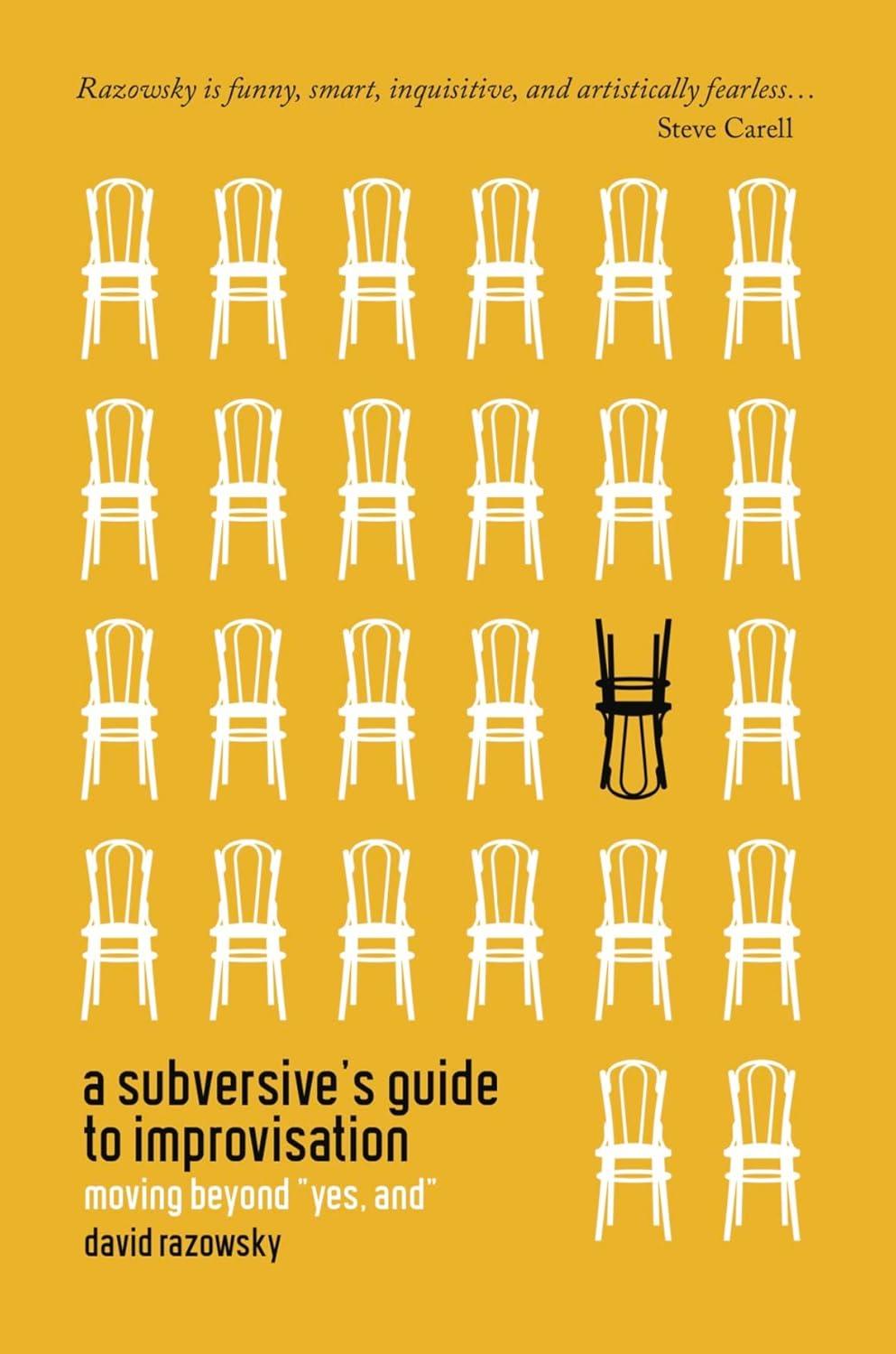
A Subversive's Guide to Improvisation
Moving Beyond "Yes, and"
David Razowsky

The Improv Mindset
How to Make Improvisation Your Superpower for Success
Keith Saltojanes

You Can Teach Improv (Yes, You!)
The Ultimate Guide to Class Planning, Skill Building, and Helping Every Student Leave With a Win
Andrew Berkowitz

Business Improv
Experiential Learning Exercises to Train Employees
Val Gee

Whose Improv Is It Anyway?
Beyond Second City
Amy E. Seham
Related Exercises
The Five Second Rule
In a two-person scene or brainstorming circle, neither person can speak until five full seconds after the previous speaker finishes. Forces genuine listening and prevents idea-steamrolling.
Flying Idea Cards
Flying Idea Cards is an applied improv exercise in which participants write ideas, observations, or responses on index cards and physically throw them into the shared space of the group. Other participants pick up cards that land near them and build on the ideas written there, adding their own thought before tossing the card back into circulation. The exercise generates a physical, kinetic version of collaborative ideation that removes status from the contribution and allows ideas to be built on without the original contributor being identified.
Yes Lets - or Rather Not
Yes Lets - or Rather Not is a variation of Yes Lets in which players can either accept a suggestion with enthusiasm or politely decline it, requiring the group to navigate agreement and disagreement gracefully. The exercise teaches that saying no can be done supportively and that the group can redirect without blocking.
Blocked Vs. Unblocked Scenes
Blocked Vs. Unblocked Scenes is a comparative exercise in which performers play the same scene twice: once using denial and blocking, and once fully accepting every offer. The side-by-side contrast vividly demonstrates how blocking kills momentum while acceptance generates possibilities. It is one of the most effective tools for teaching the principle of agreement.
Accepting Circle
Accepting Circle is a warm-up exercise in which players stand in a circle and practice receiving and building on each other's offers. One player initiates a sound, gesture, or phrase; the next player accepts it fully before adding their own. The exercise reinforces the foundational improv principle of "yes, and" in its simplest physical form.
What I Like About That Is
One person pitches an idea. Others must respond starting with What I like about that is before adding their own idea. Builds a culture of building on rather than tearing down.
How to Reference This Page
The Improv Archive. (2026). Three-Second Pauses. Retrieved March 17, 2026, from https://improvarchive.org/exercises/three-second-pauses
The Improv Archive. "Three-Second Pauses." The Improv Archive, 2026. https://improvarchive.org/exercises/three-second-pauses.
The Improv Archive. "Three-Second Pauses." The Improv Archive, 2026, https://improvarchive.org/exercises/three-second-pauses. Accessed March 17, 2026.
The Improv Archive is a systemically maintained repository. The archive itself acts as the corporate author.