8 Things
8 Things is a fast listing exercise and short-form game in which one player jumps into the middle of a circle, gets a category, and names eight things in that category while the rest of the group counts and cheers. The pressure is not about accuracy. The point is to answer quickly, stay supported, and keep the mind moving before self-editing can take over.
Structure
Setup
- Everyone stands in a circle.
- One player steps into the middle.
- A director, teacher, or another player gives the person in the middle a category.
Core Rule
- The player in the middle names eight things in that category.
- After each answer, the rest of the group counts it out loudly.
- The answers do not need to be correct, realistic, or even closely related as long as the player keeps responding.
How the Round Moves
- The central player gives the first answer.
- The circle immediately counts it.
- That pattern repeats until the player reaches eight.
- The round ends with applause and the next player jumping in.
What the Game Is Training
- The exercise pushes players to say the first thing that arrives.
- Group counting turns the room into active support instead of silent judgment.
- Because the answers can be imaginary or sideways, the player learns to keep offering rather than freeze while searching for the right answer.
How to Stop
- One round ends as soon as the eighth answer is counted.
- The larger exercise ends when the room is warm, fast, and willing to answer without editing.
Common Variations
- Run it in pairs instead of a full circle.
- After the eighth answer, have another player jump in and build a scene or riff from one of the accidental offers that appeared during the list.
How to Teach It
Objectives
- encourage support and visible enthusiasm from the whole group
- train players to say the first thing that comes to mind
- reduce self-editing by replacing judgment with momentum
How to Explain It
Jump into the middle when you are ready. We will give you a category, and you just say eight things as fast as you can while the rest of us count and cheer after every answer.
Teaching Notes
- This works because the room supports every offer instead of evaluating it.
- Make it clear that the player does not need to be correct. The game is not about right answers.
- Coach the outside circle as hard as the player in the middle. If the support is weak, the exercise becomes exposed instead of freeing.
- Keep the rhythm bouncy. Slow counting or hesitant cheering makes the player feel judged.
Notes That Appear Directly in Source Material
- Hoopla lists the teaching purpose as encouraging and supporting, saying the first thing that comes to mind, and supporting offers.
- The source example includes obviously playful answers, which reinforces that the player does not need to stay literal.
- Hoopla's description notes that the answers can be unrelated or imaginary.
How to Perform It
One-Line Audience Intro
We are going to ask for a category, and our player has to name eight things as fast as possible while everyone else counts and cheers.
Playing Notes
- Keep the circle loud and supportive after every answer.
- The count matters because it gives the player momentum and lets the audience track progress.
- Do not stall on whether an answer is correct. The source makes clear that unrelated or imaginary answers are still playable.
- Finish with a strong shared response after the eighth answer so the round lands cleanly.
Wrap-Up Logic
- End the round as soon as the eighth answer is counted.
- Move quickly to the next player so the energy stays high.
History
Hoopla documents 8 Things as a contemporary improv exercise and notes that its origin is uncertain, describing it as a universal improv game. The current source base supports the modern rules outline and teaching purpose, but it does not identify a single inventor or troupe of origin.
Worth Reading
See all books →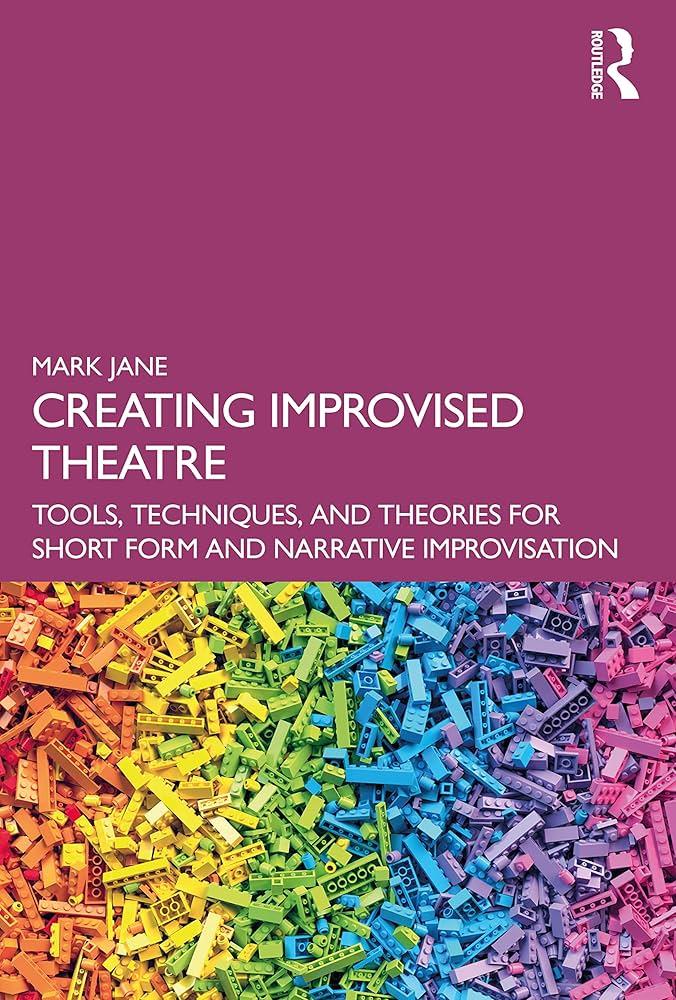
Creating Improvised Theatre
Tools, Techniques, and Theories
Mark Jane

Acting Through Improv
Improv Through Theatresports
Lynda Belt; Rebecca Stockley

Pirate Robot Ninja
An Improv Fable
Billy Merritt; Will Hines

Group Improvisation
The Manual of Ensemble Improv Games
Peter Campbell Gwinn; Charna Halpern
Theater Games for the Classroom
Viola Spolin
Theater Games for Rehearsal
Viola Spolin
Related Games
Five Things
Five Things is a fast-paced listing warm-up in which a performer must rapidly name five items in a given category. The group claps, chants, or counts along to maintain pace and energy. The exercise trains rapid-fire associative thinking and breaks through the self-censorship that slows improvised offers. Speed is the mechanism: when performers must respond faster than they can judge their responses, the internal editor shuts down and genuine spontaneity emerges.
Eight Things
Eight Things is a variant of the listing game in which a player must rapidly name eight items in a given category. The group counts along to maintain energy and pressure. The exercise trains spontaneous retrieval and the ability to generate ideas without filtering. It functions as both a warm-up and a performance game.
3 Things
3 Things is a quick-response listing game in which one player gives another player a category and the second player rapidly names three things that fit it. The chant that follows each answer keeps the room playful and makes the speed of response more important than correctness.
How to Reference This Page
The Improv Archive. (2026). 8 Things. Retrieved March 17, 2026, from https://improvarchive.org/games/8-things
The Improv Archive. "8 Things." The Improv Archive, 2026. https://improvarchive.org/games/8-things.
The Improv Archive. "8 Things." The Improv Archive, 2026, https://improvarchive.org/games/8-things. Accessed March 17, 2026.
The Improv Archive is a systemically maintained repository. The archive itself acts as the corporate author.