Krypton Factor
Krypton Factor is a short-form game named after the British television game show of the same name, in which performers are challenged to reproduce or complete a complex sequence of physical movements, words, or actions with precision after observing them once. The game rewards close attention, recall under pressure, and the willingness to commit to a remembered pattern even when confidence is incomplete.
Structure
Setup
One performer or the host establishes a specific sequence -- typically a combination of physical movements, phrases, or actions -- performed clearly and at a pace that can be observed but not easily memorized on first viewing.
Progression
After the sequence is demonstrated, a performer attempts to reproduce it exactly. The host or other performers judge accuracy against the original, identifying elements that were recalled correctly and those that were altered or missed.
Variations may introduce increasing complexity across rounds, adding elements to the sequence each time, or require multiple performers to collectively reconstruct a sequence that was shown only once.
Ending
The round ends when a performer successfully reproduces the complete sequence, when all performers have attempted the reproduction, or when the host determines the audience has seen enough attempts to generate the desired comic energy from near-misses and corrections.
How to Teach It
Objectives
Krypton Factor trains attention, short-term recall, and the willingness to commit to a pattern under uncertainty. The core challenge is the tension between perfect recall and the commitment required when recall is imperfect: performers must deliver a reproduction even when they are not certain.
How to Explain It
"Watch everything. Not just the obvious parts -- the small details, the order of moves, the timing. When you go up, don't wait until you're sure -- commit to what you remember and see it through."
Scaffolding
Begin with simple three-to-four element sequences before building to more complex combinations. Use the game first as a pure recall exercise before introducing the performance pressure of public reproduction.
Common Pitfalls
Performers who are uncertain about a sequence often slow down and lose physical commitment in the process of recalling, which makes the incomplete memory even more visible to the audience. Coach performers to maintain the energy and pace of the original even when individual elements are uncertain.
How to Perform It
Audience Intro
"We're going to show you something once. Then our performers are going to try to remember it -- exactly. Let's see how good their memories are."
Cast Size
Minimum 2 (demonstrator and 1 reproducer). Ideal: 3 to 5 performers, with rotation across attempts.
Staging
The demonstrating performer or host stands clearly visible to both the audience and the reproducing performer. The reproduction attempts happen in the same central area, allowing direct comparison.
Wrap-Up Logic
End the round once a successful reproduction is achieved, after a set number of attempts, or when the comic value of the near-misses has reached its peak. Avoid running a round where success never occurs, as this deflates the energy.
Worth Reading
See all books →
Acting Through Improv
Improv Through Theatresports
Lynda Belt; Rebecca Stockley

Pirate Robot Ninja
An Improv Fable
Billy Merritt; Will Hines

Theatrical Improvisation
Short Form, Long Form, and Sketch-Based Improv
Jeanne Leep

Group Improvisation
The Manual of Ensemble Improv Games
Peter Campbell Gwinn; Charna Halpern

The Upright Citizens Brigade Comedy Improvisation Manual
Matt Besser; Ian Roberts; Matt Walsh
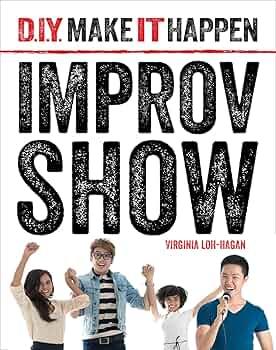
Improv Show
Virginia Loh-Hagan
Related Games
The Gauntlet
The Gauntlet is a short-form challenge game in which performers must survive a series of escalating improv challenges to avoid elimination. Each round tests a different skill: character, narrative, physicality, or musical ability. The competitive structure creates stakes and audience investment in individual performers' survival.
Survivor
Survivor is a competitive short-form game format that adapts the structure of the reality television series for improv performance. Performers compete in improvised challenges, form alliances, and are progressively eliminated by audience vote or fellow players until one winner remains. The format layers character strategy onto improvised performance, rewarding both strong scene work and the social maneuvering of an ensemble competition.
How to Reference This Page
The Improv Archive. (2026). Krypton Factor. Retrieved March 17, 2026, from https://improvarchive.org/games/krypton-factor
The Improv Archive. "Krypton Factor." The Improv Archive, 2026. https://improvarchive.org/games/krypton-factor.
The Improv Archive. "Krypton Factor." The Improv Archive, 2026, https://improvarchive.org/games/krypton-factor. Accessed March 17, 2026.
The Improv Archive is a systemically maintained repository. The archive itself acts as the corporate author.