Action and Justify
Action and Justify is an exercise in which a player performs an unexplained physical action, then retroactively provides a logical reason for it within the scene. The separation of doing from explaining trains performers to commit physically first and let narrative follow. It builds trust in the body as a source of strong scenic choices.
Structure
Setup
- One player performs an unexplained physical action.
- The action is committed and specific: it should read clearly as something.
- After the action is complete, the player provides a retrospective justification for it within the scene.
The Separation of Action and Explanation
- The action comes first. The explanation comes after.
- The explanation is not an apology or clarification. It is a narrative justification that makes the action make sense.
- The scene emerges from the justification: the action is the premise, the justification is the world.
Why the Order Matters
- In ordinary scene work, performers decide what a scene will be and then do actions that support that decision.
- This exercise inverts the order: the body acts, and the narrative follows.
- This trains trust in the body as a source of scenic choices, rather than as an executor of pre-planned ideas.
Examples
- A player drops suddenly to one knee. Justification: "That's the floorboard I've been meaning to fix for months."
- A player reaches up and holds an invisible weight above their head. Justification: "I've been keeping the ceiling up all day."
Facilitation
- The facilitator calls an action if the player is unable to generate one: "Stop. Do something with your hands."
- Multiple rounds: the player does many actions and justifies each one.
How to Teach It
How to Explain It
"Do something. Anything physical. Commit to it completely. Then, and only then, tell us what you are doing and why. The body goes first. The story follows the body. Don't know what you're doing before you do it."
Common Notes
- Players who cannot generate spontaneous actions have lost access to instinct. This is valuable diagnostic information.
- The justification should not apologize for the action or explain it as a mistake. The action was exactly right; the justification explains why.
- Encourage unusual or awkward actions. The exercise is most valuable when the body does something that the mind would not have planned.
Common Pitfalls
- Players decide on an action and then do it. The exercise requires genuine spontaneity.
- The justification is a label ("I am doing yoga") rather than a narrative ("I have been doing this pose every morning since the accident").
- Players are afraid to make unusual actions and default to safe, conventional movement. The unusual action is the point of the exercise.
Worth Reading
See all books →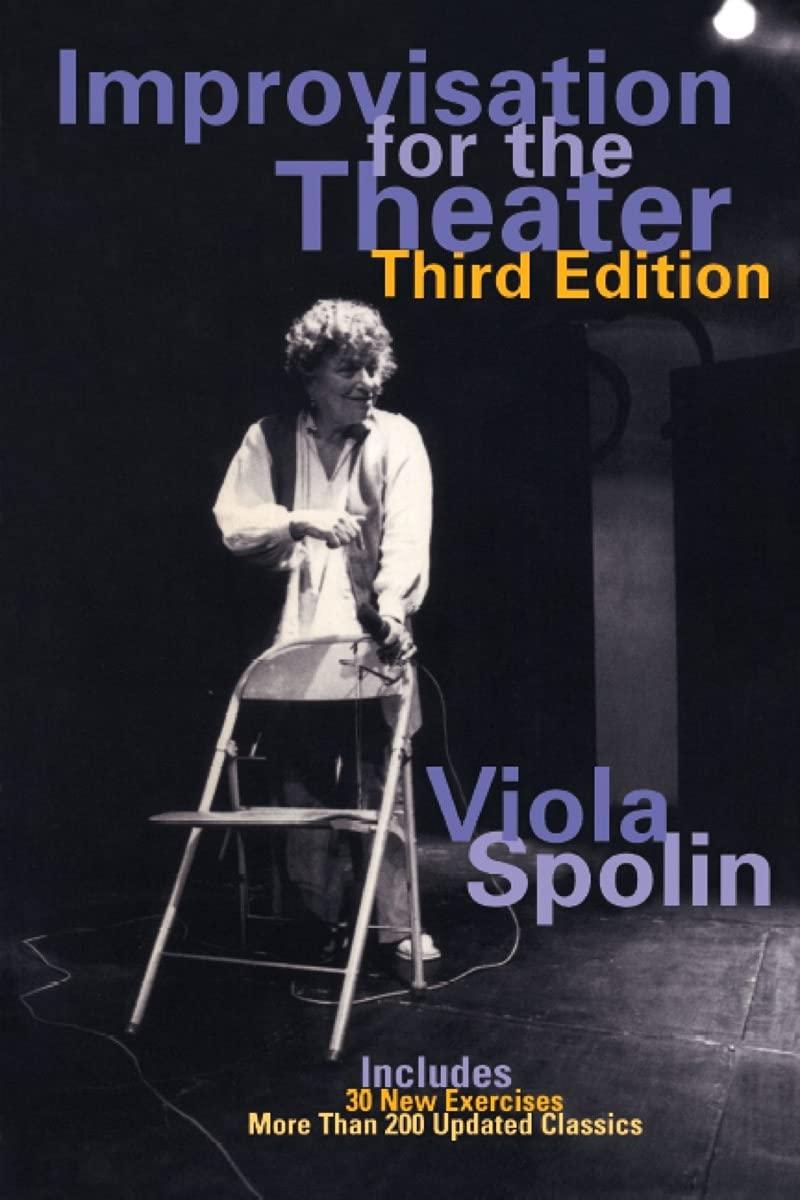
Improvisation for the Theater
A Handbook of Teaching and Directing Techniques
Viola Spolin

Action Theater
The Improvisation of Presence
Ruth Zaporah

Improv Ideas
A Book of Games and Lists
Mary Ann Kelley; Justine Jones

The Improv Illusionist
Using Object Work, Environment, and Physicality in Performance
David Raitt

Drama Games and Improvs
Games for the Classroom and Beyond
Justine Jones; Mary Ann Kelley

Pirate Robot Ninja
An Improv Fable
Billy Merritt; Will Hines
Related Exercises
Action and Entrance
Action and Entrance is an exercise in which a player enters the scene space performing a specific physical activity that establishes character and context before any dialogue begins. The emphasis on physical initiation teaches performers that action communicates faster than words. It reinforces the principle of entering a scene with a strong, clear choice.
Enter and Exit
Enter and Exit is a physical exercise in which performers practice making clear, purposeful entrances and exits from the stage. Each entry or departure must communicate character, intention, or emotional state without relying on dialogue. The exercise highlights how much information an audience reads from the simple act of walking on or off stage: pace, posture, direction of gaze, and physical tension all communicate story before a single word is spoken. Enter and Exit builds awareness of the stage as a defined space with its own rules and teaches performers that every entrance is an offer and every exit is an edit.
Advancing and Expanding
Advancing and Expanding is a scene technique exercise in which players practice the dual skills of moving a narrative forward and deepening the current moment. A caller instructs performers to either advance the plot or expand on the present beat with more detail and emotion. The exercise builds the storytelling instinct for when to push forward and when to linger.
Surprise Movement
Surprise Movement is an exercise in which performers interrupt their own scenes or monologues with sudden, unexpected physical choices and must justify them within the scene. The exercise breaks habitual movement patterns and teaches players that physical surprises can open new scene directions.
Strike a Pose
Strike a Pose is a physical exercise in which players assume strong, committed physical positions and use each pose as a starting point for character, scene, or interpretive discovery. The exercise demonstrates that physical choices precede and inform emotional and character choices, rather than following from them. Multiple documented variants use the same core mechanic of striking and holding a pose to develop ensemble responsiveness, scene inspiration, and interpretive skill.
Automatic Storytelling
Automatic Storytelling is an exercise in which a player tells a story as rapidly as possible, following the first narrative impulse that arises without planning or editing. The technique bypasses the conscious mind's desire to control and produces raw, surprising material. It trains the instinct to trust one's first offer.
How to Reference This Page
The Improv Archive. (2026). Action and Justify. Retrieved March 17, 2026, from https://improvarchive.org/exercises/action-and-justify
The Improv Archive. "Action and Justify." The Improv Archive, 2026. https://improvarchive.org/exercises/action-and-justify.
The Improv Archive. "Action and Justify." The Improv Archive, 2026, https://improvarchive.org/exercises/action-and-justify. Accessed March 17, 2026.
The Improv Archive is a systemically maintained repository. The archive itself acts as the corporate author.