Creative Inspiration
Creative Inspiration is a category of applied improvisation exercises that use unexpected prompts, arbitrary constraints, and non-linear starting points to spark creative thinking and generate innovative approaches to familiar problems. The exercises work by disrupting habitual thinking patterns: participants are forced to make associations and connections they would not reach through direct analytical approaches. They are used in innovation, ideation, and creative problem-solving programs.
Structure
Prompt-Based Ideation
Participants receive a problem or challenge to address. Instead of working directly toward a solution, they are given an unrelated prompt: a random word, an image, an object, a sound, or a constraint that seems to have nothing to do with the problem. Participants use the prompt as a starting point and generate connections to the original challenge, however indirect.
Constraint-Based Generation
Alternatively, an arbitrary constraint is placed on the problem-solving process: "solve this in exactly six words," "assume unlimited budget," "assume the opposite of what you believe about this problem is true," or "solve this for an eight-year-old." Constraints force the mind out of its default approaches.
Association Chains
A third common form: participants free-associate from an unrelated starting point, linking each new word or image to the previous one, until an unexpected connection to the original problem emerges. The association chain is examined for insights that would not have appeared through direct analysis.
Conclusion
The facilitator collects and organizes the outputs, filtering for connections that may generate genuinely new approaches to the original challenge.
How to Teach It
Objectives
Creative Inspiration exercises target lateral thinking, the disruption of habitual problem-solving patterns, and comfort with non-linear approaches to challenge. They are most useful for groups stuck in repetitive solutions to persistent problems.
How to Explain It
"We're going to approach this problem sideways. Instead of going straight at it, we're going to start somewhere completely unrelated and see where the connection appears. The stranger the starting point, the more useful it might turn out to be. Trust the indirectness."
Common Pitfalls
Participants who are highly analytical or who have strong expertise in the problem domain sometimes resist the indirectness of the approach, perceiving it as evasion or play rather than useful work. Acknowledge the resistance and continue: the most resistant participants often generate the most unexpected connections when they eventually let go of direct analysis.
In Applied Settings
Learning Objectives
Creative Inspiration exercises address the problem of innovative stagnation: groups that keep generating the same solutions to the same problems because they approach each challenge using the same habitual analytical frameworks. The exercises develop tolerance for ambiguity and the willingness to follow unexpected associative paths before evaluating where they lead.
Workplace Transfer
The skills developed in creative inspiration work transfer to product development, strategic planning, process improvement, and any organizational context where novel approaches are needed. The specific technique of constraint-based thinking transfers to situations where resources or time are limited and conventional approaches are foreclosed. Association-based ideation transfers to any brainstorming context where the group needs to move past its initial obvious ideas.
Facilitation Context
Creative Inspiration exercises are used in innovation workshops, design thinking programs, strategy retreats, product development sessions, and any applied setting where a group needs to move beyond its habitual thinking patterns. They work with groups of any size and with any level of improv experience.
Debrief Framing
Facilitators ask: "Which prompt or constraint produced the most unexpected connection? What did you find when you stopped going directly at the problem? How does this approach differ from how your team normally generates ideas? Where could you use this kind of indirectness in your actual work?"
Skills Developed
Worth Reading
See all books →
Brain Disruption
Radical Innovation in Business Through Improv
Bruce Montgomery; Gail Montgomery

The "Yes And" Business Evolution
Improv Skills for Leadership and Life
Tracy Shea-Porter

The Improv Mindset
How to Make Improvisation Your Superpower for Success
Keith Saltojanes
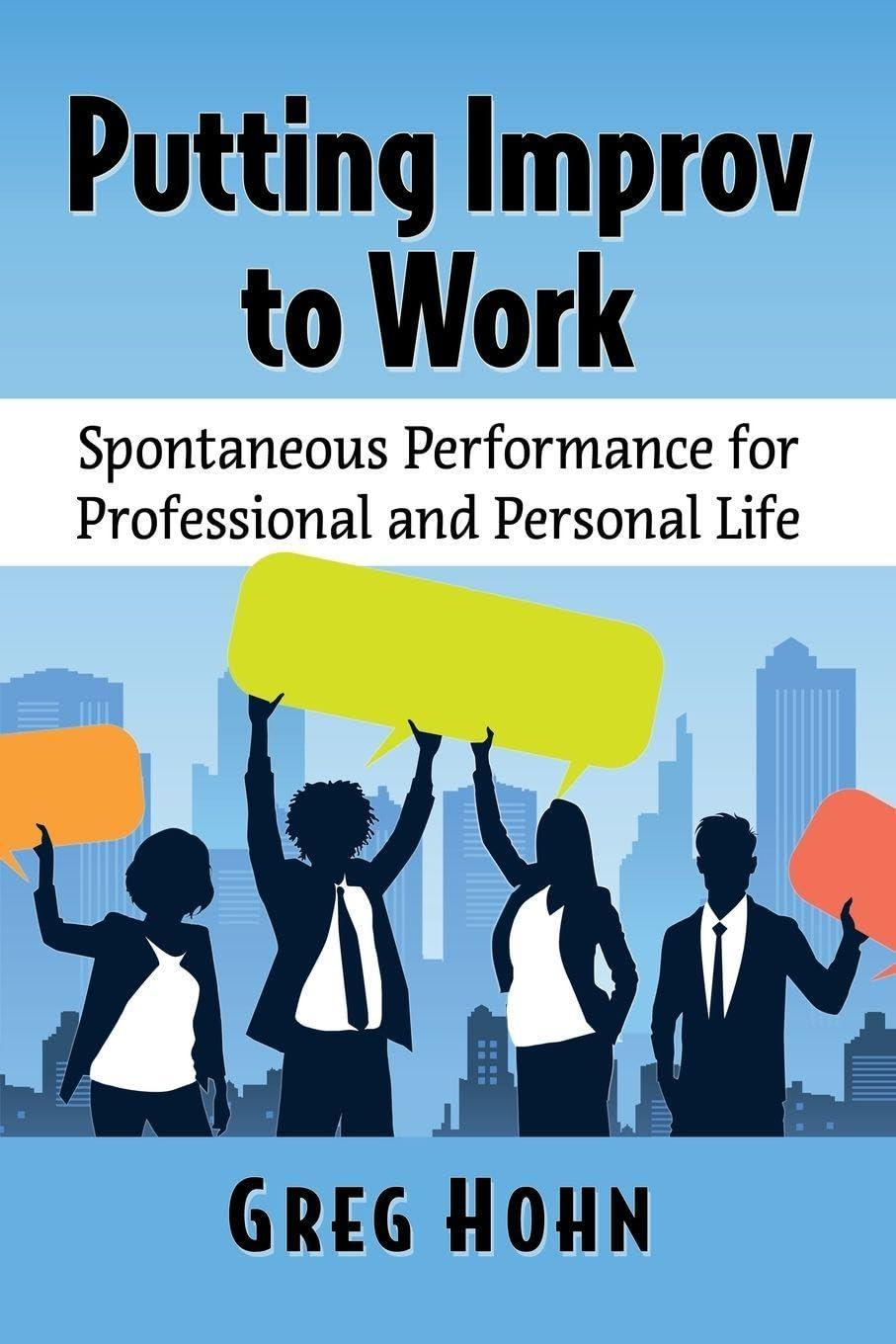
Putting Improv to Work
Spontaneous Performance for Leadership, Learning, and Life
Greg Hohn
Improvising Cinema
Gilles Mouëllic
Improv Show
Virginia Loh-Hagan
Related Exercises
Creative Solution Building
Creative Solution Building is an applied improvisation exercise in which participants use improvisational principles -- acceptance, building, and collaborative emergence -- to develop solutions to presented problems or scenarios. Rather than analyzing the problem and generating solutions individually, participants build solutions incrementally through a structured ensemble process, with each contribution extending and complying with what has already been offered.
Turbocharged Brainstorm
Gamify a brainstorm by imposing ambitious targets around volume and time. The constraint frees people from needing good ideas, which helps them have better ones.
Problem Solving
Improvisational problem-solving exercises where teams tackle challenges using 'Yes, And' principles to build creative solutions.
Do More with Less
Do More with Less is an applied improvisation exercise inspired by the improvisational principle that constraints generate creativity. Participants identify a real or hypothetical problem they face with limited resources, then use constraint-based thinking to generate solutions that work without the resources they think they need. The exercise challenges the assumption that more resources automatically produce better solutions.
Positive Scene Challenge
Positive Scene Challenge is an exercise in which performers must play an entire scene without conflict, negativity, or problems to solve. The constraint forces players to find sources of engagement beyond argument and teaches that scenes can be compelling through shared joy, discovery, and mutual support.
Funny You Should Say That!
Funny You Should Say That is an applied improv exercise in which participants practice building enthusiastically on unexpected or challenging statements by finding and naming a genuine connection to their own experience or contribution. Rather than redirecting or correcting an unexpected statement, the participant responds with "Funny you should say that..." and then connects the unexpected statement to something real. The exercise develops cognitive flexibility, active listening, and the capacity to find genuine relevance in what was not anticipated.
How to Reference This Page
The Improv Archive. (2026). Creative Inspiration. Retrieved March 17, 2026, from https://improvarchive.org/exercises/creative-inspiration
The Improv Archive. "Creative Inspiration." The Improv Archive, 2026. https://improvarchive.org/exercises/creative-inspiration.
The Improv Archive. "Creative Inspiration." The Improv Archive, 2026, https://improvarchive.org/exercises/creative-inspiration. Accessed March 17, 2026.
The Improv Archive is a systemically maintained repository. The archive itself acts as the corporate author.