Scene to Music
Scene to Music is an exercise in which performers improvise a scene while a musician or recorded soundtrack plays underneath, allowing the music to influence the mood, pacing, and emotional trajectory of the action. Players learn to follow musical cues and let external rhythm shape their choices. The exercise builds sensitivity to nonverbal emotional signals.
Worth Reading
See all books →
Business Improv
Experiential Learning Exercises to Train Employees
Val Gee

The Comedy Improv Handbook
A Comprehensive Guide to University Improvisational Comedy
Matt Fotis; Siobhan O'Hara

The Improv Mindset
How to Make Improvisation Your Superpower for Success
Keith Saltojanes

The Ultimate Improv Book
A Complete Guide to Comedy Improvisation
Edward J. Nevraumont; Kurt Smeaton; Nicholas P. Hanson
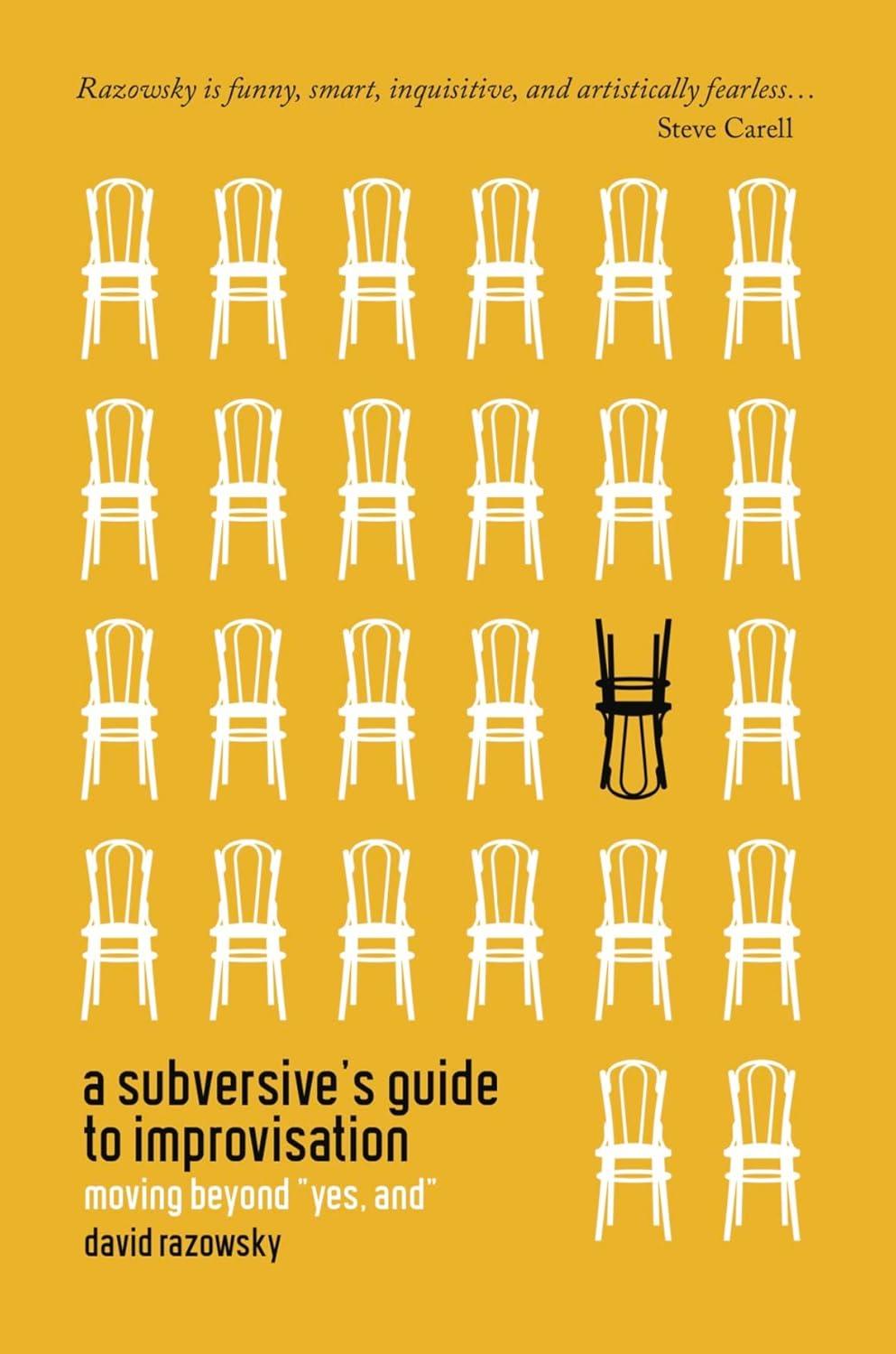
A Subversive's Guide to Improvisation
Moving Beyond "Yes, and"
David Razowsky
The Improvisation Book
How to Conduct Successful Improvisation Sessions
John S.C. Abbott
Related Exercises
Meditation to Scenes
Meditation to Scenes is an exercise in which performers begin with a brief guided meditation and then immediately bring the images, sensations, or emotional states that arose in meditation into an improvised scene. The exercise trains the ability to work from genuine internal experience rather than externally constructed premises, using the quieted, image-rich state of meditation as a source of authentic material for scene initiation.
Underscore
Underscore is a scene exercise in which a live musician provides continuous music beneath an improvised scene, offering an emotional layer that performers can follow, play against, or let shape their choices. The exercise trains sensitivity to nonverbal emotional cues and builds the habit of receiving external offers from non-human sources. It is a standard element of improv training that uses live or recorded sound as an environmental collaborator.
Touch to Talk
Touch to Talk is a scene exercise in which performers may only speak while physically touching another player or an object in the environment. The constraint forces players to make physical contact meaningful and teaches the connection between physical engagement and verbal expression.
New Object to Talk
New Object to Talk is a warm-up exercise in which a player picks up or mimes a new object each time they wish to speak. The constraint forces performers to justify constant physical activity while maintaining conversational coherence. The exercise trains object work skills and teaches players to integrate physicality with dialogue.
Sound Sensations
Sound Sensations is an exercise in which players close their eyes and respond to a series of sounds introduced by a facilitator, using the audio stimuli to trigger emotional reactions, physical movement, or improvised scenes. The exercise trains associative thinking through the auditory channel and expands the range of sensory inputs performers draw from.
Without Sound
Without Sound is a scene exercise in which performers play an entire scene with no vocal output, communicating exclusively through physicality, facial expression, and gesture. The exercise reveals how much of scene work can be conveyed nonverbally and trains performers to make bold, clear physical choices.
How to Reference This Page
The Improv Archive. (2026). Scene to Music. Retrieved March 17, 2026, from https://improvarchive.org/exercises/scene-to-music
The Improv Archive. "Scene to Music." The Improv Archive, 2026. https://improvarchive.org/exercises/scene-to-music.
The Improv Archive. "Scene to Music." The Improv Archive, 2026, https://improvarchive.org/exercises/scene-to-music. Accessed March 17, 2026.
The Improv Archive is a systemically maintained repository. The archive itself acts as the corporate author.