Pillars/columns
Pillars/Columns is a variant of the Pillars game in which two or more performers serve as human columns that deliver random lines when touched by scene players. The scene players must seamlessly integrate each interjected line into the ongoing narrative. The game emphasizes justification skills and the ability to maintain scene coherence despite constant disruption.
Structure
Setup
- Two performers stand at the edges of the playing space, serving as human pillars or columns.
- Each pillar player holds a card or is assigned a short line of text, or improvises lines from within a defined category.
- Two scene players perform a normal improvised scene between the pillars.
How the Pillars Work
- At any moment, a scene player may touch one of the pillars.
- The pillar delivers their assigned or improvised line immediately.
- The scene player must accept the line as real, meaningful dialogue and justify it within the scene.
- The pillar returns to stillness after speaking.
What the Scene Player Must Do
- Every line delivered by a pillar must be integrated into the scene as though it belongs there.
- The scene player cannot reject or ignore the interjection. Acceptance and justification are mandatory.
- The scene continues at pace. The interjection is an offer, not an interruption.
What Makes It Work
- The constraint generates unexpected dialogue that the scene players could not have planned.
- The best scenes are those where a seemingly absurd pillar line becomes the most important thing said in the scene.
- Scene players who are skilled at justification can take any pillar line and make it feel inevitable.
Variations
- Pillar lines are audience suggestions gathered before the game begins.
- Scene players must touch a pillar before they can speak, making every line of dialogue dependent on the pillars.
How to Teach It
How to Explain It
"These two performers are pillars. They don't move and they don't play the scene. When you touch one of them, they say something. You must use what they say as part of your scene. Whatever it is. You cannot ignore it. It just became the scene."
Common Notes
- The scene players should touch the pillars with intention, not at random. Touching a pillar when the scene needs a new direction is more dramatically useful than touching when things are already clear.
- Pillar players should deliver their lines with confidence and without apology. An uncertain pillar line is harder to justify.
- Coach scene players to justify before understanding. The scene should receive the pillar line and move forward, even if the connection takes a moment to emerge.
Common Pitfalls
- Scene players pause after a pillar line to work out its meaning before continuing. The scene should absorb and continue without visible calculation.
- Pillar players become passive and lose presence between touches. Pillars should remain physically and energetically available.
- Scene players only touch the pillar when they are stuck, turning the exercise into a lifeline rather than a scene-shaping device.
How to Perform It
Audience Intro
"We have two human pillars on either side of our playing space. When a performer touches a pillar, the pillar says something. Whatever the pillar says, it immediately becomes part of the scene. Give us a suggestion to start."
Cast Size
- Ideal: Two scene players plus two pillar performers.
- A single pillar can work but reduces the structural tension.
Staging
- Pillars stand at the stage edges or upstage corners, visible but clearly outside the scene space.
- Scene players occupy center stage.
Wrap Logic
- The host ends the game when the scene has fully incorporated its most significant pillar moment, or when a clear button lands.
Worth Reading
See all books →
Theater Games for Rehearsal
Viola Spolin

Acting Through Improv
Improv Through Theatresports
Lynda Belt; Rebecca Stockley

Pirate Robot Ninja
An Improv Fable
Billy Merritt; Will Hines

The Upright Citizens Brigade Comedy Improvisation Manual
Matt Besser; Ian Roberts; Matt Walsh
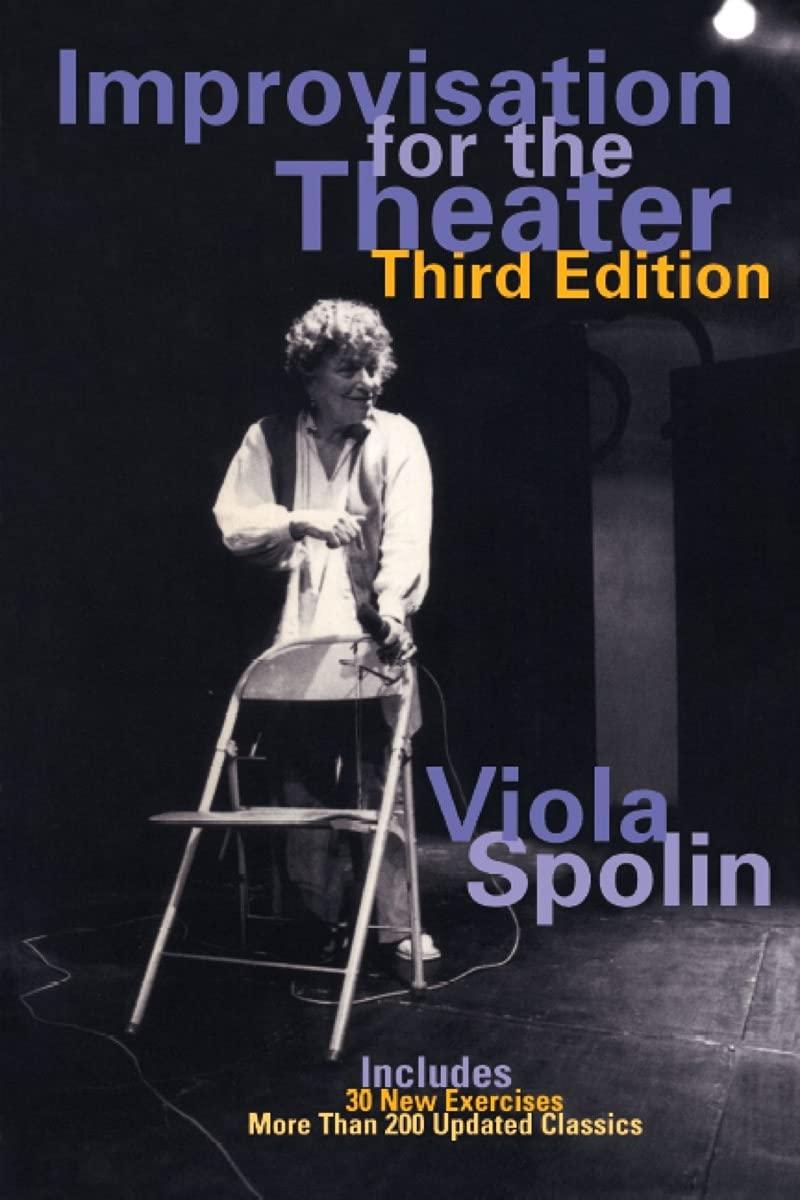
Improvisation for the Theater
A Handbook of Teaching and Directing Techniques
Viola Spolin

The Playbook
Improv Games for Performers
William Hall
Related Games
Pillars
Pillars is a short-form game in which two or more players stand stock-still onstage as human pillars. Scene players perform a two-person scene, and whenever a scene player taps a pillar, that pillar delivers a random line of dialogue. The scene player must immediately accept and incorporate the line into the scene. The unpredictable verbal intrusions test the performer's ability to justify bizarre offers on the spot and maintain scene logic under pressure.
Columns/pillars
Columns/Pillars is a scene game in which two or more simultaneous scenes share the stage, separated by imagined walls or columns. Players switch between scenes, and thematic or verbal connections between them emerge organically. The structure rewards performers who listen across scenes and find resonant parallels.
Written Lines
Written Lines is a scene game in which performers hold slips of paper with pre-written lines that they must incorporate naturally into an improvised scene at opportune moments. The challenge lies in finding the right context to deliver each unrelated line without breaking the scene's logic. The game rewards smooth justification and the ability to steer a scene toward unexpected material.
Blind Line Offers
Blind Line Offers is a scene exercise in which performers receive random written lines from slips of paper and must incorporate each one seamlessly into the scene as it unfolds. The unexpected text forces players to justify and connect disparate material in real time. The exercise trains adaptability and the skill of making any offer work.
Bucket
Bucket is a short-form game in which scene suggestions, character traits, or constraints are written on slips of paper and placed in a bucket before the show. During scenes, performers draw slips at designated moments and must immediately incorporate whatever is written into the ongoing action. The random elements inject controlled unpredictability, forcing performers to accept and justify offers that could not be anticipated. The game rewards flexibility, quick thinking, and the ability to absorb any suggestion without hesitation. Bucket demonstrates the core improv principle that accepting external offers, no matter how disruptive, produces stronger and more surprising scene work than relying solely on performer-generated choices.
Doors
Doors is a scene game in which performers enter and exit through imagined doors, with each entrance bringing a new character, revelation, or complication. The physical act of entering through a door heightens the theatrical convention and gives each new addition a clear punctuation. The game rewards strong entrance choices and the ability to build on what has already been established.
How to Reference This Page
The Improv Archive. (2026). Pillars/columns. Retrieved March 17, 2026, from https://improvarchive.org/games/pillarscolumns
The Improv Archive. "Pillars/columns." The Improv Archive, 2026. https://improvarchive.org/games/pillarscolumns.
The Improv Archive. "Pillars/columns." The Improv Archive, 2026, https://improvarchive.org/games/pillarscolumns. Accessed March 17, 2026.
The Improv Archive is a systemically maintained repository. The archive itself acts as the corporate author.